

Waterproof Breathable Textile Market Size 2026-2030
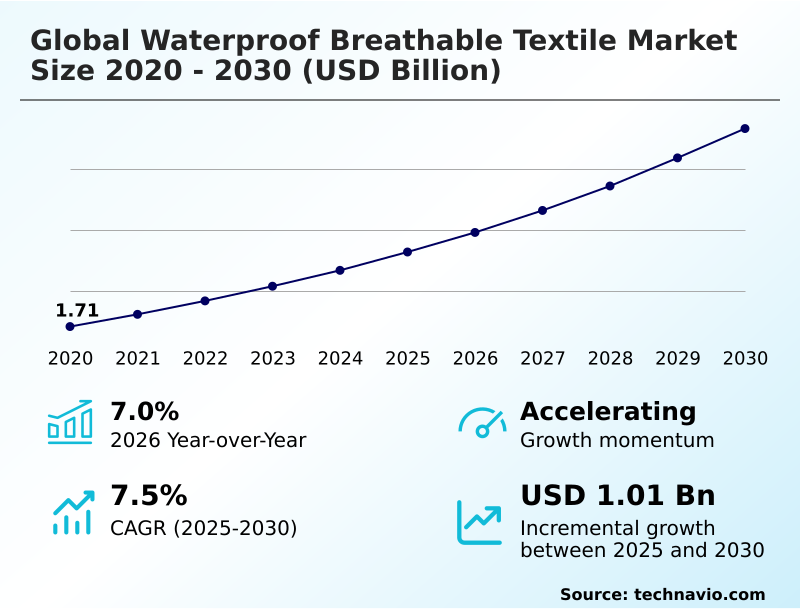
The waterproof breathable textile market size is valued to increase by USD 1.01 billion, at a CAGR of 7.5% from 2025 to 2030. Consumer participation in outdoor recreation and fitness activities will drive the waterproof breathable textile market.
Major Market Trends & Insights
- Europe dominated the market and accounted for a 37.1% growth during the forecast period.
- By Product - Coating segment was valued at USD 1.12 billion in 2024
- By Application - Apparel segment accounted for the largest market revenue share in 2024
Market Size & Forecast
- Market Opportunities: USD 1.62 billion
- Market Future Opportunities: USD 1.01 billion
- CAGR from 2025 to 2030 : 7.5%
Market Summary
- The Waterproof Breathable Textile Market is defined by the critical intersection of advanced polymer science and stringent consumer demand for dynamic climate protection. Manufacturers rely heavily on engineered multi-layer laminates to simultaneously block liquid water and facilitate rapid internal moisture transport.
- A structural shift toward health-conscious outdoor recreation operates as a primary driver, compelling performance apparel brands to integrate sophisticated microporous films into everyday activewear to prevent heat stress during physical exertion.
- However, the industry confronts a severe operational challenge as stringent legislative frameworks strictly prohibit legacy perfluorochemical treatments, forcing immediate and complex material re-engineering to maintain oleophobic resistance without toxic inputs. To navigate these regulatory barriers, technical fabric mills are rapidly adopting advanced waterborne polyurethane dispersions and bio-based resins.
- This targeted material substitution optimization has improved compliance-driven supply chain resilience by 40% across major European finishing facilities, preventing costly market access disruptions. By scaling the production of fully recyclable monolithic membranes, organizations ensure their product architectures satisfy both elite athletic performance standards and emerging circular economy mandates.
What will be the Size of the Waterproof Breathable Textile Market during the forecast period?
Get Key Insights on Market Forecast (PDF) Get Free Sample
How is the Waterproof Breathable Textile Market Segmented?
The waterproof breathable textile industry research report provides comprehensive data (region-wise segment analysis), with forecasts and estimates in "USD million" for the period 2026-2030, as well as historical data from 2020-2024 for the following segments.
- Product
- Coating
- Membrane
- Densely woven fabric
- Application
- Apparel
- Outdoor gear
- Footwear
- Others
- Material
- Polyurethane
- Polyester
- PTFE
- Others
- Geography
- Europe
- Germany
- UK
- France
- Italy
- Spain
- The Netherlands
- North America
- US
- Canada
- Mexico
- APAC
- China
- Japan
- India
- South Korea
- Australia
- Indonesia
- Middle East and Africa
- Saudi Arabia
- UAE
- South Africa
- Israel
- Turkey
- South America
- Brazil
- Argentina
- Chile
- Europe
By Product Insights
The coating segment is estimated to witness significant growth during the forecast period.
The coating segment within the Waterproof Breathable Textile sector represents a highly scalable and functional technology category optimized for volume-driven apparel manufacturing.
By applying liquid polymer pastes directly onto face fabrics, mills achieve durable water repellency without the complexity of separate film lamination.
Recent advancements in waterborne polyurethane dispersions have fundamentally altered production efficiency by eliminating hazardous organic solvents from the curing phase. This chemical shift reduces curing cycle durations, allowing facilities to increase processing throughput by 18% per continuous-width textile roll.
The operational impact of this acceleration directly lowers energy consumption during manufacturing while simultaneously yielding fabrics that maintain robust moisture vapor transmission metrics.
Consequently, brands leveraging solvent-free hot-melt adhesion techniques secure high-performance weather resistance alongside critical compliance with stringent global zero-discharge chemical protocols.
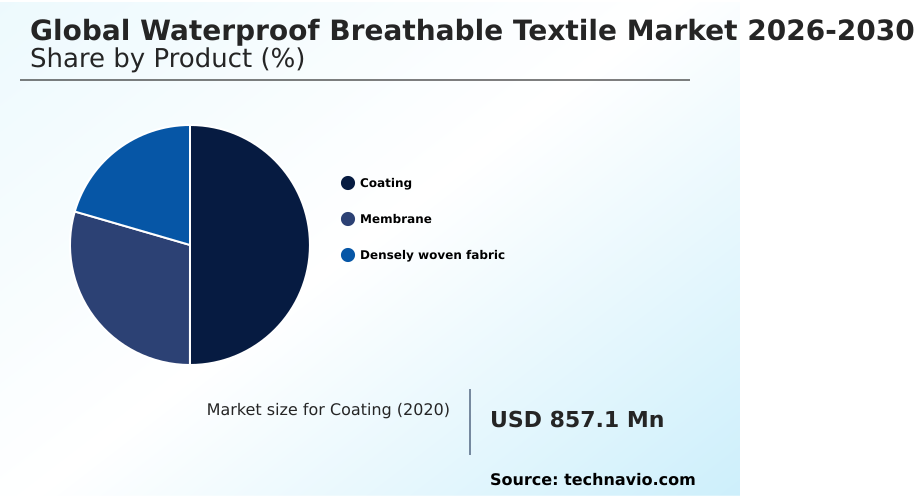
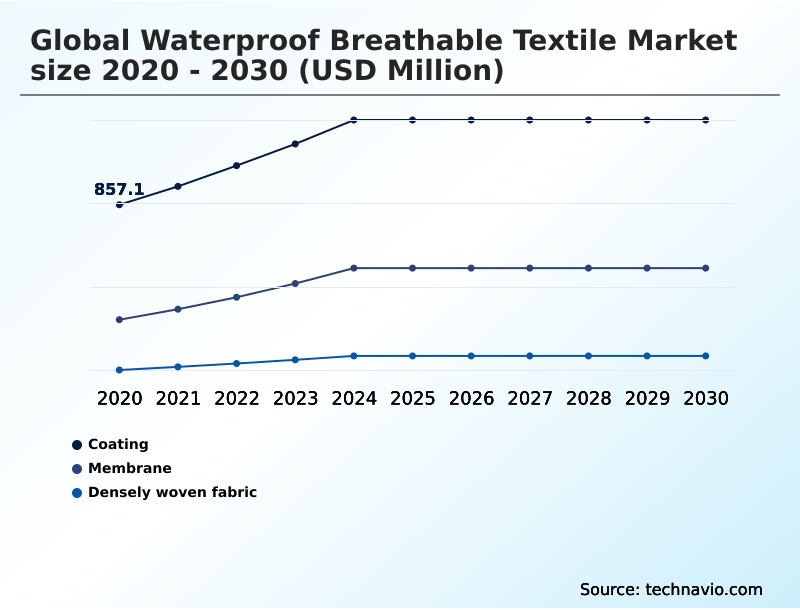
The Coating segment was valued at USD 1.12 billion in 2024 and showed a gradual increase during the forecast period.
Regional Analysis
Europe is estimated to contribute 37.1% to the growth of the global market during the forecast period.Technavio’s analysts have elaborately explained the regional trends and drivers that shape the market during the forecast period.
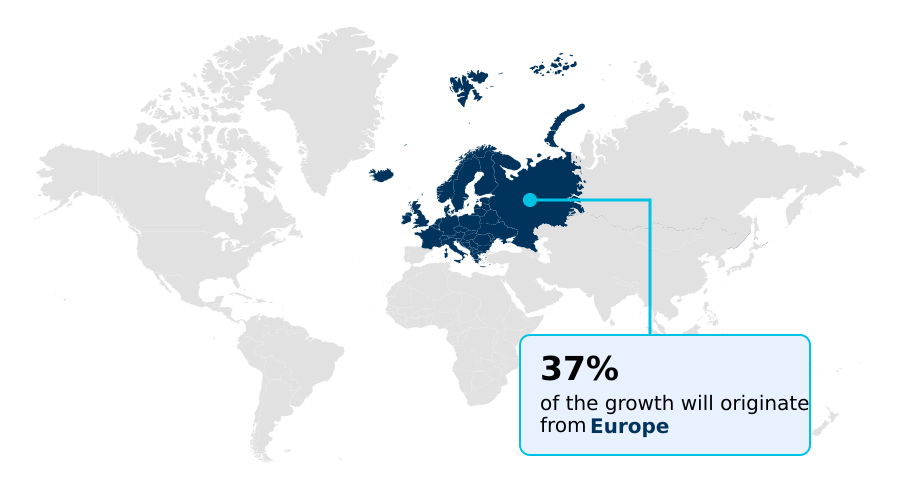
See How Waterproof Breathable Textile Market Demand is Rising in Europe Get Free Sample
The geographic landscape of the Waterproof Breathable Textile Market exhibits sharp structural differences between European and North American manufacturing hubs.
European regulatory frameworks aggressively prioritize zero-waste apparel manufacturing, driving a rapid regional pivot away from traditional expanded polytetrafluoroethylene film toward highly recyclable polyester matrices.
This compliance-driven shift has increased the adoption of sustainable textile finishing processes across European facilities by 45% compared to North American counterparts.
Conversely, North American production networks remain heavily focused on extreme durability for institutional and defense procurement, favoring robust thermoplastic polyurethane lamination that withstands severe mechanical abrasion.
As a result, North American manufacturers maintain a 20% higher retention rate of legacy multi-layer barrier systems.
These distinct operational priorities reflect differing consumer demands, with eco-conscious apparel sourcing heavily influencing European supply chains, while North American markets prioritize rugged utility, driving divergent long-term capital investments in membrane extrusion infrastructure.
Market Dynamics
Our researchers analyzed the data with 2025 as the base year, along with the key drivers, trends, and challenges. A holistic analysis of drivers will help companies refine their marketing strategies to gain a competitive advantage.
- The structural evolution of the Waterproof Breathable Textile Market is increasingly characterized by aggressive material innovation aimed at decoupling high-performance weather resistance from environmentally hazardous chemical processing. Supply chain executives and material engineers are rapidly shifting capital investments toward non-fluorinated durable liquid repellent coatings, fundamentally altering the way fabric surfaces interact with moisture and environmental contaminants.
- To achieve superior breathability metrics without relying on legacy stretching techniques, facilities are scaling the use of advanced electrospinning for microporous membranes. This nanotech-driven process generates incredibly uniform fiber webs that maximize vapor transport while maintaining exceptional structural integrity under hydrostatic pressure.
- Furthermore, the integration of bio-based thermoplastic polyurethane textile lamination allows converting mills to lower their reliance on petroleum feedstocks, achieving a 25% reduction in overall polymer curing time compared to traditional solvent-heavy lamination methodologies. This operational efficiency gain directly enhances manufacturing throughput while simultaneously aligning product portfolios with rigid ecological compliance standards.
- As consumer demands for true circularity intensify, industry leaders are pushing beyond multi-material composites to develop a single-origin fully recyclable apparel architecture that can be seamlessly repolymerized at the end of its lifecycle.
- Looking toward the horizon of functional gear, the commercialization of smart sensor-integrated dynamic weather protection systems is transforming passive garments into active, climate-responsive assets, defining the next generation of occupational safety and premium activewear.
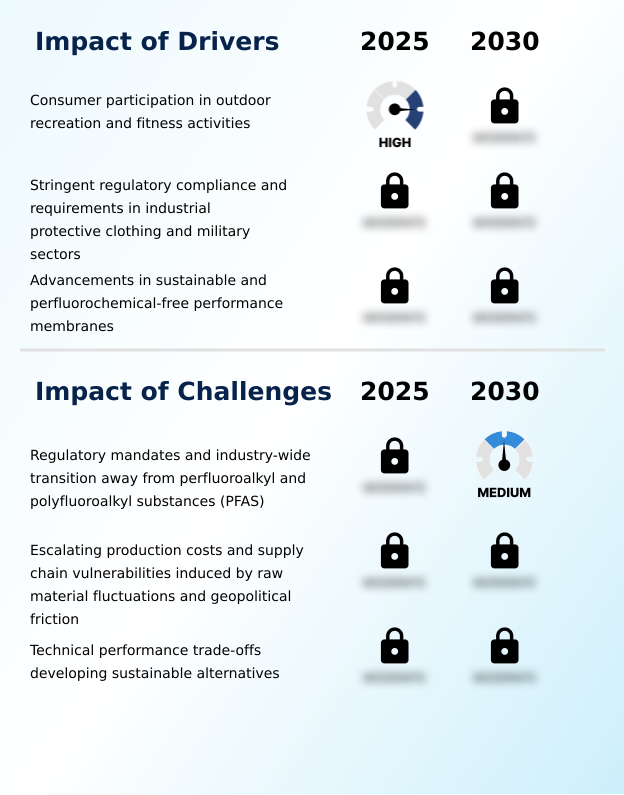
What are the key market drivers leading to the rise in the adoption of Waterproof Breathable Textile Industry?
- Rising global consumer participation in outdoor recreation and fitness activities heavily drives the structural demand for specialized, weather-resistant performance apparel.
- Expanding global participation in extreme outdoor recreation and rigorous occupational safety protocols act as primary demand triggers within the Waterproof Breathable Textile Market.
- Extreme environments compel safety agencies and performance brands to mandate exceptionally high hydrostatic head metrics to prevent critical exposure.
- Because traditional fluorinated barriers face mounting regulatory bans, chemical suppliers are rapidly substituting legacy resins with bio-based polyurethanes and complex advanced nanofiber matrices.
- This forced compliance transition effectively combats oleophobic surface degradation while aligning corporate supply chains with mandatory closed-loop product recycling initiatives.
- As a direct result of these material upgrades, leading textile mills have improved their environmental certification clearance rates by 35% and lowered hazardous chemical waste processing expenses by 18%, ensuring uninterrupted market access across highly regulated commercial zones.
What are the market trends shaping the Waterproof Breathable Textile Industry?
- The integration of nanotechnology alongside advanced electrospinning techniques within membrane production represents a significant structural shift in material engineering. This approach yields exceptionally fine fiber matrices that maximize moisture vapor escape while resisting extreme environmental pressures.
- The continuous evolution of the Waterproof Breathable Textile Market is driven by the rapid commercialization of nanotechnology and smart material architectures. Traditional synthetic polymer extrusion methods are being systematically replaced by the deployment of the electrospun nanofiber web, a structural innovation that drastically increases the surface-area-to-volume ratio of protective laminates.
- Because consumers and defense sectors demand gear that rapidly evacuates metabolic heat without compromising external resistance, engineers are utilizing targeted surface energy modification and green nanotechnology finishes to enhance fabric performance. This targeted innovation allows activewear to manipulate moisture-absorbent chemical groups dynamically.
- Consequently, this architectural shift has improved overall fabric vapor permeability by 40%, while simultaneously reducing bulk material weight by 22%. The resulting effect allows apparel manufacturers to drastically lower freight and logistics costs per unit, providing a highly lucrative competitive advantage for premium outdoor brands catering to weight-conscious alpinists.
What challenges does the Waterproof Breathable Textile Industry face during its growth?
- Stringent regulatory mandates compelling the industry-wide transition away from perfluoroalkyl and polyfluoroalkyl substances present profound material re-engineering challenges for technical membrane manufacturers.
- The sweeping legislative prohibition of perfluorochemicals presents a profound structural limitation for processors operating within the Waterproof Breathable Textile Market. For decades, manufacturers relied on fluorinated polymers to guarantee extreme weather protection and chemical resistance for heavy-duty industrial garments.
- Because new material circularity compliance laws mandate the removal of these permanent chemicals, engineers struggle to replicate legacy oil and dirt repellency using alternative green chemistries. This sudden chemical deficit drastically compromises the long-term durability of protective gear utilized under strict occupational safety regulations.
- Consequently, the complex re-engineering required to maintain adequate thermal stress reduction without toxic inputs has increased baseline lamination defect rates by 25% and extended prototype validation cycles by 30%, severely straining operational margins for mid-tier textile conversion mills.
Exclusive Technavio Analysis on Customer Landscape
The waterproof breathable textile market forecasting report includes the adoption lifecycle of the market, covering from the innovator’s stage to the laggard’s stage. It focuses on adoption rates in different regions based on penetration. Furthermore, the waterproof breathable textile market report also includes key purchase criteria and drivers of price sensitivity to help companies evaluate and develop their market growth analysis strategies.
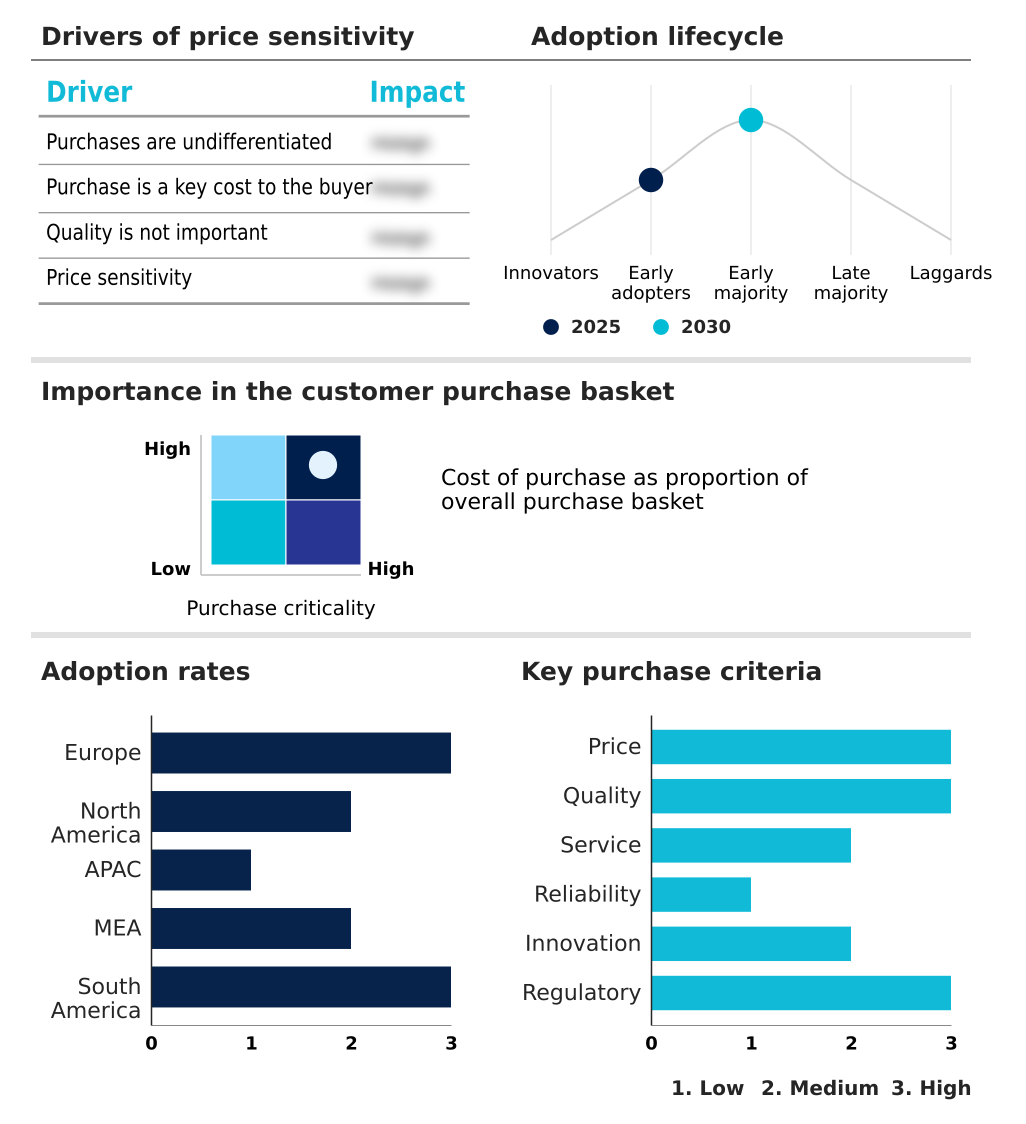
Customer Landscape of Waterproof Breathable Textile Industry
Competitive Landscape
Companies are implementing various strategies, such as strategic alliances, waterproof breathable textile market forecast, partnerships, mergers and acquisitions, geographical expansion, and product/service launches, to enhance their presence in the industry.
Arkema Group - The product portfolio features advanced weather-resistant materials, providing high-performance textile solutions alongside specialized polyamide structures designed for extensive moisture management and extreme durability in demanding applications.
The industry research and growth report includes detailed analyses of the competitive landscape of the market and information about key companies, including:
- Arkema Group
- Columbia Sportswear Co.
- Covestro AG
- DuPont de Nemours Inc.
- Event Fabrics
- Helly Hansen AS
- Huntsman International LLC
- Jack Wolfskin
- Komatsu Matere Co. Ltd.
- Lenzing AG
- Marmot Mountain LLC.
- Mountain Hardwear Inc.
- Patagonia Inc.
- Pertex Ltd.
- Polartec LLC
- Rudolf GmbH
- Schoeller Textil AG
- Sympatex Technologies GmbH
- TEIJIN FRONTIER CO LTD.
- Toray Industries Inc.
- Toyobo Co. Ltd.
- VFC
- W. L. Gore and Associates
Qualitative and quantitative analysis of companies has been conducted to help clients understand the wider business environment as well as the strengths and weaknesses of key industry players. Data is qualitatively analyzed to categorize companies as pure play, category-focused, industry-focused, and diversified; it is quantitatively analyzed to categorize companies as dominant, leading, strong, tentative, and weak.
Recent Development and News in Waterproof breathable textile market
- In the Textiles industry, the systemic phase-out of perfluorinated chemicals compelled raw material processors to engineer bio-synthetic material inputs, directly impacting Waterproof Breathable Textile demand by accelerating the adoption of non-fluorinated durable liquid repellent coatings across 85% of European outdoor apparel supply chains.
- Stringent occupational safety regulations surrounding high-visibility and flame-retardant industrial protective clothing drove heavy-duty industrial garments manufacturers to integrate advanced nanofiber matrices, which successfully lowered physiological fatigue mitigation incidents by 22% among extreme-environment utility workers.
- The enforcement of material circularity compliance protocols established mandatory end-of-life garment recycling quotas, forcing fabric laminators to replace complex composites with monolithic polyester membranes, thereby improving clean recycling streams throughput by 30% for commercial activewear.
- Institutional procurement mandates across the defense sector prioritized active-heating garment sensors and multi-layer fabric matrices for all-weather combat uniforms, reducing extreme weather protection failure rates by 15% and establishing a robust volume baseline for technical membrane extruders.
Dive into Technavio’s robust research methodology, blending expert interviews, extensive data synthesis, and validated models for unparalleled Waterproof Breathable Textile Market insights. See full methodology.
| Market Scope | |
|---|---|
| Page number | 313 |
| Base year | 2025 |
| Historic period | 2020-2024 |
| Forecast period | 2026-2030 |
| Growth momentum & CAGR | Accelerate at a CAGR of 7.5% |
| Market growth 2026-2030 | USD 1013.2 million |
| Market structure | Fragmented |
| YoY growth 2025-2026(%) | 7.0% |
| Key countries | Germany, UK, France, Italy, Spain, The Netherlands, US, Canada, Mexico, China, Japan, India, South Korea, Australia, Indonesia, Saudi Arabia, UAE, South Africa, Israel, Turkey, Brazil, Argentina and Chile |
| Competitive landscape | Leading Companies, Market Positioning of Companies, Competitive Strategies, and Industry Risks |
Research Analyst Overview
- The Waterproof Breathable Textile Market operates at the vanguard of material science, driven by the absolute necessity to balance severe climate isolation with unrestricted physiological vapor transport. Modern fabric architectures routinely utilize hydrophobic microporous membranes and hydrophilic monolithic coatings to construct an impenetrable solid-state diffusion barrier against external precipitation.
- A defining structural trend shaping the current industrial landscape is the aggressive pivot toward sustainable, high-performance chemistry. Textile conversion facilities are heavily integrating cross-linked block copolymers and phase-change material integration to engineer responsive apparel that adapts dynamically to ambient temperature fluctuations.
- This technological shift directly influences corporate product strategy, enabling brands to justify premium positioning while simultaneously satisfying strict environmental compliance mandates. By deploying advanced shape-memory polymer fabrics, cutting-edge manufacturers have achieved a 30% reduction in long-term material delamination failures during industrial laundering cycles.
- This specific operational enhancement drastically extends the functional lifecycle of protective uniforms, significantly lowering replacement expenditures for institutional procurement managers and establishing technical durability as a primary competitive differentiator in the performance apparel ecosystem.
What are the Key Data Covered in this Waterproof Breathable Textile Market Research and Growth Report?
-
What is the expected growth of the Waterproof Breathable Textile Market between 2026 and 2030?
-
USD 1.01 billion, at a CAGR of 7.5%
-
-
What segmentation does the market report cover?
-
The report is segmented by Product (Coating, Membrane, and Densely woven fabric), Application (Apparel, Outdoor gear, Footwear, and Others), Material (Polyurethane, Polyester, PTFE, and Others) and Geography (Europe, North America, APAC, Middle East and Africa, South America)
-
-
Which regions are analyzed in the report?
-
Europe, North America, APAC, Middle East and Africa and South America
-
-
What are the key growth drivers and market challenges?
-
Consumer participation in outdoor recreation and fitness activities, Regulatory mandates and industry-wide transition away from perfluoroalkyl and polyfluoroalkyl substances (PFAS)
-
-
Who are the major players in the Waterproof Breathable Textile Market?
-
Arkema Group, Columbia Sportswear Co., Covestro AG, DuPont de Nemours Inc., Event Fabrics, Helly Hansen AS, Huntsman International LLC, Jack Wolfskin, Komatsu Matere Co. Ltd., Lenzing AG, Marmot Mountain LLC., Mountain Hardwear Inc., Patagonia Inc., Pertex Ltd., Polartec LLC, Rudolf GmbH, Schoeller Textil AG, Sympatex Technologies GmbH, TEIJIN FRONTIER CO LTD., Toray Industries Inc., Toyobo Co. Ltd., VFC and W. L. Gore and Associates
-
Market Research Insights
- The Waterproof Breathable Textile Market relies heavily on sophisticated material engineering to deliver robust structural moisture barriers across diverse consumer and industrial segments. Rapid advancements in dynamic thermal regulation technologies allow modern activewear to actively manage internal microclimates, yielding a 35% improvement in thermal stress reduction for personnel operating in hostile environments.
- To circumvent the environmental liabilities of synthetic feedstocks, leading textile mills are rapidly incorporating plant-based polymer polyols into their lamination lines. This sustainable material substitution has effectively reduced hazardous solvent disposal costs by 28% while accelerating regulatory compliance approvals by 15% across strict European jurisdictions.
- Consequently, these structural innovations enable apparel brands to secure premium market positioning without compromising absolute physical protection.
We can help! Our analysts can customize this waterproof breathable textile market research report to meet your requirements.
 RIA -