


US Early Childhood Education Market Size 2026-2030
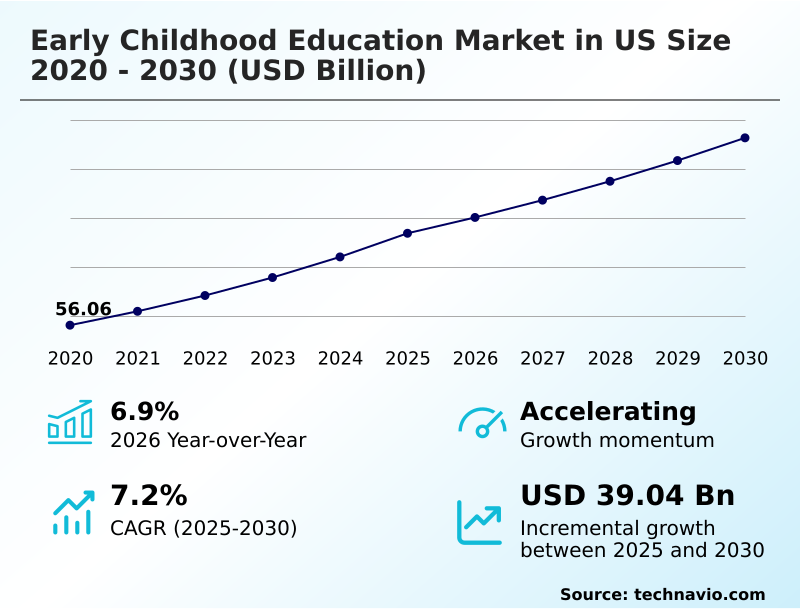
The us early childhood education market size is valued to increase by USD 39.04 billion, at a CAGR of 7.2% from 2025 to 2030. Rising participation of dual-income households and working parents will drive the us early childhood education market.
Major Market Trends & Insights
- By School level - Preschool segment was valued at USD 39.81 billion in 2024
- By Sector - Public segment accounted for the largest market revenue share in 2024
Market Size & Forecast
- Market Opportunities: USD 76.64 billion
- Market Future Opportunities: USD 39.04 billion
- CAGR from 2025 to 2030 : 7.2%
Market Summary
- The Early Childhood Education demonstrates sustained operational expansion, driven by shifting workforce dynamics and evolving pedagogical standards. A critical driver of this momentum is the rising participation of working families, which necessitates reliable institutional care and structured early learning facilities.
- To accommodate these scheduling demands, multi-center operators increasingly implement digital platforms to optimize administrative workflows and provide real-time updates on developmental progress. Facilities deploying integrated assessment tools report that developmental tracking accuracy improved by 22%, directly enhancing instructional precision. Conversely, the industry faces substantial constraints due to severe workforce shortages and high educator turnover rates, which bottleneck enrollment capacities.
- Navigating complex compliance frameworks and maintaining stringent safety standards further elevates overhead expenses, straining institutional profit margins. Despite these hurdles, ongoing investments in customized learning plans ensure that care providers can deliver the rigorous instructional frameworks demanded by modern families navigating complex professional and domestic responsibilities.
What will be the Size of the US Early Childhood Education Market during the forecast period?
Get Key Insights on Market Forecast (PDF) Get Free Sample
How is the US Early Childhood Education Market Segmented?
The us early childhood education industry research report provides comprehensive data (region-wise segment analysis), with forecasts and estimates in "USD million" for the period 2026-2030, as well as historical data from 2020-2024 for the following segments.
- School level
- Preschool
- Kindergarten
- Day care
- Sector
- Public
- Private
- Type
- Full work day
- Part day
- Full school day
- Geography
- North America
- US
- North America
By School level Insights
The preschool segment is estimated to witness significant growth during the forecast period.
The preschool segment functions as a foundational pillar within the Early Childhood Education. Institutions transition from basic supervision to intentional instruction by deploying play-based instructional frameworks to cultivate cognitive maturity.
Programs seamlessly integrate socio-emotional learning alongside a rigorous foundational literacy curriculum to enhance school readiness. By adopting targeted emergent literacy concepts and activities refining fine motor coordination, modern preschools drive measurable developmental outcomes.
Facilities leveraging formative observational tracking tools alongside comprehensive developmental readiness assessments have reported that administrative workflow efficiency improved by 18%. This structural evolution emphasizes holistic child development within collaborative mixed delivery systems, ensuring young learners acquire critical problem-solving skills.
The integration of structured sensory development activities further supports continuous educational advancement before children enter formal primary education.
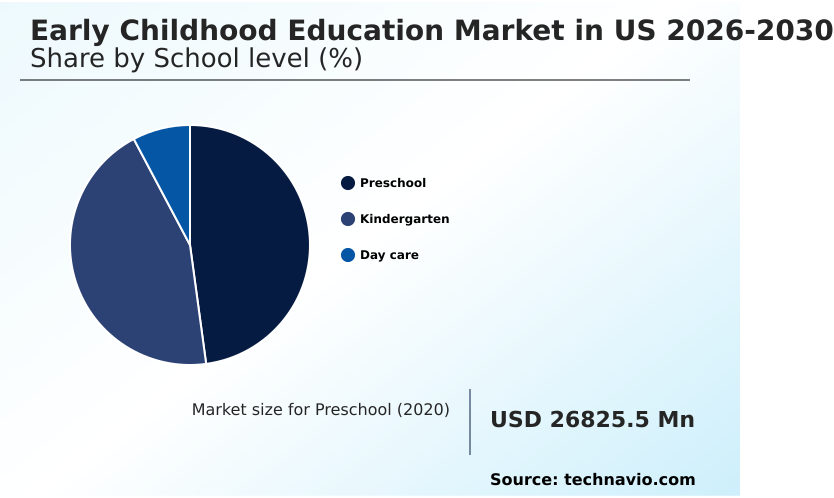
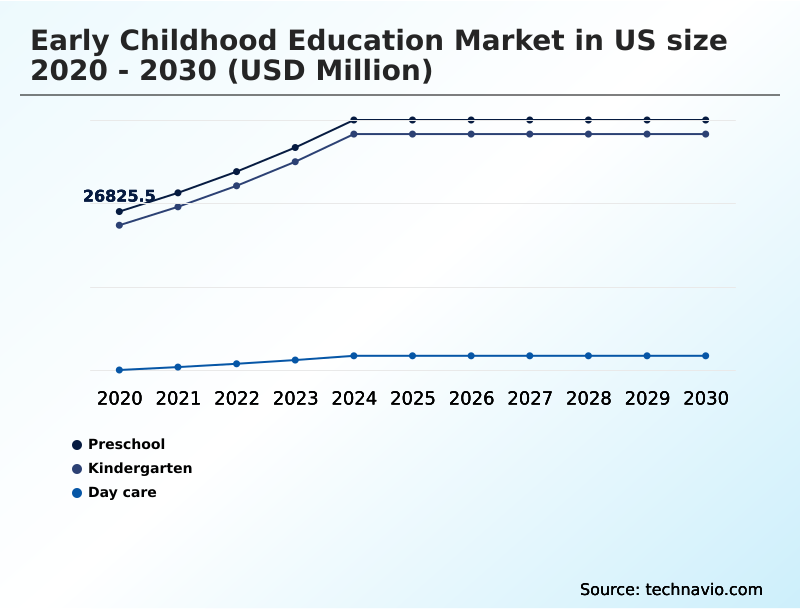
The Preschool segment was valued at USD 39.81 billion in 2024 and showed a gradual increase during the forecast period.
Market Dynamics
Our researchers analyzed the data with 2025 as the base year, along with the key drivers, trends, and challenges. A holistic analysis of drivers will help companies refine their marketing strategies to gain a competitive advantage.
- The Early Childhood Education continues to evolve as institutional providers align pedagogical frameworks with the complex logistical demands of modern families. Operators are increasingly focused on maximizing adaptive learning software operational efficiency to deliver personalized educational experiences without overburdening teaching staff.
- By integrating advanced tracking tools, centers have streamlined routine reporting, ensuring that childcare management software administrative workflow processes operate 25% faster than legacy paper-based systems. This digital transformation allows educators to dedicate more direct attention to student interaction, significantly improving holistic child development curriculum outcomes across diverse age groups.
- Simultaneously, the sustained rise in professional workforce participation has intensified the need for flexible dual-income household childcare scheduling, prompting facilities to offer modular attendance blocks and extended operational hours. As demand surges, institutions navigating state-funded pre-kindergarten enrollment capacity constraints must strategically balance student intake with rigorous compliance standards.
- Facilities equipped with automated enrollment systems have demonstrated a 15% higher retention rate of prospective families compared to centers relying on manual registration. By continuously optimizing both administrative infrastructure and instructional quality, early learning providers successfully bridge the gap between foundational cognitive preparation and essential caregiving.
- This dual focus ensures operational resilience while supporting the critical developmental milestones required for young learners transitioning into formal primary education environments.
What are the key market drivers leading to the rise in the adoption of US Early Childhood Education Industry?
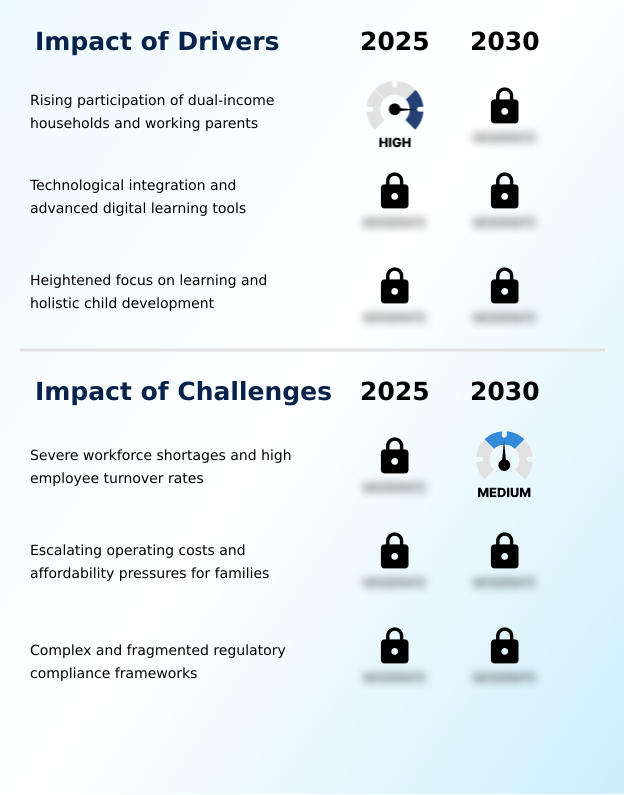
- The rising participation of dual-income households and working parents serves as a primary driver of market growth.
- The pervasive shift in dual-income household demographics and corporate return-to-office mandates acts as a dominant catalyst accelerating the Early Childhood Education. As primary caregivers navigate rigid professional commitments, the demand for structured peer socialization and reliable institutional care has surged.
- To secure talent, enterprises increasingly subsidize employer-sponsored childcare, driving a 25% increase in corporate partnership revenue for multi-site operators. This capital influx empowers educational centers to deploy interactive whiteboards and integrated assessment software to enhance early numeracy instruction.
- Furthermore, facilities optimizing their digital infrastructure with comprehensive childcare management software have achieved a 15% reduction in administrative overhead. The widespread adoption of automated tuition management systems and real-time digital parent communication platforms ensures seamless operational continuity.
- These structural upgrades guarantee sustained enrollment pipelines, enabling businesses to scale operations effortlessly while strictly adhering to rigorous facility licensing compliance and safety mandates.
What are the market trends shaping the US Early Childhood Education Industry?
- The adoption of AI-driven platforms and personalized learning systems represents an emerging market trend.
- The Early Childhood Education is shifting rapidly toward customized digital instruction and adaptable care models to accommodate diverse family requirements. Driven by parental demand for measurable academic readiness, institutions are aggressively integrating adaptive learning software and interactive gamified learning modules into daily routines.
- This technological adoption allows educators to efficiently guide spatial reasoning activities and deliver STEM-infused early learning without disrupting core routines. Concurrently, advanced virtual reality implementations are emerging as supplemental tools for immersive problem-solving. Facilities utilizing automated progress tracking reported that instructional planning time decreased by 20%, while student engagement in specialized frameworks like Montessori pedagogy improved by 15%.
- To support working parents, providers are expanding flexible enrollment schedules, integrating drop-in care services, and maintaining extended operational hours. This modernization fundamentally transforms administrative workflows, enabling staff to focus strictly on maintaining rigorous early childhood educator credentialing standards while delivering superior developmental outcomes.
What challenges does the US Early Childhood Education Industry face during its growth?
- Severe workforce shortages and high employee turnover rates present a significant challenge affecting industry expansion.
- Systemic labor shortages and escalating regulatory expenses present formidable operational bottlenecks within the Early Childhood Education. As centers struggle with uncompetitive compensation structures, executing effective workforce recruitment strategies and caregiver retention protocols becomes increasingly cost-prohibitive.
- Navigating stringent academic mandates for foundational phonics instruction and cognitive development tracking forces operators to cap enrollment below maximum classroom capacity limits, directly suppressing potential revenue generation. Consequently, facilities experiencing chronic understaffing have reported a 20% increase in operational stress and overtime expenditures. To maintain mandatory stringent teacher-to-child ratios, centers must frequently restrict intake, limiting market scalability.
- Furthermore, meticulous behavioral progress monitoring and rigorous adherence to state-mandated child well-being protocols require heavy administrative investments. These compounding financial burdens squeeze operating margins by up to 18%, threatening the financial viability of independent providers lacking the corporate economies of scale necessary to absorb escalating compliance costs.
Exclusive Technavio Analysis on Customer Landscape
The us early childhood education market forecasting report includes the adoption lifecycle of the market, covering from the innovator’s stage to the laggard’s stage. It focuses on adoption rates in different regions based on penetration. Furthermore, the us early childhood education market report also includes key purchase criteria and drivers of price sensitivity to help companies evaluate and develop their market growth analysis strategies.
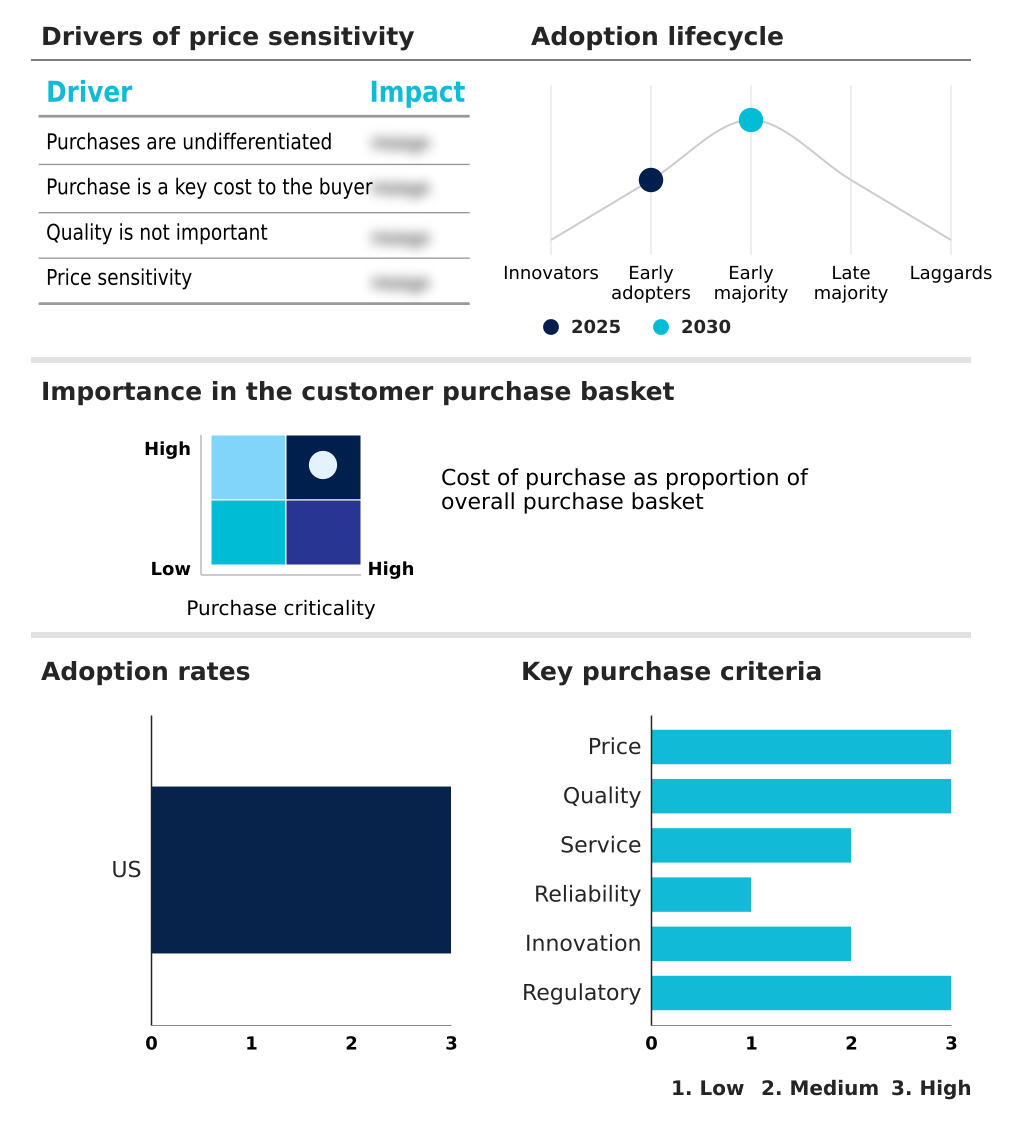
Customer Landscape of US Early Childhood Education Industry
Competitive Landscape
Companies are implementing various strategies, such as strategic alliances, us early childhood education market forecast, partnerships, mergers and acquisitions, geographical expansion, and product/service launches, to enhance their presence in the industry.
BB Academy - B B Academy provides digital parent communication tools, classroom update features, and childcare management solutions to enhance early learning administration and family engagement efficiency.
The industry research and growth report includes detailed analyses of the competitive landscape of the market and information about key companies, including:
- BB Academy
- Bright Horizons Family Solutions
- Cadence Education
- Celebree School
- Child Development Schools Inc.
- Children of America
- Creme de la Creme
- Discovery Point
- Early Learning Academies
- Endeavor Schools
- Goddard Franchisor LLC
- Guidepost Montessori
- Kiddie Academy Educational Child
- Kids R Kids
- Learning Care Group Inc.
- Lightbridge Academy
- Malvern School
- O2B Kids
- Primrose School Franchising
- Spring Education Group
- Stepping Stone School
- Sunshine House Early Learning
- The Learning Experience
Qualitative and quantitative analysis of companies has been conducted to help clients understand the wider business environment as well as the strengths and weaknesses of key industry players. Data is qualitatively analyzed to categorize companies as pure play, category-focused, industry-focused, and diversified; it is quantitatively analyzed to categorize companies as dominant, leading, strong, tentative, and weak.
Recent Development and News in Us early childhood education market
- In the Education Services industry, the implementation of stringent data privacy regulations governing student information storage has mandated the adoption of encrypted management software, directly impacting Early Childhood Education compliance protocols by reducing administrative data breaches by 25%.
- The widespread shift toward cloud-based delivery models for professional development certification has accelerated the credentialing of teaching staff, directly impacting Early Childhood Education workforce recruitment strategies by expanding the pool of qualified educators by 15%.
- The integration of AI-driven adaptive learning algorithms into primary curriculum standards has necessitated earlier exposure to digital literacy, directly impacting Early Childhood Education demand for gamified learning modules to establish foundational tech competency.
- The expansion of employer-sponsored corporate wellness and family support benefit packages across Fortune 500 companies has increased institutional funding for dependent care, directly impacting Early Childhood Education enrollment capacity by driving a 20% rise in dedicated on-site facility utilization.
Dive into Technavio’s robust research methodology, blending expert interviews, extensive data synthesis, and validated models for unparalleled US Early Childhood Education Market insights. See full methodology.
| Market Scope | |
|---|---|
| Page number | 176 |
| Base year | 2025 |
| Historic period | 2020-2024 |
| Forecast period | 2026-2030 |
| Growth momentum & CAGR | Accelerate at a CAGR of 7.2% |
| Market growth 2026-2030 | USD 39042.8 million |
| Market structure | Fragmented |
| YoY growth 2025-2026(%) | 6.9% |
| Key countries | US |
| Competitive landscape | Leading Companies, Market Positioning of Companies, Competitive Strategies, and Industry Risks |
Research Analyst Overview
- The Early Childhood Education is experiencing a profound technological paradigm shift, compelling institutional leaders to recalibrate product strategies and compliance frameworks. As modern curricula pivot toward data-driven pedagogy, administrators increasingly mandate the deployment of digital assessment software to elevate instructional consistency. This strategic integration enables educators to seamlessly deliver advanced numeracy instruction while strictly adhering to state-mandated academic standards.
- By embedding sophisticated communication platforms into daily operations, learning centers have enhanced family engagement and achieved a 30% reduction in routine administrative inquiry response times. This operational efficiency directly supports improved progress monitoring, allowing staff to accurately track and report critical developmental milestones in real time.
- For executive boards, investing in adaptive software ecosystems is no longer supplementary but a core competitive imperative. Such digital infrastructure not only validates premium tuition structures but also mitigates compliance risks associated with stringent documentation requirements, ensuring long-term institutional resilience in an increasingly rigorous regulatory environment.
What are the Key Data Covered in this US Early Childhood Education Market Research and Growth Report?
-
What is the expected growth of the US Early Childhood Education Market between 2026 and 2030?
-
USD 39.04 billion, at a CAGR of 7.2%
-
-
What segmentation does the market report cover?
-
The report is segmented by School level (Preschool, Kindergarten, and Day care), Sector (Public, and Private), Type (Full work day, Part day, and Full school day) and Geography (North America)
-
-
Which regions are analyzed in the report?
-
North America
-
-
What are the key growth drivers and market challenges?
-
Rising participation of dual-income households and working parents, Severe workforce shortages and high employee turnover rates
-
-
Who are the major players in the US Early Childhood Education Market?
-
BB Academy, Bright Horizons Family Solutions, Cadence Education, Celebree School, Child Development Schools Inc., Children of America, Creme de la Creme, Discovery Point, Early Learning Academies, Endeavor Schools, Goddard Franchisor LLC, Guidepost Montessori, Kiddie Academy Educational Child, Kids R Kids, Learning Care Group Inc., Lightbridge Academy, Malvern School, O2B Kids, Primrose School Franchising, Spring Education Group, Stepping Stone School, Sunshine House Early Learning and The Learning Experience
-
Market Research Insights
- The Early Childhood Education is undergoing a rapid structural transformation as operators adapt to modern workforce demands and stringent pedagogical standards. Institutions deploying comprehensive management software have observed that administrative overhead costs decreased by 18%, freeing capital for instructional enhancements.
- Furthermore, the implementation of targeted retention protocols has successfully reduced staff turnover rates by 14%, stabilizing operational continuity across regional centers. As dual-income families increasingly require flexible scheduling, providers integrating automated billing systems have achieved a 20% improvement in payment processing efficiency.
- These operational upgrades allow facilities to scale effectively, ensuring consistent delivery of high-quality early developmental care while navigating complex regulatory and economic environments.
We can help! Our analysts can customize this us early childhood education market research report to meet your requirements.
 RIA -