

Mexico Textile Manufacturing Market Size 2026-2030
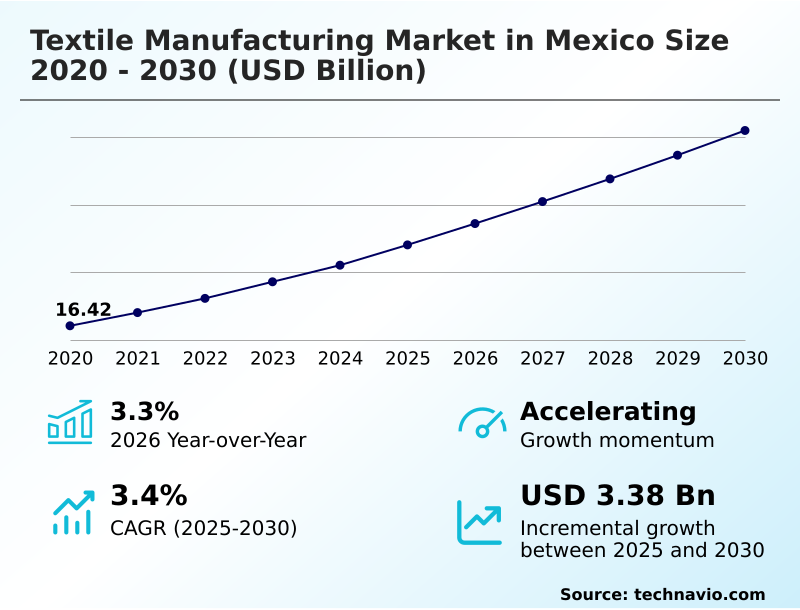
The mexico textile manufacturing market size is valued to increase by USD 3.38 billion, at a CAGR of 3.4% from 2025 to 2030. Proximity to large North American markets accelerates enterprise nearshoring investments will drive the mexico textile manufacturing market.
Major Market Trends & Insights
- By Product - Natural fibers segment was valued at USD 7.66 billion in 2024
- By Application - Fashion segment accounted for the largest market revenue share in 2024
Market Size & Forecast
- Market Opportunities: USD 5.77 billion
- Market Future Opportunities: USD 3.38 billion
- CAGR from 2025 to 2030 : 3.4%
Market Summary
- The Textile Manufacturing Market demonstrates accelerated structural progression driven by localized nearshoring supply chain architectures and advanced material engineering. Operational modernization is heavily influenced by proximity to North American consumer bases, which acts as a primary market driver.
- By utilizing proximate facilities, apparel brands can drastically cut delivery lead times, effectively reducing inventory holding periods by over 40% compared to transoceanic sourcing models. This logistical advantage accelerates nearshoring investments across automated yarn spinning and circular-knit jersey production hubs.
- However, high operational expenditures driven by fluctuating domestic energy costs severely deter corporate profitability, limiting the capacity to reinvest in continuous automated dye houses and air-jet loom technology. Despite these constraints, industrial fabric weaving facilities are aggressively implementing lean manufacturing workflows to optimize fabric utilization and mitigate material waste.
- By balancing energy-intensive synthetic polyamide extrusion with sustainable water management practices, the sector maintains a competitive edge. The ongoing demand for supply chain resilience ensures that regional networks will continue prioritizing high-value, tech-driven manufacturing methodologies to satisfy both mass apparel and specialized industrial requirements.
What will be the Size of the Mexico Textile Manufacturing Market during the forecast period?
Get Key Insights on Market Forecast (PDF) Get Free Sample
How is the Mexico Textile Manufacturing Market Segmented?
The mexico textile manufacturing industry research report provides comprehensive data (region-wise segment analysis), with forecasts and estimates in "USD million" for the period 2026-2030, as well as historical data from 2020-2024 for the following segments.
- Product
- Natural fibers
- Polyesters
- Nylon
- Others
- Application
- Fashion
- Technical
- Household
- Others
- Product type
- Garments
- Fabric
- Yarn
- Home textiles
- Technical textiles
- Geography
- North America
- Mexico
- North America
By Product Insights
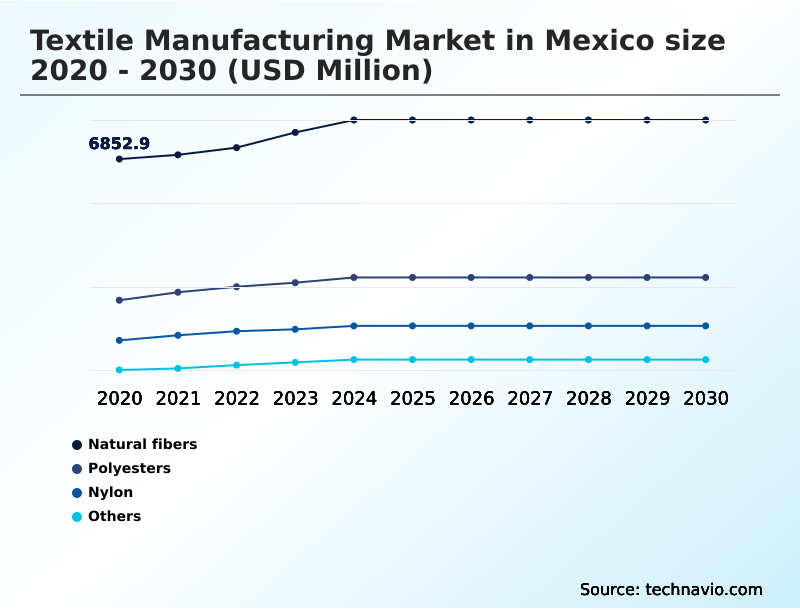
The natural fibers segment is estimated to witness significant growth during the forecast period.
The natural fibers segment occupies a prominent position due to enduring demand for breathable and culturally significant materials across domestic and export consumer bases.
Comprising plant-derived resources like cotton and agave-based sisal processing, alongside animal-derived components, this category fundamentally supports premium apparel and domestic home textiles.
The industry is rapidly shifting away from low-cost commodity weaving toward higher value-added natural fabric variations that emphasize organic origin and localized supply chain resilience.
By utilizing sustainable water management techniques, facilities handling high-grade upland cotton can achieve a 15% reduction in total resource consumption during preparation phases.
As environmental awareness increasingly drives consumer behaviors toward biodegradable alternatives, natural fibers remain an indispensable pillar of the industrial fabric landscape, offering superior tactile properties and a minimal ecological footprint.
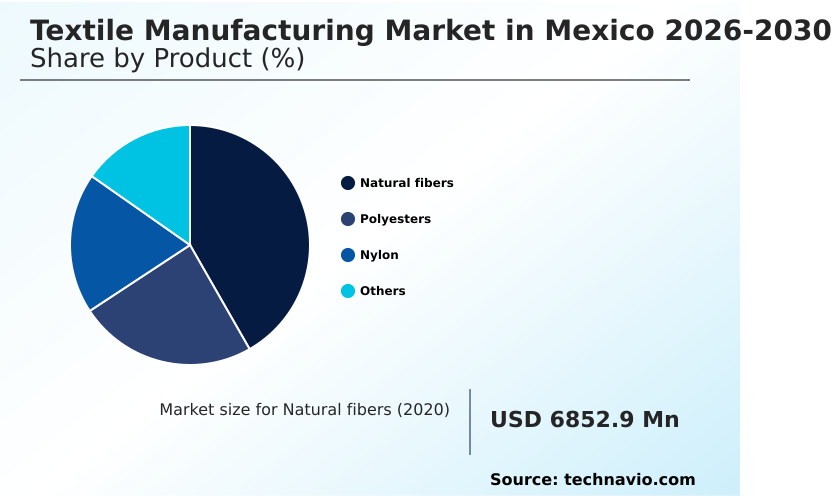
The Natural fibers segment was valued at USD 7.66 billion in 2024 and showed a gradual increase during the forecast period.
Market Dynamics
Our researchers analyzed the data with 2025 as the base year, along with the key drivers, trends, and challenges. A holistic analysis of drivers will help companies refine their marketing strategies to gain a competitive advantage.
- The transition toward sustainable and highly efficient production methodologies is fundamentally restructuring the operational baseline of the Textile Manufacturing Market. To combat escalating resource costs and strict environmental compliance mandates, modern facilities are prioritizing closed loop water recycling systems, which drastically reduce dependency on municipal grids and minimize wastewater treatment liabilities.
- This technological pivot is highly complementary to the deployment of low liquor ratio dyeing machinery, allowing dye houses to achieve superior color consistency while utilizing substantially fewer chemical inputs. On the mechanical front, automated air jet loom integration is accelerating fabric weaving speeds, yielding a 35% improvement in production throughput compared to legacy mechanical weaving configurations.
- This operational efficiency is particularly vital when processing complex synthetic blends. For instance, post consumer recycled polyester processing requires precise thermal and mechanical control to maintain fiber integrity, compelling mills to completely upgrade their extrusion networks. By heavily optimizing synthetic polyamide extrusion process efficiency, industrial fabricators can minimize thermal degradation and reduce material waste during the production of high-tensile yarns.
- These combined technological investments allow regional manufacturing hubs to offer highly competitive lead times and superior product quality, ensuring absolute alignment with the stringent sourcing requirements of international retail brands and industrial component buyers.
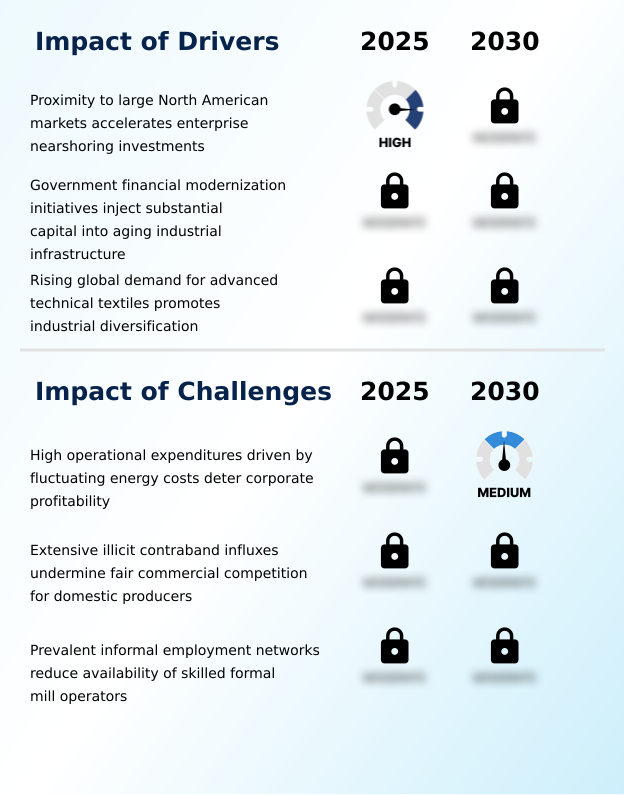
What are the key market drivers leading to the rise in the adoption of Mexico Textile Manufacturing Industry?
- Proximity to large North American consumer markets significantly accelerates enterprise nearshoring investments, enabling rapid supply chain agility and reduced transportation lead times.
- The strategic prioritization of nearshoring supply chain agility by North American retail conglomerates serves as the primary catalyst accelerating the Textile Manufacturing Market.
- To circumvent transoceanic shipping delays, international brands are aggressively localizing sourcing, which reduces inventory replenishment cycles by up to 40%. This logistical proximity drives substantial capital injections into automated yarn spinning and high-precision pattern cutting infrastructure.
- Furthermore, expanding automotive assembly operations require a localized, resilient supply of high-tensile synthetic yarns and non-woven filtration materials, pulling textile production toward high-margin technical applications.
- By intensely focusing on industrial fabric weaving, specialized facilities can achieve a 20% increase in operational profit margins over basic apparel assembly, ensuring sustained revenue generation amidst volatile global commodity pricing and volatile transportation logistics.
What are the market trends shaping the Mexico Textile Manufacturing Industry?
- The widespread adoption of automated water conservation technologies is fundamentally reshaping manufacturing operations across the sector. This integration enables facilities to minimize their ecological impact while optimizing long-term utility expenditures.
- A profound shift toward resource conservation and circular economy compliance is currently redefining operational standards within the Textile Manufacturing Market. Driven by stringent environmental regulations and escalating utility costs, modern facilities are aggressively implementing zero-water-waste finishing and low-liquor ratio dyeing systems.
- This transition directly reduces processing water reliance, generating a 95% decrease in wastewater discharge and lowering utility expenditures by 18%. Simultaneously, the rising consumer demand for sustainable apparel is accelerating the integration of post-consumer recycled polyester and advanced man-made fibers into mainstream production lines.
- By upgrading synthetic fiber extrusion networks to process recycled flakes, manufacturers achieve a 25% improvement in raw material price stability compared to volatile natural fibers. These targeted technological adoptions enable rapid vertical manufacturing integration, streamlining operations and ensuring long-term profitability amidst changing supply chains.
What challenges does the Mexico Textile Manufacturing Industry face during its growth?
- High operational expenditures, driven by fluctuating domestic energy costs, severely deter corporate profitability and limit capital reinvestment in advanced production technologies.
- Severe fluctuations in domestic energy pricing present a formidable structural constraint on the Textile Manufacturing Market, severely impacting the profitability of heavy production facilities. Energy-intensive operations, particularly continuous automated dye houses and thermoplastic polymer blending, face unexpected utility spikes that can increase monthly overhead costs by 15%.
- This financial pressure restricts the capital available for necessary upgrades in air-jet loom technology and water-recycling networks. Additionally, the persistent infiltration of illicit contraband artificially depresses market prices, causing legitimate manufacturers to experience a 20% reduction in domestic market share.
- Coupled with chronic shortages of skilled operators for advanced mechanical systems, these operational frictions force management teams to reallocate critical resources toward market defense and workforce retention rather than driving technological innovation.
Exclusive Technavio Analysis on Customer Landscape
The mexico textile manufacturing market forecasting report includes the adoption lifecycle of the market, covering from the innovator’s stage to the laggard’s stage. It focuses on adoption rates in different regions based on penetration. Furthermore, the mexico textile manufacturing market report also includes key purchase criteria and drivers of price sensitivity to help companies evaluate and develop their market growth analysis strategies.
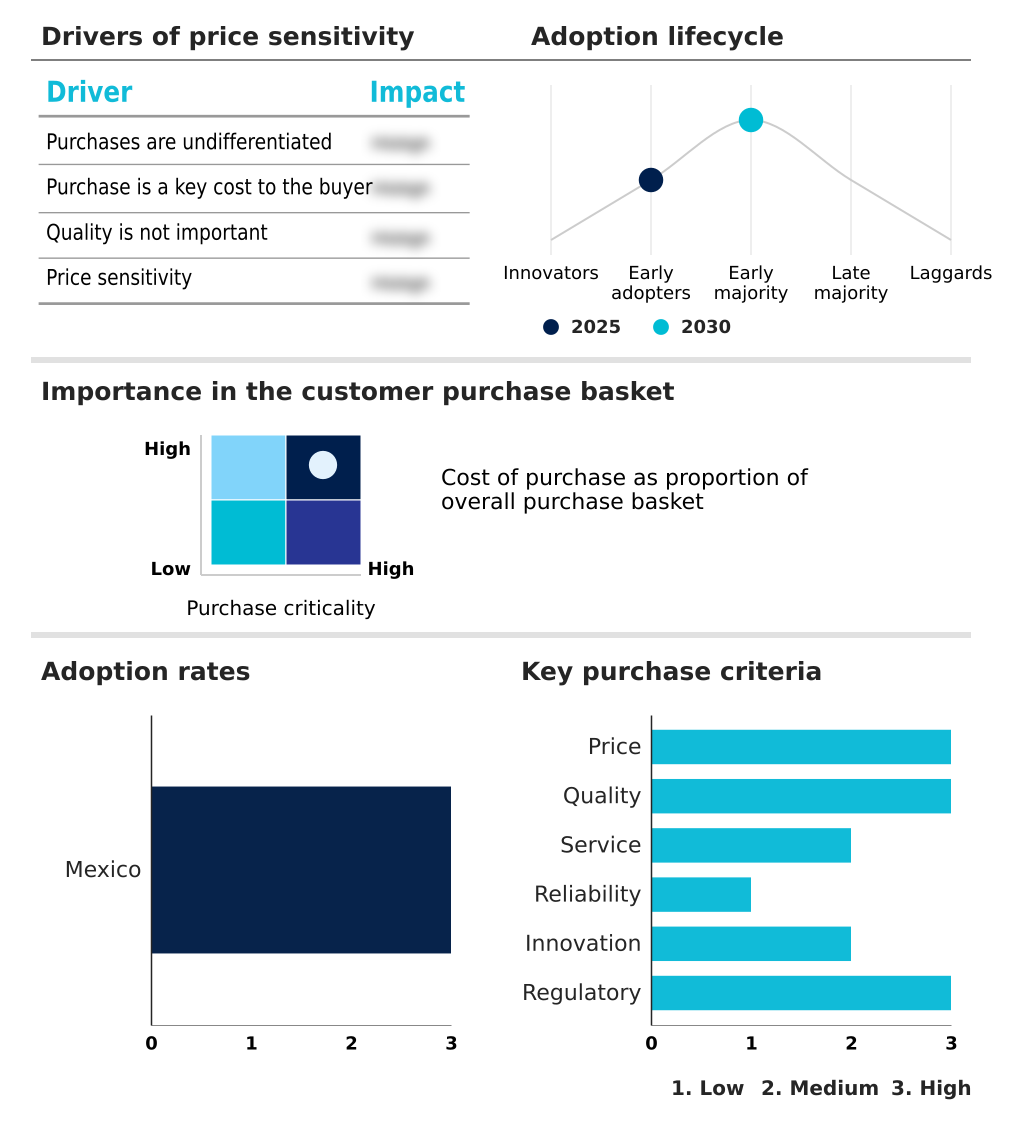
Customer Landscape of Mexico Textile Manufacturing Industry
Competitive Landscape
Companies are implementing various strategies, such as strategic alliances, mexico textile manufacturing market forecast, partnerships, mergers and acquisitions, geographical expansion, and product/service launches, to enhance their presence in the industry.
Avante Textil S.A. de C.V. - The entity provides comprehensive woven and knitted fabrics, alongside advanced textile materials engineered for diverse apparel and complex industrial applications, ensuring robust material performance across supply chains.
The industry research and growth report includes detailed analyses of the competitive landscape of the market and information about key companies, including:
- Avante Textil S.A. de C.V.
- Aztlan Textil
- Basila Textil
- Cobitel
- Corduroy S.A. de C.V.
- Cualy Textiles
- Dyexsa
- Espintex
- Grupo Kaltex S.A.de C.V.
- Hilaturas Los Angeles
- Karabe Textiles
- La Cima Textil
- La Maria Textil
- Minotex
- Nyltex
- Satex Textil
- Siete Leguas
- Skytex Mexico
- Vertical Knits S.A de C.V
- Zentrix Industrial Mexico
Qualitative and quantitative analysis of companies has been conducted to help clients understand the wider business environment as well as the strengths and weaknesses of key industry players. Data is qualitatively analyzed to categorize companies as pure play, category-focused, industry-focused, and diversified; it is quantitatively analyzed to categorize companies as dominant, leading, strong, tentative, and weak.
Recent Development and News in Mexico textile manufacturing market
- In the Textiles industry, the widespread adoption of eco-efficient dye processing and low-liquor ratio dyeing machinery has significantly reduced wastewater output, directly impacting Textile Manufacturing demand by lowering operational costs for compliant mills.
- Strict circular economy compliance mandates regarding virgin plastics have accelerated the integration of post-consumer recycled polyester, forcing Textile Manufacturing facilities to upgrade synthetic fiber extrusion lines to handle recycled inputs.
- The shift toward lightweight electric vehicle production has increased the reliance on automotive acoustic insulation and high-performance aramid fibers, pulling specialized Textile Manufacturing demand toward advanced technical fabric formulation.
- Advancements in automated continuous hem-sewing and digital textile printing have streamlined apparel mass assembly workflows, boosting Textile Manufacturing efficiency and yielding a 20% improvement in production throughput for early adopters.
Dive into Technavio’s robust research methodology, blending expert interviews, extensive data synthesis, and validated models for unparalleled Mexico Textile Manufacturing Market insights. See full methodology.
| Market Scope | |
|---|---|
| Page number | 196 |
| Base year | 2025 |
| Historic period | 2020-2024 |
| Forecast period | 2026-2030 |
| Growth momentum & CAGR | Accelerate at a CAGR of 3.4% |
| Market growth 2026-2030 | USD 3381.7 million |
| Market structure | Fragmented |
| YoY growth 2025-2026(%) | 3.3% |
| Key countries | Mexico |
| Competitive landscape | Leading Companies, Market Positioning of Companies, Competitive Strategies, and Industry Risks |
Research Analyst Overview
- Strategic boardroom decisions within the Textile Manufacturing Market are increasingly dictated by the necessity to merge ecological compliance with high-velocity production capabilities. Executive leadership teams are heavily prioritizing capital investments in closed-loop water recycling and ozone finishing loops to mitigate operational risks associated with regional water scarcity and stringent environmental audits.
- This pivot toward sustainable infrastructure allows prominent mills to secure lucrative procurement contracts with eco-conscious retail conglomerates. Consequently, the adoption of sublimation printing equipment and laser distressing systems has led to a 30% reduction in chemical processing times, directly improving overall facility throughput.
- Furthermore, the strategic integration of regenerated cellulosic fibers and bio-fabricated textiles is reshaping product portfolios, enabling manufacturers to command premium pricing in the sustainable apparel sector. To maintain high-quality output, facilities are leveraging warp knitting systems and continuous automated dye houses, ensuring exceptional material consistency across bulk orders.
- These comprehensive technological and material upgrades empower industrial fabricators to navigate fluctuating raw material markets while delivering highly specialized, compliance-verified textile solutions.
What are the Key Data Covered in this Mexico Textile Manufacturing Market Research and Growth Report?
-
What is the expected growth of the Mexico Textile Manufacturing Market between 2026 and 2030?
-
USD 3.38 billion, at a CAGR of 3.4%
-
-
What segmentation does the market report cover?
-
The report is segmented by Product (Natural fibers, Polyesters, Nylon, and Others), Application (Fashion, Technical, Household, and Others), Product Type (Garments, Fabric, Yarn, Home textiles, and Technical textiles) and Geography (North America)
-
-
Which regions are analyzed in the report?
-
North America
-
-
What are the key growth drivers and market challenges?
-
Proximity to large North American markets accelerates enterprise nearshoring investments, High operational expenditures driven by fluctuating energy costs deter corporate profitability
-
-
Who are the major players in the Mexico Textile Manufacturing Market?
-
Avante Textil S.A. de C.V., Aztlan Textil, Basila Textil, Cobitel, Corduroy S.A. de C.V., Cualy Textiles, Dyexsa, Espintex, Grupo Kaltex S.A.de C.V., Hilaturas Los Angeles, Karabe Textiles, La Cima Textil, La Maria Textil, Minotex, Nyltex, Satex Textil, Siete Leguas, Skytex Mexico, Vertical Knits S.A de C.V and Zentrix Industrial Mexico
-
Market Research Insights
- The Textile Manufacturing Market is undergoing a rapid transition toward high-performance material engineering and sustainable production methodologies. The integration of zero-water-waste finishing and centralized wastewater treatment systems has enabled modern facilities to reduce municipal water dependence by up to 95%, dramatically lowering compliance overhead.
- Simultaneously, the shift toward vertical manufacturing integration has compressed production lead times by 30%, granting enterprise buyers unmatched nearshoring supply chain agility.
- As facilities transition away from basic commodity apparel toward technical fabric formulation, the rapid adoption of moisture-wicking performance fabrics and protective fire-resistant garments has yielded a 25% increase in premium product margins, ensuring long-term operational resilience across industrial component manufacturing networks.
We can help! Our analysts can customize this mexico textile manufacturing market research report to meet your requirements.
 RIA -