



North America Road Freight Transportation Market Size 2026-2030
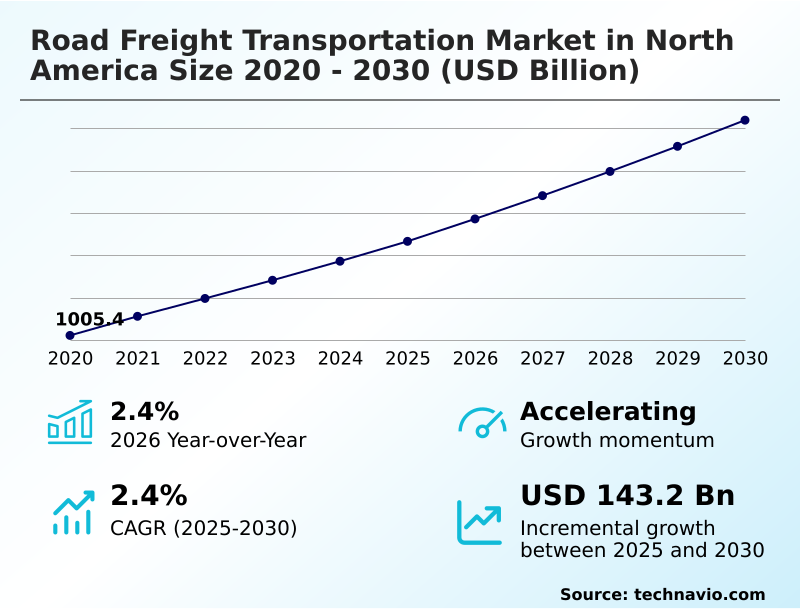
The north america road freight transportation market size is valued to increase by USD 143.2 billion, at a CAGR of 2.4% from 2025 to 2030. Institutionalization of nearshoring and cross border trade integration will drive the north america road freight transportation market.
Major Market Trends & Insights
- By Type - Full truckload segment was valued at USD 979.9 billion in 2024
- By Product Type - Solid goods segment accounted for the largest market revenue share in 2024
Market Size & Forecast
- Market Opportunities: USD 254.4 billion
- Market Future Opportunities: USD 143.2 billion
- CAGR from 2025 to 2030 : 2.4%
Market Summary
- The road freight transportation market in North America is navigating a period of technological and operational transformation. Key drivers include the intensification of cross-border trade integration, fueled by nearshoring initiatives, and the persistent growth of e-commerce, which has increased demand for both last-mile logistics and less-than truckload services.
- In response, the industry is accelerating its adoption of digital freight matching and real-time visibility platforms to enhance asset utilization. For instance, a large shipper can now leverage a unified platform to access both dedicated contract carriage and spot market capacity, using AI-powered dynamic routing to optimize for cost and delivery time.
- Concurrently, the market is addressing a structural labor scarcity through investment in autonomous freight corridors. This is complemented by a push toward sustainability with the deployment of zero-emission fleets, supported by new megawatt-class charging infrastructure.
- However, challenges such as high capital costs for new technology, infrastructure congestion, and complex regulatory compliance continue to shape the strategic landscape for all operators, from large carriers to independent owner-operators.
What will be the Size of the North America Road Freight Transportation Market during the forecast period?
Get Key Insights on Market Forecast (PDF) Get Free Sample
How is the North America Road Freight Transportation Market Segmented?
The north america road freight transportation industry research report provides comprehensive data (region-wise segment analysis), with forecasts and estimates in "USD billion" for the period 2026-2030, as well as historical data from 2020-2024 for the following segments.
- Type
- Full truckload
- Less-than truckload
- Product type
- Solid goods
- Liquid goods
- Vehicle type
- Light commercial vehicles
- Heavy commercial vehicles
- Service type
- 3PL
- Express and parcel services
- Freight forwarding
- Geography
- North America
- US
- Canada
- Mexico
- North America
By Type Insights
The full truckload segment is estimated to witness significant growth during the forecast period.
The full truckload segment is the logistical cornerstone for high-volume freight, defined by dedicated trailer use for single-origin, single-destination shipments. This model, crucial for large manufacturers and retailers, prioritizes speed and cargo security by eliminating intermediate handling.
The segment's evolution is driven by the integration of fleet telematics and real-time visibility platforms, which enhance supply chain resilience. Digital freight matching and load-matching algorithms are becoming standard, with some platforms reducing empty backhaul miles by up to 15%.
As nearshoring initiatives reshape cross-border logistics, FTL operations are adapting with advanced customs-clearance software and a push toward autonomous freight corridors for long-haul efficiency, optimizing asset utilization and managing total cost of ownership across integrated networks.
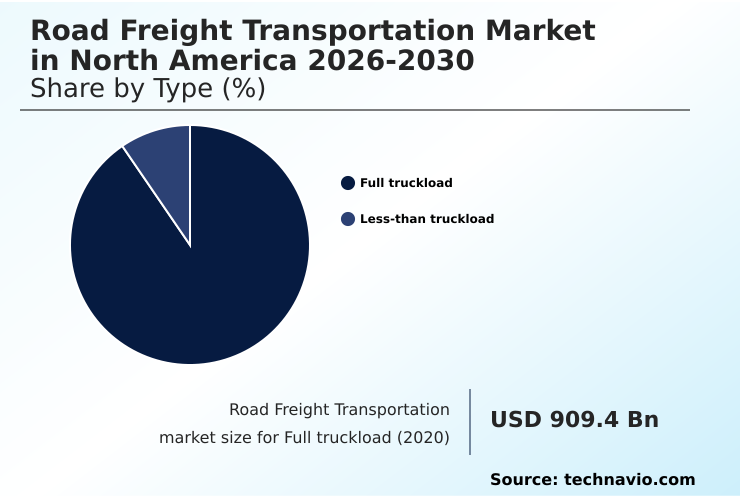
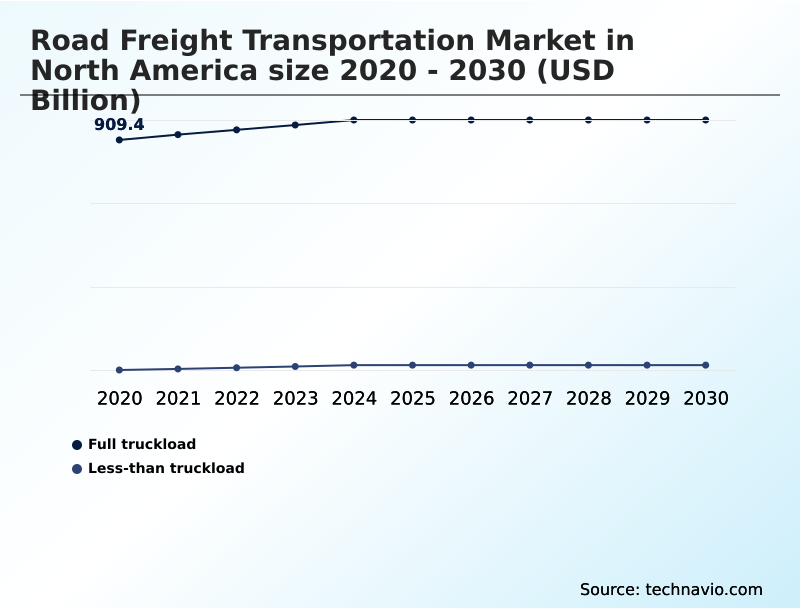
The Full truckload segment was valued at USD 979.9 billion in 2024 and showed a gradual increase during the forecast period.
Market Dynamics
Our researchers analyzed the data with 2025 as the base year, along with the key drivers, trends, and challenges. A holistic analysis of drivers will help companies refine their marketing strategies to gain a competitive advantage.
- Strategic decision-making in the road freight transportation market in North America 2026-2030 hinges on mastering complex operational variables. Optimizing asset utilization in truckload fleets is no longer just about maximizing loaded miles; it requires sophisticated strategies for reducing empty miles with AI platforms, which can improve fleet productivity by more than double that of manual planning methods.
- A critical component of this is the effective role of telematics in fleet management, providing the data needed for predictive analytics. At the same time, managing driver shortages through automation is becoming a central pillar of long-term strategy, leading to focused investment in autonomous freight corridors.
- Navigating cross-border trade compliance is another key challenge, where the impact of nearshoring on freight demand has strained existing infrastructure. Firms are now focused on strategies for reducing border dwell times, as delays at these chokepoints can negate any on-road efficiency gains.
- The challenges of zero-emission vehicle transition, including the high upfront cost and the need for new megawatt charging infrastructure, are shaping capital expenditure plans. As a result, securing capacity in a volatile market depends on a carrier's ability to integrate these technological, regulatory, and logistical factors into a cohesive operational model.
What are the key market drivers leading to the rise in the adoption of North America Road Freight Transportation Industry?
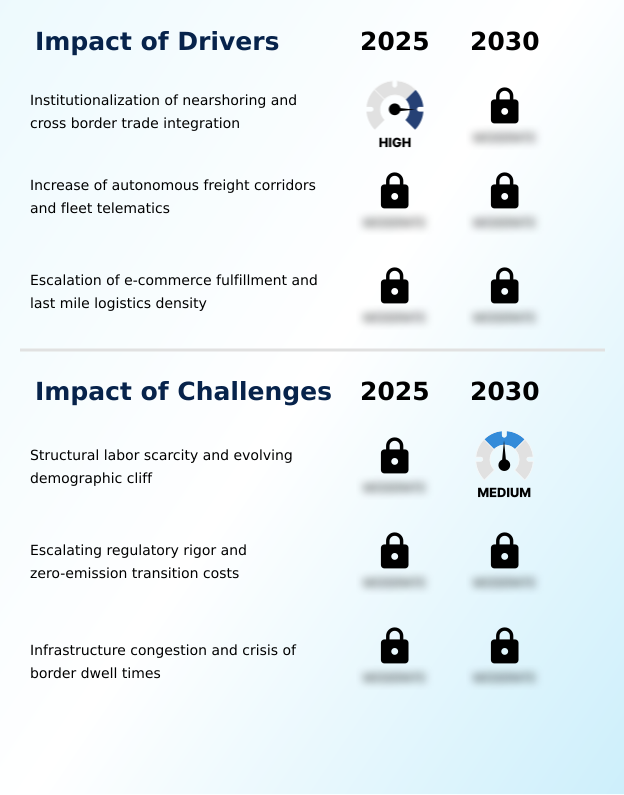
- The institutionalization of nearshoring and the intensification of cross-border trade integration are key drivers for the market.
- Market growth is propelled by powerful macroeconomic and technological drivers.
- The institutionalization of nearshoring initiatives has intensified cross-border trade integration, leading to a surge in demand for heavy-duty trucking; trade volume between the US and Mexico via truck increased by over 9% in a single year.
- Simultaneously, the escalation of e-commerce fulfillment has fundamentally altered freight patterns, with a 20% annual increase in short-haul freight movements under 100 miles. This has spurred demand for both light commercial vehicles in final-mile delivery and less-than truckload services.
- To manage this complexity, carriers are deploying fleet telematics and advanced transportation management systems, which are critical for maintaining supply chain resilience and on-time performance.
What are the market trends shaping the North America Road Freight Transportation Industry?
- A key market trend is the industrialization of autonomous middle-mile logistics. This shift targets high-volume corridors between distribution centers to improve efficiency.
- Key trends are reshaping the market's operational fabric, driven by a convergence of technology and economic pressures. The industrialization of autonomous freight corridors is moving from pilot to production, with some dedicated routes showing a 30% improvement in asset utilization by enabling 24/7 operation.
- Concurrently, the build-out of megawatt-class charging infrastructure is accelerating the viability of zero-emission fleets for regional-haul routes, a critical step for carriers to meet decarbonization goals. In the brokerage space, the adoption of digital freight matching and real-time visibility platforms has become widespread, with AI-powered systems reducing freight booking times from hours to minutes.
- These platforms leverage sophisticated load-matching algorithms to improve operational efficiency and reduce empty miles.
What challenges does the North America Road Freight Transportation Industry face during its growth?
- Structural labor scarcity and an evolving demographic cliff present a key challenge affecting industry growth.
- The market grapples with significant structural challenges that constrain growth and compress margins. A persistent structural labor scarcity, coupled with an aging workforce, creates a constant upward pressure on wages and recruitment costs.
- This is compounded by escalating regulatory compliance burdens, particularly the transition to zero-emission fleets, where new electric tractors can cost up to three times more than their diesel counterparts. Furthermore, chronic infrastructure congestion and significant border dwell times, often lasting several hours, erode operational efficiency and undermine on-time performance.
- These logistical bottlenecks add a layer of unpredictability and cost, challenging the total cost of ownership models that carriers rely on for profitability.
Exclusive Technavio Analysis on Customer Landscape
The north america road freight transportation market forecasting report includes the adoption lifecycle of the market, covering from the innovator’s stage to the laggard’s stage. It focuses on adoption rates in different regions based on penetration. Furthermore, the north america road freight transportation market report also includes key purchase criteria and drivers of price sensitivity to help companies evaluate and develop their market growth analysis strategies.
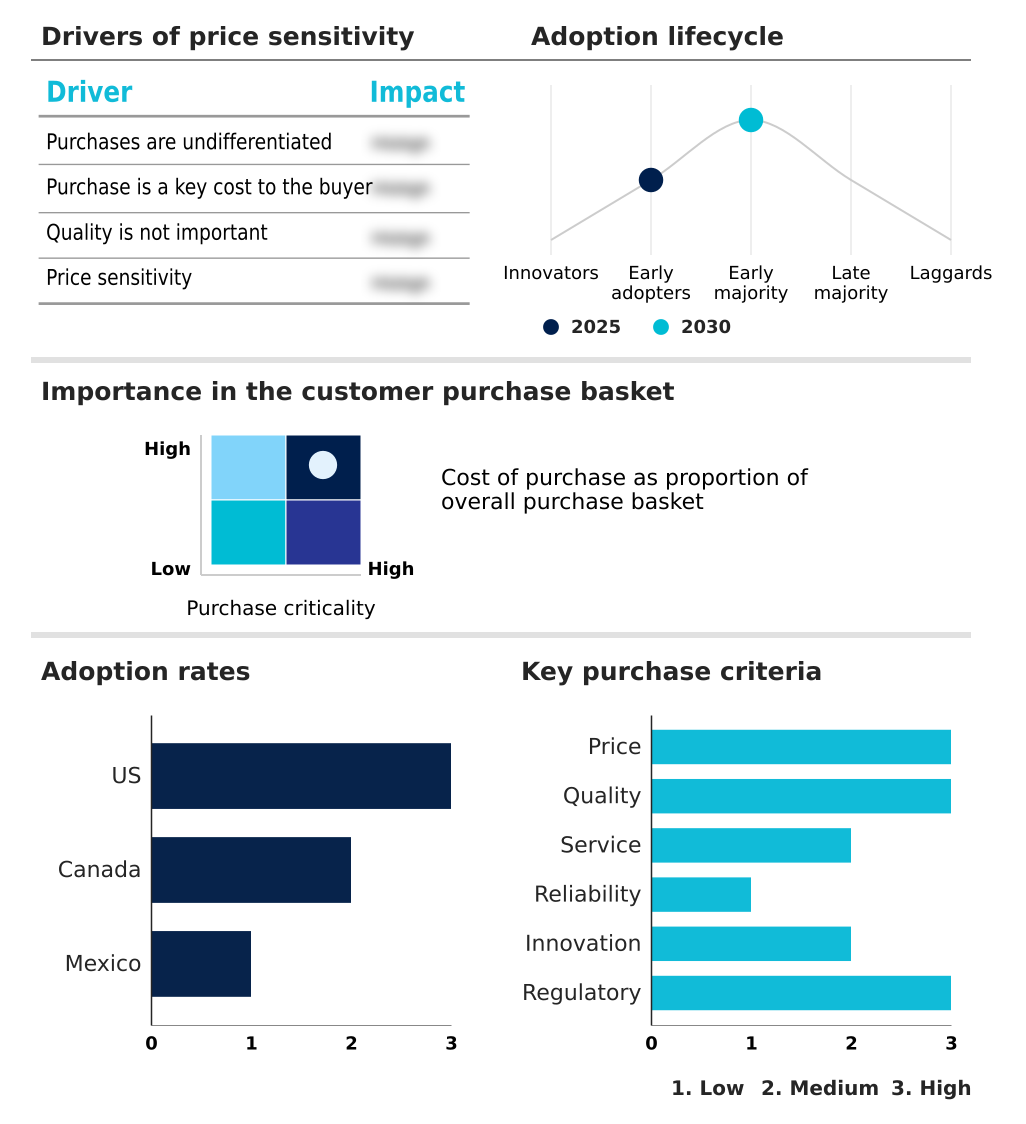
Customer Landscape of North America Road Freight Transportation Industry
Competitive Landscape
Companies are implementing various strategies, such as strategic alliances, north america road freight transportation market forecast, partnerships, mergers and acquisitions, geographical expansion, and product/service launches, to enhance their presence in the industry.
ArcBest Corp. - Provides integrated logistics through asset-based and asset-light models, focusing on LTL, supply chain solutions, and brokerage to optimize freight movement and network efficiency.
The industry research and growth report includes detailed analyses of the competitive landscape of the market and information about key companies, including:
- ArcBest Corp.
- Covenant Logistics Group
- CRST International Inc
- Estes Express Lines
- FedEx Corp.
- JB Hunt Transport Services
- Knight Swift Transportation
- Marten Transport Ltd.
- Old Dominion Freight Line
- PAM Transport Inc
- Penske Truck Leasing Co. L.P.
- Prime Inc.
- Ruan
- Ryder System Inc.
- Saia Inc.
- Schneider National Inc.
- TFI International Inc.
- United Parcel Service Inc.
- Werner Enterprises Inc.
- XPO Inc.
Qualitative and quantitative analysis of companies has been conducted to help clients understand the wider business environment as well as the strengths and weaknesses of key industry players. Data is qualitatively analyzed to categorize companies as pure play, category-focused, industry-focused, and diversified; it is quantitatively analyzed to categorize companies as dominant, leading, strong, tentative, and weak.
Recent Development and News in North america road freight transportation market
- In March, 2025, United Parcel Service Inc. introduced an advanced road freight services platform integrating centralized fleet management with AI-driven route optimization to enhance expedited delivery reliability.
- In January, 2025, an autonomous technology firm completed the first fully driverless commercial freight run between Dallas and Phoenix, marking a key transition from pilot testing to real-world operations.
- In November, 2024, DSV finalized its acquisition of DB Schenker, significantly expanding its tri-national brokerage and drayage capacity across the United States, Canada, and Mexico.
- In September, 2024, C.H. Robinson unveiled a bundled service package integrating freight consolidation in Mexico with bonded warehousing and AI-optimized delivery within the United States.
Dive into Technavio’s robust research methodology, blending expert interviews, extensive data synthesis, and validated models for unparalleled North America Road Freight Transportation Market insights. See full methodology.
| Market Scope | |
|---|---|
| Page number | 214 |
| Base year | 2025 |
| Historic period | 2020-2024 |
| Forecast period | 2026-2030 |
| Growth momentum & CAGR | Accelerate at a CAGR of 2.4% |
| Market growth 2026-2030 | USD 143.2 billion |
| Market structure | Fragmented |
| YoY growth 2025-2026(%) | 2.4% |
| Key countries | US, Canada and Mexico |
| Competitive landscape | Leading Companies, Market Positioning of Companies, Competitive Strategies, and Industry Risks |
Research Analyst Overview
- The road freight transportation market in North America is defined by a rigorous push toward technological and operational maturation. The sector is actively integrating advanced systems, from full truckload and less-than truckload carriers adopting digital freight matching to the deployment of light commercial vehicles for last-mile logistics. Fleet telematics and real-time visibility platforms are now standard for enhancing asset utilization.
- Boardroom decisions are increasingly focused on long-term sustainability, with investments in zero-emission fleets and megawatt-class charging infrastructure aligning with corporate ESG goals and creating a competitive advantage. This transition is supported by the adoption of predictive maintenance and dynamic routing to manage costs.
- The industrialization of autonomous freight corridors, utilizing automated driving systems and collision avoidance technology, addresses labor shortages and improves safety. Carriers are using load-matching algorithms and hub-and-spoke network designs for efficiency gains, while advancements in customs-clearance software streamline cross-border trade integration, with some systems reducing documentation errors by over 25%.
- This convergence of technologies, including heavy commercial vehicles and advanced tanker equipment, is creating a more resilient and efficient supply chain.
What are the Key Data Covered in this North America Road Freight Transportation Market Research and Growth Report?
-
What is the expected growth of the North America Road Freight Transportation Market between 2026 and 2030?
-
USD 143.2 billion, at a CAGR of 2.4%
-
-
What segmentation does the market report cover?
-
The report is segmented by Type (Full truckload, and Less-than truckload), Product Type (Solid goods, and Liquid goods), Vehicle Type (Light commercial vehicles, and Heavy commercial vehicles), Service Type (3PL, Express and parcel services, and Freight forwarding) and Geography (North America)
-
-
Which regions are analyzed in the report?
-
North America
-
-
What are the key growth drivers and market challenges?
-
Institutionalization of nearshoring and cross border trade integration, Structural labor scarcity and evolving demographic cliff
-
-
Who are the major players in the North America Road Freight Transportation Market?
-
ArcBest Corp., Covenant Logistics Group, CRST International Inc, Estes Express Lines, FedEx Corp., JB Hunt Transport Services, Knight Swift Transportation, Marten Transport Ltd., Old Dominion Freight Line, PAM Transport Inc, Penske Truck Leasing Co. L.P., Prime Inc., Ruan, Ryder System Inc., Saia Inc., Schneider National Inc., TFI International Inc., United Parcel Service Inc., Werner Enterprises Inc. and XPO Inc.
-
Market Research Insights
- The market's dynamics are increasingly defined by the pursuit of operational efficiency and supply chain resilience. Shippers navigating complex cross-border logistics due to nearshoring initiatives are leveraging advanced transportation management systems to improve on-time performance, with some achieving a 20% reduction in customs-related delays.
- The rise of e-commerce fulfillment has created intense logistics density in urban centers, compelling carriers to adopt multi-stop delivery route optimization software, which can increase deliveries per vehicle by over 15%. To manage yield management in a volatile market, firms are focusing on strategic border hubs and inventory optimization.
- This data-driven approach is critical for maintaining profitability amid challenges like infrastructure congestion and managing the total cost of ownership for modern fleets.
We can help! Our analysts can customize this north america road freight transportation market research report to meet your requirements.
 RIA -
RIA -