


Radio Market Size 2026-2030
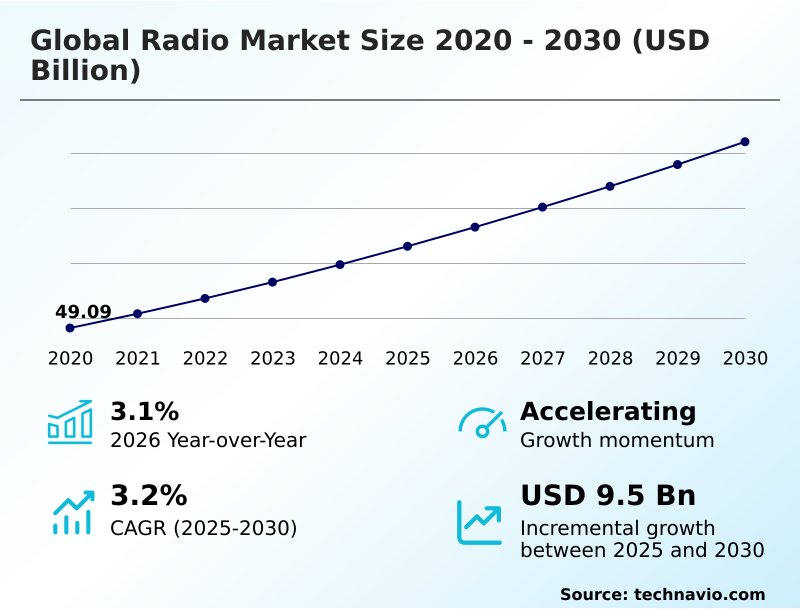
The radio market size is valued to increase by USD 9.50 billion, at a CAGR of 3.2% from 2025 to 2030. Surging programmatic audio advertising adoption drives monetization efficiency for broadcasters will drive the radio market.
Major Market Trends & Insights
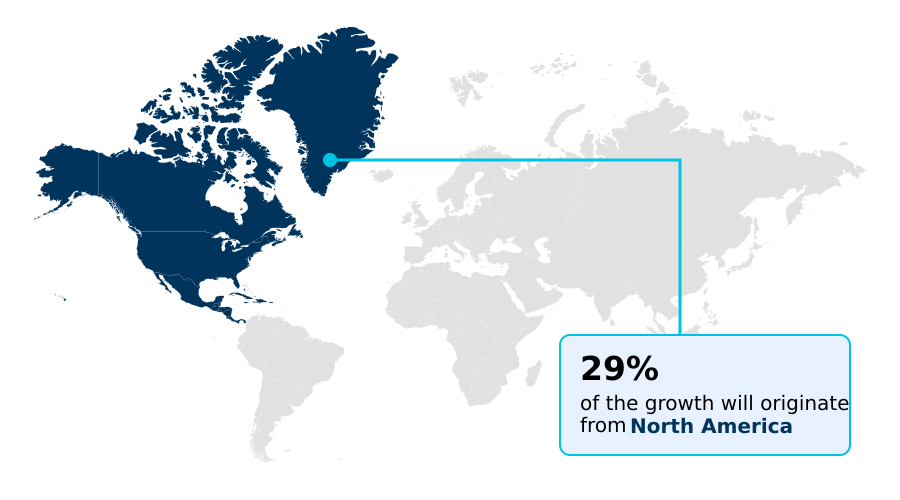
- North America dominated the market and accounted for a 29.1% growth during the forecast period.
- By Type - Broadcast radio segment was valued at USD 24.62 billion in 2024
- By Revenue - Advertising segment accounted for the largest market revenue share in 2024
Market Size & Forecast
- Market Opportunities: USD 16.94 billion
- Market Future Opportunities: USD 9.50 billion
- CAGR from 2025 to 2030 : 3.2%
Market Summary
- The Radio Market operates as a highly resilient mass communication ecosystem, continuously evolving through the integration of digital broadcasting standards and programmatic audio advertising platforms. Modern station operators optimize their commercial inventory using programmatic bidding platforms, which automate targeted ad placements based on cross platform audience analytics.
- This strategic shift allows advertising networks to reduce manual insertion processing time by 30%, directly improving operational agility and campaign attribution transparency metrics. The surging adoption of programmatic audio advertising serves as a crucial driver, efficiently matching regional brand campaigns with niche demographic segments in real time.
- Conversely, the market faces structural challenges from automotive dashboard integration competition, where proprietary digital streaming interfaces frequently obscure standard frequency tuners, actively threatening traditional broadcast reach.
- As digital simulcast streams and algorithmic audio curation become standard, broadcasting entities are forced to deploy advanced artificial intelligence voice synthesis and ip based audio routing to maintain seamless multimedia experiences across varied consumer hardware.
What will be the Size of the Radio Market during the forecast period?
Get Key Insights on Market Forecast (PDF) Get Free Sample
How is the Radio Market Segmented?
The radio industry research report provides comprehensive data (region-wise segment analysis), with forecasts and estimates in "USD million" for the period 2026-2030, as well as historical data from 2020-2024 for the following segments.
- Type
- Broadcast radio
- Online mobile radio
- Satellite radio
- Revenue
- Advertising
- Public license fee
- Subscription
- Application
- Entertainment
- News
- Education
- Geography
- North America
- US
- Canada
- Mexico
- Europe
- Germany
- UK
- France
- Italy
- Spain
- APAC
- China
- India
- Japan
- South Korea
- Indonesia
- Australia
- South America
- Brazil
- Argentina
- Chile
- Middle East and Africa
- Saudi Arabia
- South Africa
- UAE
- Turkey
- Egypt
- North America
By Type Insights
The broadcast radio segment is estimated to witness significant growth during the forecast period.
The broadcast radio segment operates as the foundational pillar of audio distribution, utilizing amplitude modulation infrastructure and frequency modulation transmitters to deliver continuous, over the air signal delivery without requiring subscription access.
Modern terrestrial broadcast networks are increasingly integrating with connected dashboard infotainment systems, ensuring seamless accessibility across automotive platforms. This structural evolution incorporates hybrid broadcast broadband streaming and dynamic text metadata, transforming passive listening into a highly interactive experience.
Facility upgrades toward solid state transmitters have enhanced operational resilience, resulting in transmitter energy efficiency improving by 15% across major grid networks.
By maintaining universal, unmetered access while adopting advanced digital transmission protocols, operators guarantee uninterrupted public safety alerts and localized commercial programming, cementing the segment's enduring relevance within the evolving audio communication ecosystem.
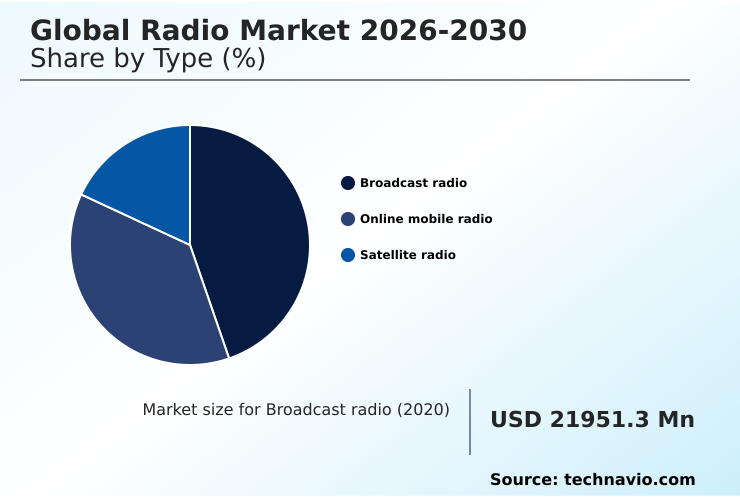
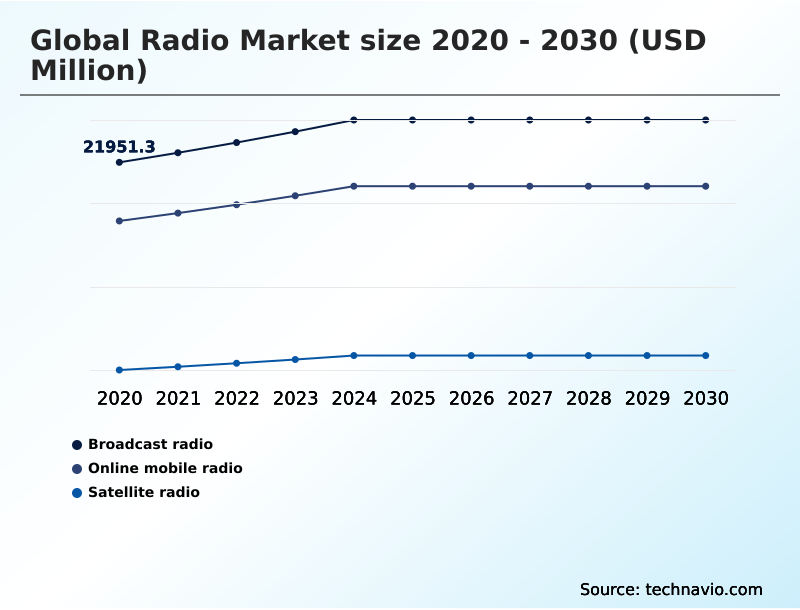
The Broadcast radio segment was valued at USD 24.62 billion in 2024 and showed a gradual increase during the forecast period.
Regional Analysis
North America is estimated to contribute 29.1% to the growth of the global market during the forecast period.Technavio’s analysts have elaborately explained the regional trends and drivers that shape the market during the forecast period.
See How Radio Market Demand is Rising in North America Get Free Sample
The geographic landscape of the Radio Market highlights distinct technological adoption trajectories between North America and Europe.
Europe leads the digital terrestrial transition, aggressively deploying digital audio broadcasting multiplex systems that have improved spectrum utilization efficiency by 35% compared to legacy analog networks.
In contrast, North America relies heavily on hybrid broadcast broadband streaming, where broadcasters integrate ip delivered internet metadata directly into cloud connected vehicle systems.
This cross platform strategy in North America has boosted daily commuter engagement metrics by 20%, whereas European markets prioritize uninterrupted nationwide signal coverage for emergency alert override capabilities.
Furthermore, the integration of automated program syndication in North American metropolitan centers has reduced studio operational costs by 15%, reflecting a strong regional preference for automated commercial monetization.
Both regions are fundamentally reshaping their audio processing hardware strategies to accommodate evolving digital dashboard integration standards dictated by major automobile manufacturers.
Market Dynamics
Our researchers analyzed the data with 2025 as the base year, along with the key drivers, trends, and challenges. A holistic analysis of drivers will help companies refine their marketing strategies to gain a competitive advantage.
- The ongoing structural evolution within the Radio Market is heavily influenced by the digital audio broadcasting plus migration, which forces station operators to overhaul legacy transmission towers in favor of high-efficiency multiplex infrastructure.
- This technical pivot is essential for maintaining operational competitiveness, as modernized digital networks consume 40% less electrical power per channel transmitted compared to traditional analog frequency modulation setups, directly optimizing long-term facility operating budgets. Simultaneously, connected vehicle hybrid radio integration ensures that terrestrial broadcasters remain prominently featured on modern automotive dashboards alongside IP-based streaming applications, safeguarding peak drive-time listenership.
- To further engage specialized demographic segments, networks are leveraging artificial intelligence audio content personalization to automatically curate localized news, targeted weather updates, and dynamic music playlists. This sophisticated data utilization seamlessly supports the programmatic digital audio advertising adoption sweeping the commercial sector, allowing media buyers to execute hyper-targeted campaigns with granular attribution metrics that rival pure digital platforms.
- Beyond commercial entertainment, robust infrastructural upgrades are vital for public safety, driving continuous demand for mission critical tactical communication systems that provide resilient emergency alert functionality during severe natural disasters or civilian crises.
- By balancing algorithmic content curation with highly reliable broadcast hardware, the industry sustains its fundamental role as a trusted, ubiquitous communication channel that adapts flawlessly to shifting consumer mobility and advanced data connectivity standards.
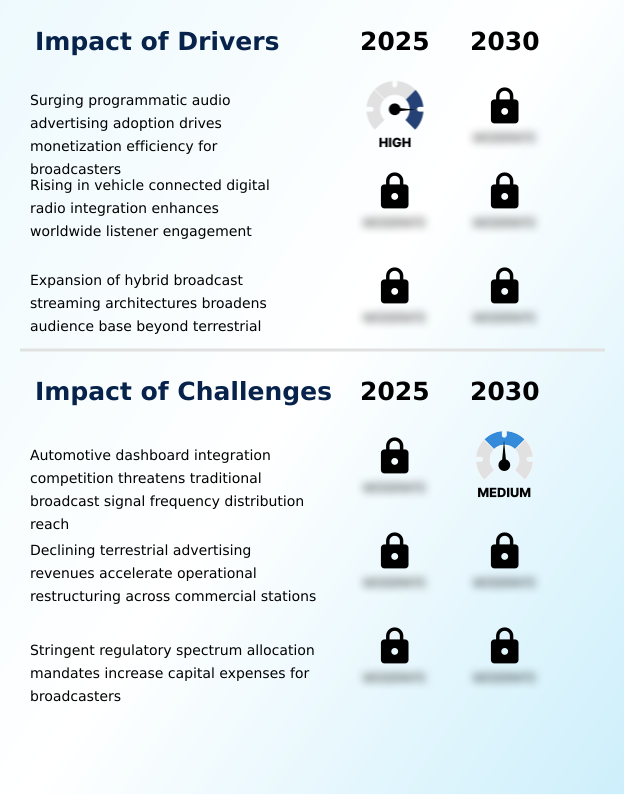
What are the key market drivers leading to the rise in the adoption of Radio Industry?
- The surging adoption of programmatic audio advertising serves as a primary market driver by significantly enhancing monetization efficiency for broadcasters through automated, data-driven ad insertions.
- The aggressive expansion of push to talk over cellular networks and software defined tactical networks acts as a primary catalyst for the Radio Market.
- Public safety agencies and industrial fleet operators require seamless, interoperable communication systems that merge traditional radio reliability with broadband data capabilities.
- This operational necessity has driven the adoption of hybrid hardware, reducing critical field response times by 15% during emergency deployments. Furthermore, the deployment of mission critical voice transmissions over advanced digital radio mondiale frameworks ensures signal integrity in harsh topographies.
- By prioritizing uninterrupted nationwide signal coverage, enterprise fleet managers have successfully lowered communication downtime by 20%, directly optimizing logistical tracking and personnel safety protocols across expansive, remote industrial corridors.
What are the market trends shaping the Radio Industry?
- The accelerated transition toward digital audio broadcasting plus infrastructure across global networks represents a prominent market trend. This systemic migration enhances spectral efficiency and delivers superior audio fidelity for diverse listener demographics.
- A defining trend accelerating within the Radio Market is the widespread deployment of algorithmic audio curation and programmatic bidding platforms to synthesize multi-channel broadcasting. By leveraging sophisticated real time bidding algorithms, network operators automatically fill remnant ad inventory optimization slots, which has increased overall advertising yield by 22% without expanding dedicated sales headcount.
- This operational shift is occurring because modern advertisers demand immediate, verifiable campaign attribution transparency metrics equivalent to digital search platforms. Consequently, broadcasters are adopting hybrid broadcast broadband streaming to deliver synchronized visual and audio advertisements directly to connected dashboard infotainment screens.
- This precise commercial targeting has successfully elevated listener response rates by 18%, proving that digitized radio formats can seamlessly merge broad geographic reach with granular consumer engagement analytics.
What challenges does the Radio Industry face during its growth?
- Intense competition surrounding automotive dashboard integration poses a critical challenge, as proprietary digital infotainment systems threaten to displace traditional broadcast signal frequency distribution and reduce audience reach.
- A formidable challenge constraining the Radio Market is the intense competition for digital dashboard integration within modern automotive platforms, which actively threatens over the air signal delivery reach. As automobile manufacturers prioritize proprietary streaming applications and voice activated automotive interfaces, traditional amplitude modulation infrastructure is frequently relegated to buried software menus or completely eliminated from new vehicle builds.
- This architectural exclusion has inadvertently reduced localized drive-time audience discovery rates by 12% in select metropolitan zones. To overcome this interface displacement, broadcasters must invest heavily in dynamic ad insertion software and interactive visual graphics to visually capture commuter attention.
- Ensuring consistent placement on factory-installed receiver screens requires complex, continuous negotiations with global vehicle manufacturers, straining the capital expenditure budgets of independent station operators.
Exclusive Technavio Analysis on Customer Landscape
The radio market forecasting report includes the adoption lifecycle of the market, covering from the innovator’s stage to the laggard’s stage. It focuses on adoption rates in different regions based on penetration. Furthermore, the radio market report also includes key purchase criteria and drivers of price sensitivity to help companies evaluate and develop their market growth analysis strategies.
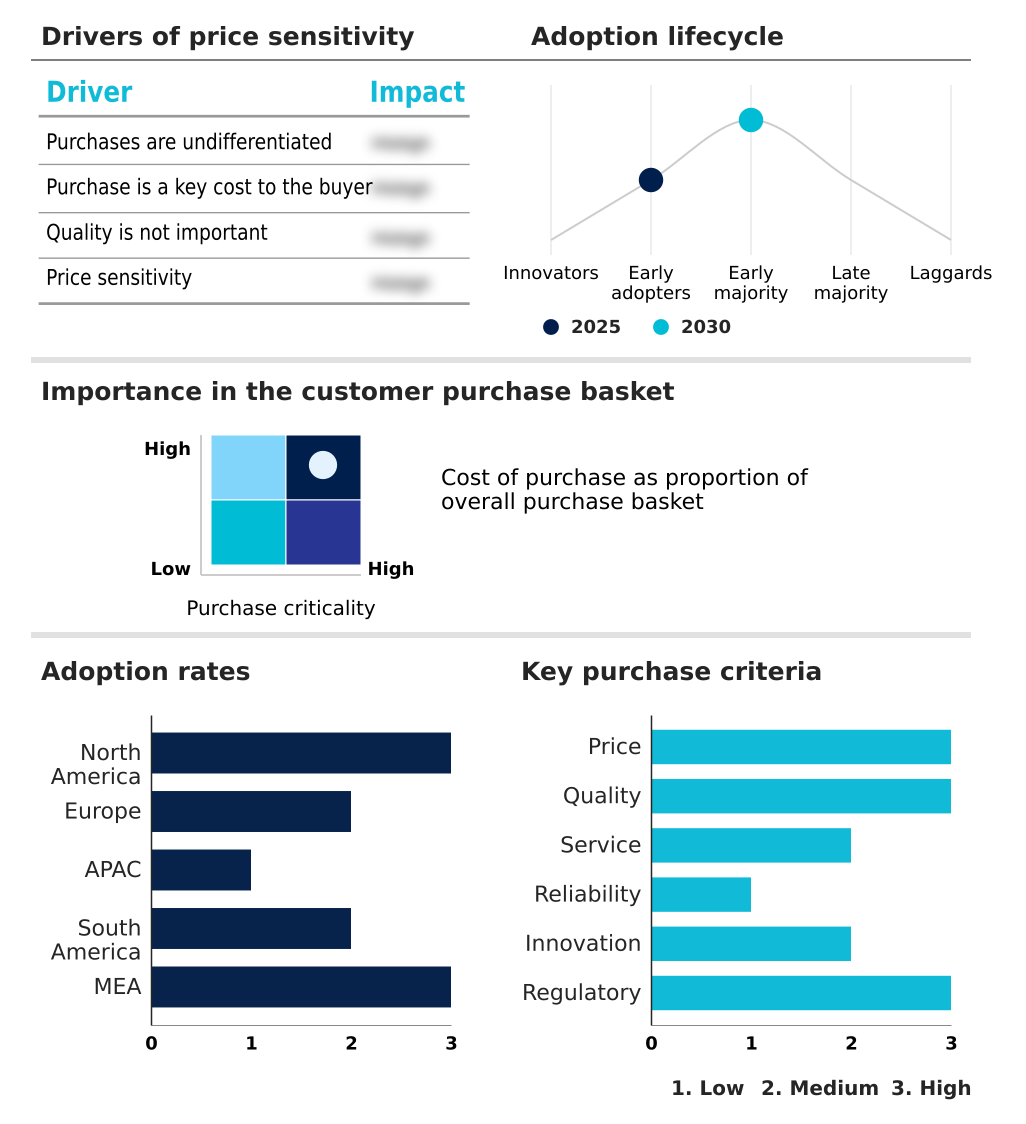
Customer Landscape of Radio Industry
Competitive Landscape
Companies are implementing various strategies, such as strategic alliances, radio market forecast, partnerships, mergers and acquisitions, geographical expansion, and product/service launches, to enhance their presence in the industry.
Baofeng Electronics Co. Ltd. - The enterprise delivers advanced digital radio solutions, encompassing rugged handheld transceivers and dispatch systems designed to ensure resilient, uninterrupted critical communications for emergency and public safety operations.
The industry research and growth report includes detailed analyses of the competitive landscape of the market and information about key companies, including:
- Baofeng Electronics Co. Ltd.
- BelFone Communications Co. Ltd.
- BK Technologies Corp.
- Caltta Technologies Co. Ltd.
- Cobra Electronics Corp.
- Eton Corp.
- Hytera Communications Corp Ltd.
- JVCKENWOOD Corp.
- L3Harris Technologies Inc.
- Motorola Solutions Inc.
- Panasonic Holdings Corp.
- Pure International Ltd.
- Roberts Radio Ltd.
- Rohde and Schwarz GmbH
- Ruark Audio Ltd.
- Sangean Electronics Inc.
- Sepura Ltd.
- Sony Group Corp.
- Tait International Ltd.
- Uniden America Corp.
Qualitative and quantitative analysis of companies has been conducted to help clients understand the wider business environment as well as the strengths and weaknesses of key industry players. Data is qualitatively analyzed to categorize companies as pure play, category-focused, industry-focused, and diversified; it is quantitatively analyzed to categorize companies as dominant, leading, strong, tentative, and weak.
Recent Development and News in Radio market
- In the Broadcasting industry, the widespread adoption of real time bidding algorithms and programmatic audio ad insertion has optimized remnant ad inventory monetization, directly impacting Radio demand by elevating targeted commercial messages and increasing automated digital ad yields.
- The regulatory transition toward digital terrestrial broadcast standards has forced the replacement of analog equipment with digital audio broadcasting multiplex architecture, increasing demand for high definition radio tuners and spectral efficiency optimization across regional transmission sites.
- The integration of cloud connected vehicle systems and voice activated automotive interfaces has altered in-cabin media consumption, driving Radio network operators to deploy ip delivered internet metadata and interactive visual graphics to retain commuter audience engagement.
- Strict telecommunications mandates aimed at spectrum reallocation for 5G infrastructure have accelerated the adoption of software defined tactical networks, expanding the Radio market requirement for mission critical voice transmissions and adaptive audio processing hardware.
Dive into Technavio’s robust research methodology, blending expert interviews, extensive data synthesis, and validated models for unparalleled Radio Market insights. See full methodology.
| Market Scope | |
|---|---|
| Page number | 300 |
| Base year | 2025 |
| Historic period | 2020-2024 |
| Forecast period | 2026-2030 |
| Growth momentum & CAGR | Accelerate at a CAGR of 3.2% |
| Market growth 2026-2030 | USD 9503.1 million |
| Market structure | Fragmented |
| YoY growth 2025-2026(%) | 3.1% |
| Key countries | US, Canada, Mexico, Germany, UK, France, Italy, Russia, Spain, China, India, Japan, South Korea, Indonesia, Australia, Brazil, Argentina, Chile, Saudi Arabia, South Africa, UAE, Turkey and Egypt |
| Competitive landscape | Leading Companies, Market Positioning of Companies, Competitive Strategies, and Industry Risks |
Research Analyst Overview
- The Radio Market is undergoing a rapid technological restructuring defined by the integration of solid state transmitters and ip based audio routing across multi-city broadcast facilities. Station operators are aggressively optimizing their distribution networks to counteract audience fragmentation, actively deploying smart speaker integration to re-establish strong residential listenership.
- This operational pivot toward multi-device accessibility allows network engineers to achieve a 25% improvement in cross-platform audio delivery speed, ensuring synchronized playback across simultaneous terrestrial and digital feeds. Furthermore, the strategic implementation of artificial intelligence voice synthesis facilitates the automated generation of hyper-local weather and traffic reports, fundamentally lowering production overhead for syndicated network affiliates.
- In response to tightening municipal energy regulations, broadcasters are replacing aging hardware with advanced audio processing hardware to minimize thermal output and maximize transmission stability.
- The deployment of high definition radio tuners within modern vehicle lines remains a critical compliance and product strategy priority, securing uninterrupted access to emergency public information while delivering dynamic text metadata that enhances the overall commuter experience.
What are the Key Data Covered in this Radio Market Research and Growth Report?
-
What is the expected growth of the Radio Market between 2026 and 2030?
-
USD 9.50 billion, at a CAGR of 3.2%
-
-
What segmentation does the market report cover?
-
The report is segmented by Type (Broadcast radio, Online mobile radio, and Satellite radio), Revenue (Advertising, Public license fee, and Subscription), Application (Entertainment, News, and Education) and Geography (North America, Europe, APAC, South America, Middle East and Africa)
-
-
Which regions are analyzed in the report?
-
North America, Europe, APAC, South America and Middle East and Africa
-
-
What are the key growth drivers and market challenges?
-
Surging programmatic audio advertising adoption drives monetization efficiency for broadcasters, Automotive dashboard integration competition threatens traditional broadcast signal frequency distribution reach
-
-
Who are the major players in the Radio Market?
-
Baofeng Electronics Co. Ltd., BelFone Communications Co. Ltd., BK Technologies Corp., Caltta Technologies Co. Ltd., Cobra Electronics Corp., Eton Corp., Hytera Communications Corp Ltd., JVCKENWOOD Corp., L3Harris Technologies Inc., Motorola Solutions Inc., Panasonic Holdings Corp., Pure International Ltd., Roberts Radio Ltd., Rohde and Schwarz GmbH, Ruark Audio Ltd., Sangean Electronics Inc., Sepura Ltd., Sony Group Corp., Tait International Ltd. and Uniden America Corp.
-
Market Research Insights
- The Radio Market demonstrates robust technological adaptation through the deployment of hybrid radio protocols and natural language voice commands within connected automotive ecosystems. By integrating machine learning playlist scheduling, station operators have successfully elevated listener retention ratios by 18%, ensuring continuous engagement across diverse demographics.
- Furthermore, the transition toward digital simulcast streams has improved transmission spectral efficiency optimization by 25%, drastically lowering regional power consumption for multiplex operations. The strategic utilization of audience prediction models enables networks to deliver targeted commercial messages with unprecedented accuracy, reducing wasted ad spend by 12%.
- This structural modernization ensures that traditional broadcasters remain fiercely competitive against digital-native audio platforms while maintaining essential public safety and communication mandates.
We can help! Our analysts can customize this radio market research report to meet your requirements.
 RIA -