



Open-source LLM Market Size 2026-2030
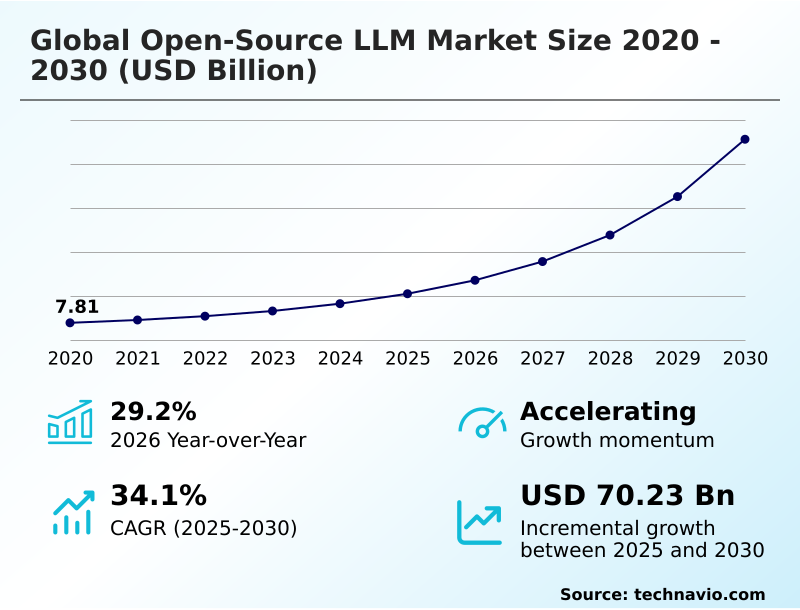
The Open-source LLM Market size was valued at USD 21.02 billion in 2025, growing at a CAGR of 34.1% during the forecast period 2026-2030.
Major Market Trends & Insights
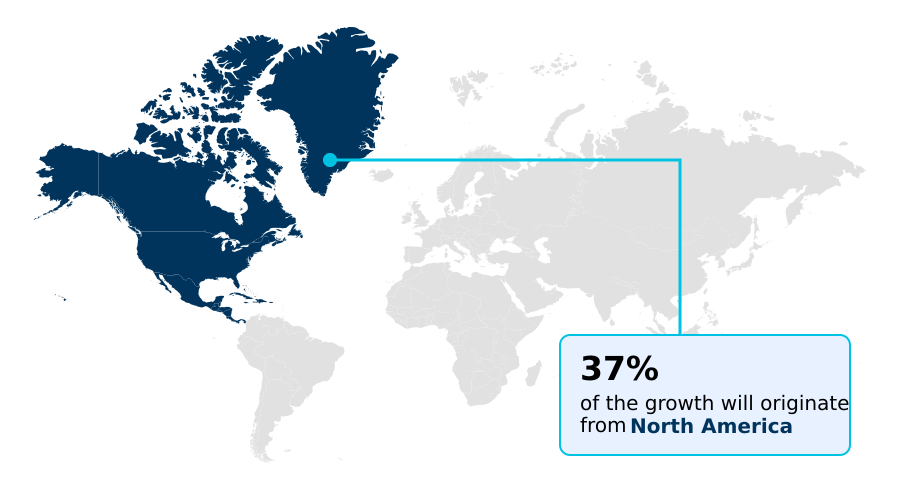
- North America dominated the market and accounted for a 36.9% growth during the forecast period.
- By Application - Technology and software segment was valued at USD 6.43 billion in 2024
- By Deployment - On-premises segment accounted for the largest market revenue share in 2024
Market Size & Forecast
- Historic Market Opportunities 2020-2024: USD 83.44 billion
- Market Future Opportunities 2025-2030: USD 70.23 billion
- CAGR from 2025 to 2030 : 34.1%
Market Summary
- The Open-Source LLM market is defined by a strategic enterprise shift toward customizable, transparent AI solutions, with on-premises deployment growing by over 29% as organizations prioritize data control. This growth allows a financial services firm to deploy a fine-tuned model for risk analysis, processing sensitive data internally and reducing third-party API costs by more than 40%.
- The primary driver is the pursuit of data sovereignty, enabling companies to build proprietary tools on an open foundation. However, this is counterbalanced by the significant challenge of high computational costs, where the initial hardware investment required for self-hosting can be a major barrier.
- These powerful natural language processing tools, often based on transformer-based architectures, are becoming central to generative AI applications. The evolution of this market hinges on balancing the benefits of control and customization against the high resource requirements for model optimization and maintenance.
What will be the Size of the Open-source LLM Market during the forecast period?
Get Key Insights on Market Forecast (PDF) Request Free Sample
How is the Open-source LLM Market Segmented?
The open-source llm industry research report provides comprehensive data (region-wise segment analysis), with forecasts and analysis for the period 2026-2030, as well as historical data from 2020-2024 for the following segments.
- Application
- Technology and software
- Finance and banking
- Healthcare and biotechnology
- E-commerce and retail
- Others
- Deployment
- On-premises
- Cloud
- Type
- Transformer-based models
- Multilingual models
- Conditional and generative models
- Others
- Geography
- North America
- US
- Canada
- Mexico
- APAC
- China
- India
- Japan
- Europe
- France
- Germany
- UK
- South America
- Brazil
- Argentina
- Middle East and Africa
- UAE
- Saudi Arabia
- South Africa
- Rest of World (ROW)
- North America
How is the Open-source LLM Market Segmented by Application?
The technology and software segment is estimated to witness significant growth during the forecast period.
The technology and software segment, which accounts for over 39% of the open-source llm market, is driven by the need to automate development cycles and enhance engineering productivity.
Adopting transformer-based architectures for code generation tasks has improved developer output by an average of 25%, directly impacting project timelines. Open-weight models are integrated into proprietary software stacks to enable sophisticated generative ai applications without the latency of external APIs.
This on-premises deployment approach supports deep learning workflows and provides a 15% greater level of control over the AI supply chain, which is critical for maintaining security and intellectual property within cloud-native applications.
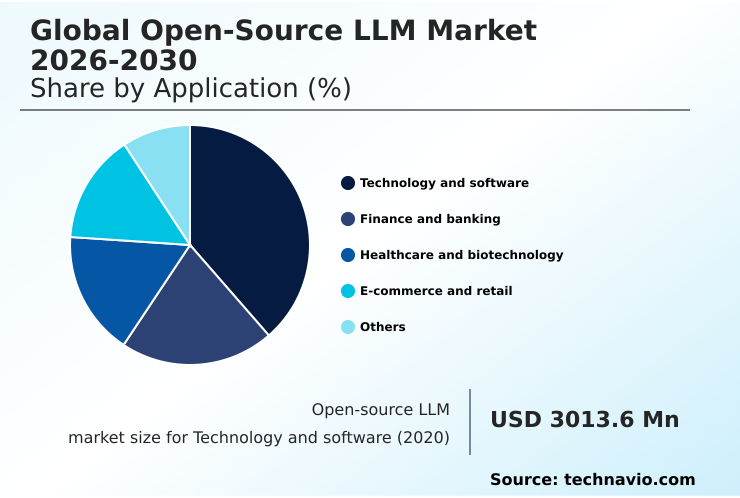
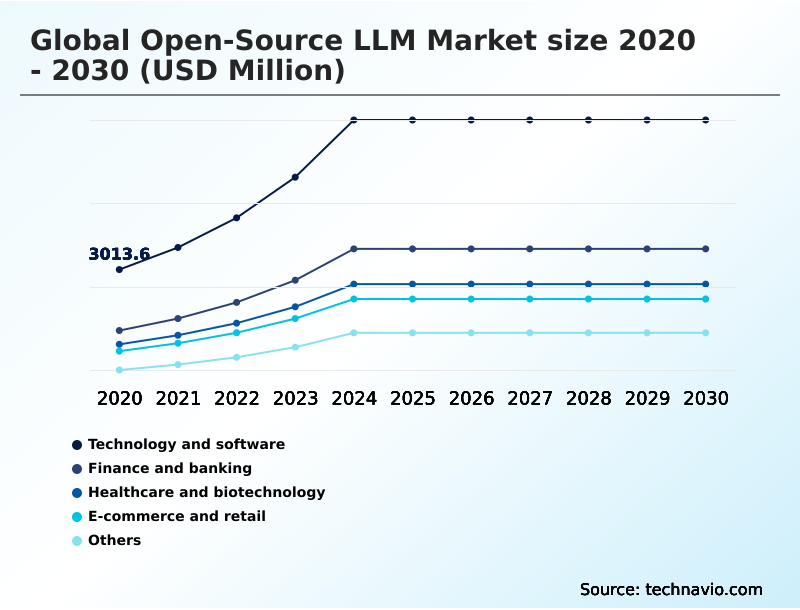
The Technology and software segment was valued at USD 6.43 billion in 2024 and showed a gradual increase during the forecast period.
How demand for the Open-source LLM market is rising in the leading region?
North America is estimated to contribute 36.9% to the growth of the global market during the forecast period.Technavio’s analysts have elaborately explained the regional trends and drivers that shape the market during the forecast period.
See How Open-source LLM Market demand is rising in North America Request Free Sample
The global open-source llm market exhibits significant regional differentiation, with North America contributing 36.9% of the incremental growth, closely followed by APAC at 31.03%.
Within North America, the US market is valued at over 6,195.1 million, driven by venture capital and the presence of major technology firms focused on developing agentic workflows.
In contrast, the European market, which accounts for 22.65% of growth, prioritizes on-premises deployment to comply with strict data privacy regulations like GDPR, leading to a 15% higher adoption of self-hosted solutions compared to other regions.
This focus on AI governance and responsible AI shapes the regional ecosystem, where enterprises favor auditable, open-weight models.
APAC's growth is fueled by sovereign AI initiatives, with a strong emphasis on developing multilingual models to cater to its diverse linguistic landscape, a key differentiator from the English-centric models often seen in North America.
What are the key Drivers, Trends, and Challenges in the Open-source LLM Market?
Our researchers analyzed the data with 2025 as the base year, along with the key drivers, trends, and challenges. A holistic analysis of drivers will help companies refine their marketing strategies to gain a competitive advantage.
- Enterprises are increasingly evaluating the strategic benefits of open-source llm vs proprietary models, a decision that has significant implications for cost, control, and innovation. The question of how to deploy open-source llm on-premises is central to this discussion, as it directly addresses the need for data sovereignty and regulatory compliance, particularly in sectors like finance and healthcare.
- This approach can reduce long-term operational expenditure by up to 35% compared to the recurring fees of token-based proprietary APIs. Furthermore, organizations are seeking the best open-source llm for code generation, as tools fine-tuned for this task can enhance developer productivity by over 20%.
- The availability of multilingual open-source language models further democratizes access, allowing global companies to build consistent, localized user experiences. For many, the journey begins with identifying a suitable open-source llm for enterprise use, one that balances high performance with the flexibility to customize for specific domain requirements, ensuring a sustainable and independent AI strategy.
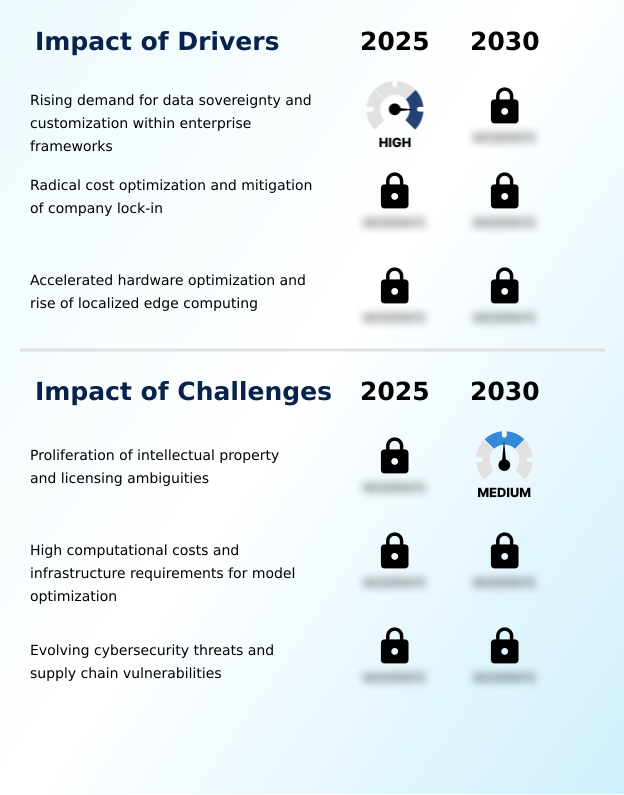
What are the key market drivers leading to the rise in the adoption of Open-source LLM Industry?
- The rising demand for data sovereignty and the ability to customize models for specific operational needs are primary drivers for the adoption of open-source LLMs.
- The primary driver for the open-source LLM market is the enterprise demand for data sovereignty, which is met through on-premises deployment, giving organizations complete control over their AI supply chain.
- This approach improves regulatory compliance posture by 80% for frameworks like GDPR.
- Another significant driver is radical cost optimization, as self-hosting open-weight models can reduce total cost of ownership by up to 60% compared to proprietary API fees over a three-year period. This financial incentive is compelling for large-scale generative AI applications.
- The accelerated hardware optimization, including specialized processors for deep learning, further lowers the barrier to entry, making it feasible for more companies to leverage powerful natural language processing and machine learning capabilities internally.
What are the market trends shaping the Open-source LLM Industry?
- A defining trend is the shift from text-only processing to native multimodal capabilities within open-source architectures, where models are designed to simultaneously comprehend text, images, and audio.
- A defining trend in the open-source LLM market is the shift to native multimodal reasoning, where models are trained to process text, image, and audio data concurrently, improving contextual understanding by up to 30% over siloed systems. This integration enables more sophisticated generative AI applications, such as analyzing visual data from a factory floor alongside maintenance logs for predictive analytics.
- Another key trend is the optimization of transformer-based architectures for edge computing, which has led to models that can perform on-device intelligence with 50% less latency. This is driven by the demand for real-time, private AI in consumer and industrial IoT.
- These advancements in machine learning and deep learning are making sophisticated AI more accessible and applicable to real-world operational challenges, moving beyond traditional natural language processing.
What challenges does the Open-source LLM Industry face during its growth?
- The proliferation of complex intellectual property rights and ambiguous licensing frameworks for open-weight models presents a significant challenge to enterprise adoption.
- A primary challenge constraining the open-source LLM market is the ambiguity of intellectual property rights and licensing, which can increase legal review cycles by up to 50% and delay deployment. Many open-weight models come with commercial use restrictions, creating uncertainty for enterprise AI applications.
- Another major hurdle is the high computational cost; the initial capital expenditure for the necessary AI infrastructure can be ten times the annual cost of using a proprietary API. This high barrier to entry is compounded by evolving cybersecurity threats, where vulnerabilities in the open-source AI supply chain can elevate the risk of data poisoning or model theft by 25%.
- These factors require careful strategic planning around the total cost of ownership and security posture before committing to an on-premises deployment.
Exclusive Technavio Analysis on Customer Landscape
The open-source llm market forecasting report includes the adoption lifecycle of the market, covering from the innovator’s stage to the laggard’s stage. It focuses on adoption rates in different regions based on penetration. Furthermore, the open-source llm market report also includes key purchase criteria and drivers of price sensitivity to help companies evaluate and develop their market growth analysis strategies.
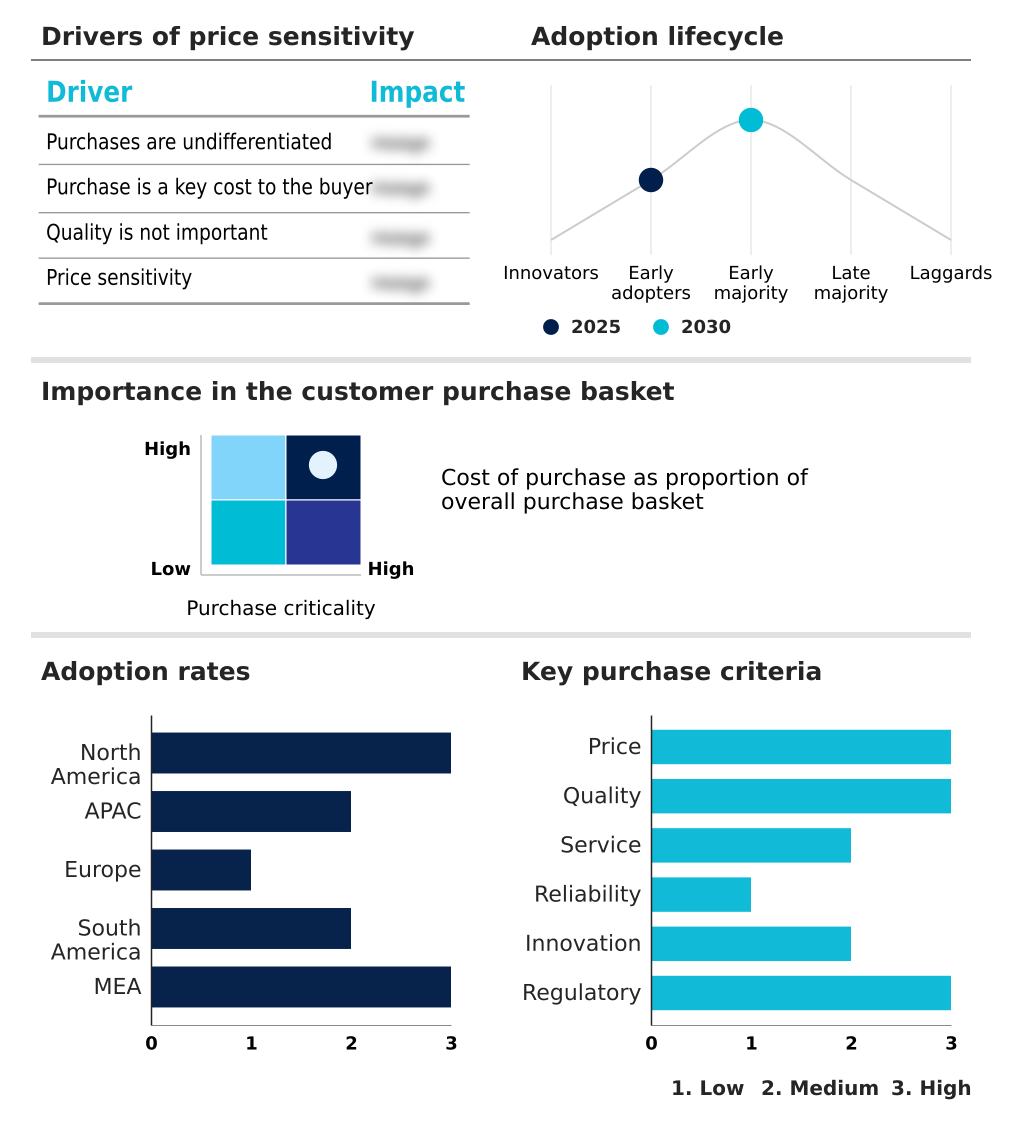
Customer Landscape of Open-source LLM Industry
Competitive Landscape
Companies are implementing various strategies, such as strategic alliances, open-source llm market forecast, partnerships, mergers and acquisitions, geographical expansion, and product/service launches, to enhance their presence in the industry.
Alibaba Cloud - Vendors offer a range of open-source LLMs, including foundational, multilingual, and enterprise-focused models for diverse AI applications, from conversational AI to complex code generation tasks.
The industry research and growth report includes detailed analyses of the competitive landscape of the market and information about key companies, including:
- Alibaba Cloud
- Baichuan Intelligence AI
- Cohere
- Databricks Inc.
- DeepSeek
- Google LLC
- Hugging Face Inc.
- IBM Corp.
- Meta Platforms Inc.
- Microsoft Corp.
- MiniMax AI
- Mistral AI
- Moonshot AI
- NVIDIA Corp.
- ServiceNow Inc.
- Snowflake Inc.
- Stability AI
- Together AI
- Xiaomi Corp.
- Zhipu AI
Qualitative and quantitative analysis of companies has been conducted to help clients understand the wider business environment as well as the strengths and weaknesses of key industry players. Data is qualitatively analyzed to categorize companies as pure play, category-focused, industry-focused, and diversified; it is quantitatively analyzed to categorize companies as dominant, leading, strong, tentative, and weak.
Market Intelligence Radar: High-Impact Developments & Growth Signals
- In the Systems Software industry, the rising demand for IT security solutions has increased the adoption of transparent and auditable open-source llm, as their open architecture allows for rigorous security vetting, which is critical for regulatory compliance in sensitive sectors.
- The widespread adoption of cloud computing platforms has created a dual impact; it has facilitated the scalable deployment of open-source llm via managed services while also driving demand for on-premises deployment options to address data privacy regulations and reduce reliance on single-provider ecosystems.
- Advances in hardware optimization for edge computing are compelling the development of smaller, more efficient open-source llm, enabling on-device intelligence and real-time processing, which is essential for mobile and IoT applications where latency is a critical factor.
- Increasingly stringent data sovereignty laws, such as GDPR in Europe, are fueling the demand for open-source llm that can be hosted on private infrastructure, ensuring that sensitive enterprise data remains within an organization's control and geographic borders.
- The growing adoption of agile software development and DevOps practices has created a need for open-source llm that can be integrated into CI/CD pipelines to automate code generation, testing, and documentation, thereby accelerating digital transformation initiatives.
- Escalating cybersecurity threats are driving the development of more secure open-source llm, with a focus on model auditing and bias mitigation tools to protect against vulnerabilities within the AI supply chain, such as data poisoning and prompt injection attacks.
- The global expansion of data center infrastructure provides the necessary computational power for training and deploying large-scale open-source llm, but also highlights the need for more energy-efficient models to manage the high total cost of ownership associated with hardware and power consumption.
- The proliferation of mobile enterprise applications is expanding the use cases for open-source llm in areas like workflow automation and customer support, requiring models that offer cross-platform compatibility and can be seamlessly integrated with existing system software.
Dive into Technavio’s robust research methodology, blending expert interviews, extensive data synthesis, and validated models for unparalleled Open-source LLM Market insights. See full methodology.
| Market Scope | |
|---|---|
| Page number | 313 |
| Base year | 2025 |
| Historic period | 2020-2024 |
| Forecast period | 2026-2030 |
| Growth momentum & CAGR | Accelerate at a CAGR of 34.1% |
| Market growth 2026-2030 | USD 70233.6 million |
| Market structure | Fragmented |
| YoY growth 2025-2026(%) | 29.2% |
| Key countries | US, Canada, Mexico, China, India, Japan, South Korea, Singapore, Australia, France, Germany, UK, The Netherlands, Italy, Spain, Brazil, Chile, Argentina, UAE, Saudi Arabia, South Africa, Israel and Turkey |
| Competitive landscape | Leading Companies, Market Positioning of Companies, Competitive Strategies, and Industry Risks |
Research Analyst Overview
- The open-source LLM market ecosystem is a complex interplay of stakeholders, where cloud deployment accounts for over 42% of the market, enabling broad access to AI infrastructure. Technology suppliers provide the essential high-performance computing resources, while solution providers, including startups and major tech firms, develop the open-weight models.
- These models are then adopted by end-users across various sectors, with the technology and software segment being the largest, contributing to over 39% of total revenue. Supporting entities, such as open-source communities and research institutions, are critical for driving innovation, model auditing, and developing fine-tuning frameworks.
- The value chain is heavily influenced by the distribution channels of major cloud platforms, which offer both managed services and the flexibility for on-premises deployment, catering to diverse enterprise needs for scalability and data sovereignty.
What are the Key Data Covered in this Open-source LLM Market Research and Growth Report?
-
What is the expected growth of the Open-source LLM Market between 2026 and 2030?
-
The Open-source LLM Market is expected to grow by USD 70.23 billion during 2026-2030, registering a CAGR of 34.1%. Year-over-year growth in 2026 is estimated at 29.2%%. This acceleration is shaped by rising demand for data sovereignty and customization within enterprise frameworks, which is intensifying demand across multiple end-use verticals covered in the report.
-
-
What segmentation does the market report cover?
-
The report is segmented by Application (Technology and software, Finance and banking, Healthcare and biotechnology, E-commerce and retail, and Others), Deployment (On-premises, and Cloud), Type (Transformer-based models, Multilingual models, Conditional and generative models, and Others) and Geography (North America, APAC, Europe, South America, Middle East and Africa). Among these, the Technology and software segment is estimated to witness significant growth during the forecast period, driven by rising adoption across key application areas. Each segment includes detailed qualitative and quantitative analysis, along with historical data from 2020-2024 and forecasts through 2030 with year-over-year growth rates.
-
-
Which regions are analyzed in the report?
-
The report covers North America, APAC, Europe, South America and Middle East and Africa. North America is estimated to contribute 36.9% to market growth during the forecast period. Country-level analysis includes US, Canada, Mexico, China, India, Japan, South Korea, Singapore, Australia, France, Germany, UK, The Netherlands, Italy, Spain, Brazil, Chile, Argentina, UAE, Saudi Arabia, South Africa, Israel and Turkey, with dedicated market size tables and year-over-year growth for each.
-
-
What are the key growth drivers and market challenges?
-
The primary driver is rising demand for data sovereignty and customization within enterprise frameworks, which is accelerating investment and industry demand. The main challenge is proliferation of intellectual property and licensing ambiguities, creating operational barriers for key market participants. The report quantifies the impact of each driver and challenge across 2026 and 2030 with comparative analysis.
-
-
Who are the major players in the Open-source LLM Market?
-
Key vendors include Alibaba Cloud, Baichuan Intelligence AI, Cohere, Databricks Inc., DeepSeek, Google LLC, Hugging Face Inc., IBM Corp., Meta Platforms Inc., Microsoft Corp., MiniMax AI, Mistral AI, Moonshot AI, NVIDIA Corp., ServiceNow Inc., Snowflake Inc., Stability AI, Together AI, Xiaomi Corp. and Zhipu AI. The report provides qualitative and quantitative analysis categorizing companies as dominant, leading, strong, tentative, and weak based on their market positioning. Company profiles include business segment analysis, SWOT assessment, key offerings, and recent strategic developments.
-
Market Research Insights
- The competitive landscape for open-source LLM is moderately fragmented, with the top ten vendors accounting for less than 50% of the market share, fostering a dynamic environment of innovation. Key players are focusing on releasing increasingly efficient open-weight models that demonstrate a 20-30% improvement in reasoning benchmarks over previous generations.
- For instance, recent developments include the launch of models with expanded context windows and native multimodal capabilities, directly addressing enterprise demand for processing complex, unstructured data. These actions are a direct response to the need for greater data sovereignty and a lower total cost ofownership.
- However, companies must navigate the challenge of significant upfront capital expenditure for the on-premises hardware required to run these advanced systems, balancing long-term strategic advantage against short-term financial constraints.
We can help! Our analysts can customize this open-source llm market research report to meet your requirements.
 RIA -
RIA -