



Online Language Learning Market Size 2026-2030
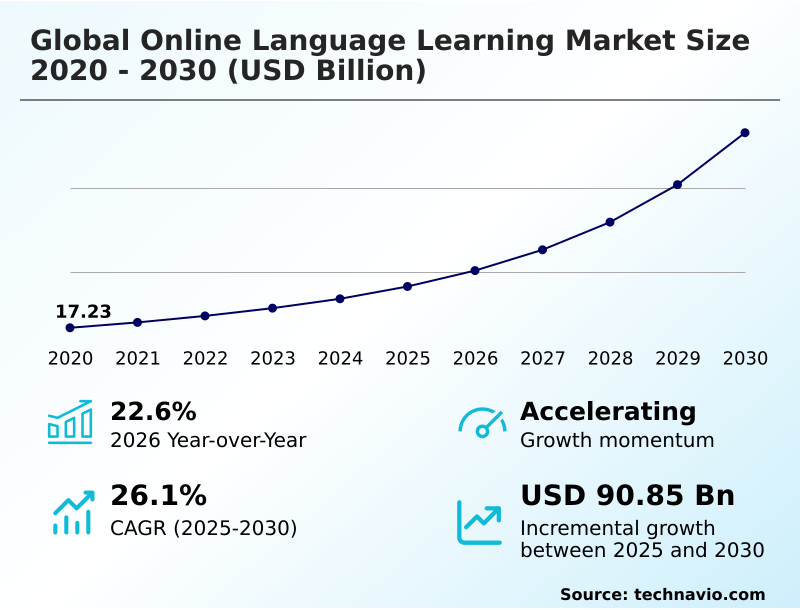
The online language learning market size is valued to increase by USD 90.85 billion, at a CAGR of 26.1% from 2025 to 2030. Rising demand for multilingual communication skills will drive the online language learning market.
Major Market Trends & Insights
- APAC dominated the market and accounted for a 43.1% growth during the forecast period.
- By End-user - Courses segment was valued at USD 15.11 billion in 2024
- By Language - English segment accounted for the largest market revenue share in 2024
Market Size & Forecast
- Market Opportunities: USD 115.25 billion
- Market Future Opportunities: USD 90.85 billion
- CAGR from 2025 to 2030 : 26.1%
Market Summary
- The online language learning market is undergoing a significant transformation, driven by the convergence of globalization and technological innovation. The increasing need for cross-border communication in corporate environments has made language proficiency a critical asset, fueling demand for flexible and accessible educational platforms.
- These platforms leverage advanced technologies like AI-powered tutoring and natural language processing to offer personalized learning paths that adapt to individual user performance, a stark contrast to traditional one-size-fits-all methods. Trends such as gamification and immersive learning through virtual reality are enhancing user engagement and retention.
- A common business scenario involves multinational corporations deploying corporate language training solutions to upskill their global teams, ensuring seamless collaboration across different regions and improving operational efficiency by over 20%. However, the market also faces challenges related to maintaining learner motivation and ensuring consistent quality and accreditation across a fragmented landscape of providers.
- The integration of speech recognition technology and real-time feedback mechanisms is crucial for developing practical conversational skills and building learner confidence.
What will be the Size of the Online Language Learning Market during the forecast period?
Get Key Insights on Market Forecast (PDF) Request Free Sample
How is the Online Language Learning Market Segmented?
The online language learning industry research report provides comprehensive data (region-wise segment analysis), with forecasts and estimates in "USD million" for the period 2026-2030, as well as historical data from 2020-2024 for the following segments.
- End-user
- Courses
- Solutions
- Apps
- Language
- English
- Mandarin
- Spanish
- Others
- Deployment
- Cloud-based
- On-premises
- Geography
- APAC
- China
- Japan
- India
- Europe
- Germany
- UK
- France
- North America
- US
- Canada
- Mexico
- South America
- Brazil
- Argentina
- Middle East and Africa
- Saudi Arabia
- UAE
- South Africa
- Rest of World (ROW)
- APAC
By End-user Insights
The courses segment is estimated to witness significant growth during the forecast period.
The courses segment is defined by its structured, curriculum-based learning approach, which integrates self-paced learning modules with comprehensive digital content libraries.
These platforms are designed for users who prefer a systematic progression, often culminating in certification-oriented programs and formal language proficiency assessment.
The use of blended learning systems, which combine interactive video lessons with traditional methods, is becoming more common in institutional settings.
By offering clear learning pathways, these platforms improve learner discipline, with some reporting a 25% higher course completion rate than unstructured learning apps.
This segment caters to both academic and professional learners seeking verifiable skills through structured web-based language courses and foreign language e-courses, supported by extensive digital resources for language teachers and self-study language tools.
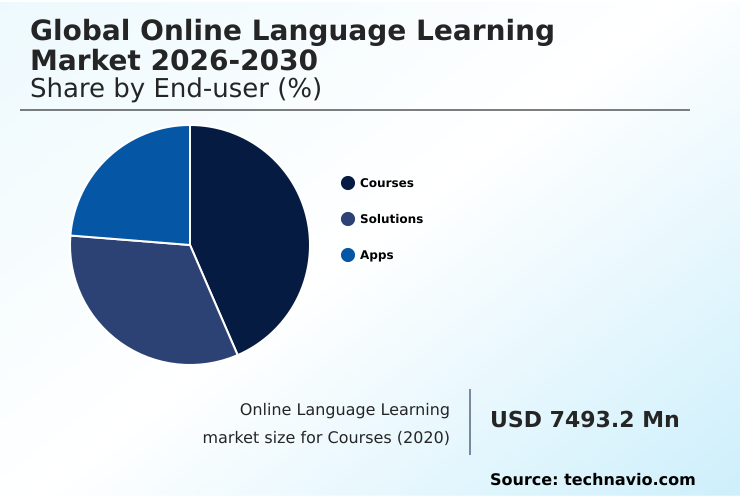
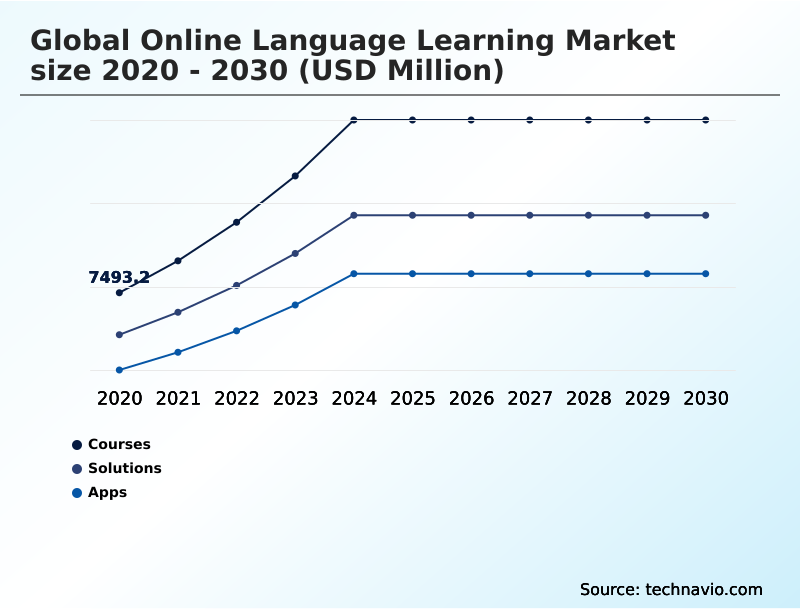
The Courses segment was valued at USD 15.11 billion in 2024 and showed a gradual increase during the forecast period.
Regional Analysis
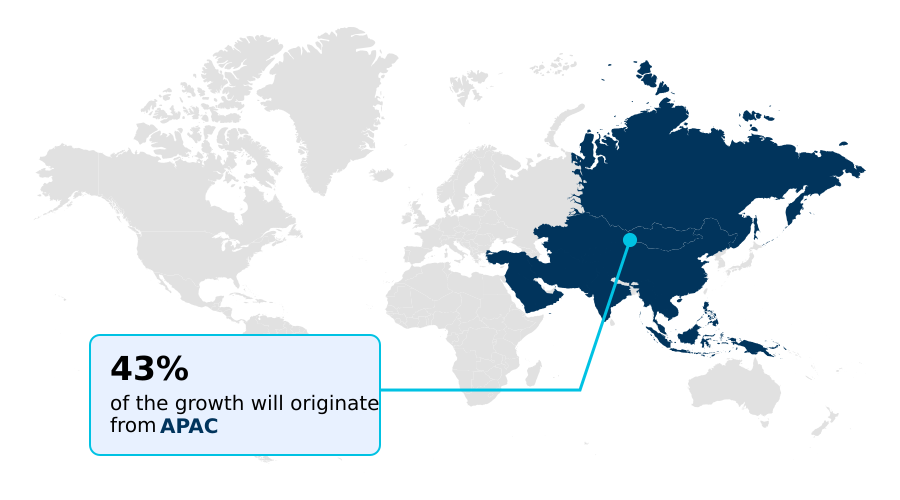
APAC is estimated to contribute 43.1% to the growth of the global market during the forecast period.Technavio’s analysts have elaborately explained the regional trends and drivers that shape the market during the forecast period.
See How Online Language Learning Market Demand is Rising in APAC Request Free Sample
The geographic landscape of the market is characterized by varied growth dynamics, with APAC set to contribute over 43% of the incremental growth.
This expansion is driven by rising demand for corporate language training to enhance bilingual communication training and cross-cultural communication skills. In North America and Europe, mature markets are focusing on advanced industry-specific terminology modules and blended learning systems.
Enterprise adoption of cloud-based learning platforms for multilingual workforce development has been a key factor, with corporate e-learning solutions showing a 25% higher engagement rate in programs that include live virtual classes and peer-to-peer language exchange.
South America and the Middle East and Africa are emerging regions, where mobile-first virtual language instruction is bridging access gaps.
Market Dynamics
Our researchers analyzed the data with 2025 as the base year, along with the key drivers, trends, and challenges. A holistic analysis of drivers will help companies refine their marketing strategies to gain a competitive advantage.
- The evolution of the Online Language Learning Market is increasingly influenced by sophisticated user demands and specialized applications. Debates around the effectiveness of AI tutors vs human teachers are pushing platforms toward hybrid models that combine automated feedback with nuanced human instruction.
- For enterprise clients, measuring the ROI of employee language programs has become a priority, leading to a focus on corporate language training for remote teams that integrates directly into corporate LMS. The demand for verifiable credentials has boosted online French courses with CEFR certification and other accredited programs.
- Technologically, platforms are differentiating through features like virtual reality for immersive German learning and AI tools for Spanish pronunciation practice, which have been shown to accelerate skill acquisition by up to 30% compared to non-interactive methods. Key challenges include securing user data on language learning platforms and the accreditation for online language learning certificates.
- Meanwhile, adaptive learning platforms for business English and mobile language learning apps with offline mode are addressing specific user needs for flexibility and accessibility, highlighting the market's shift toward highly personalized and outcome-oriented solutions.
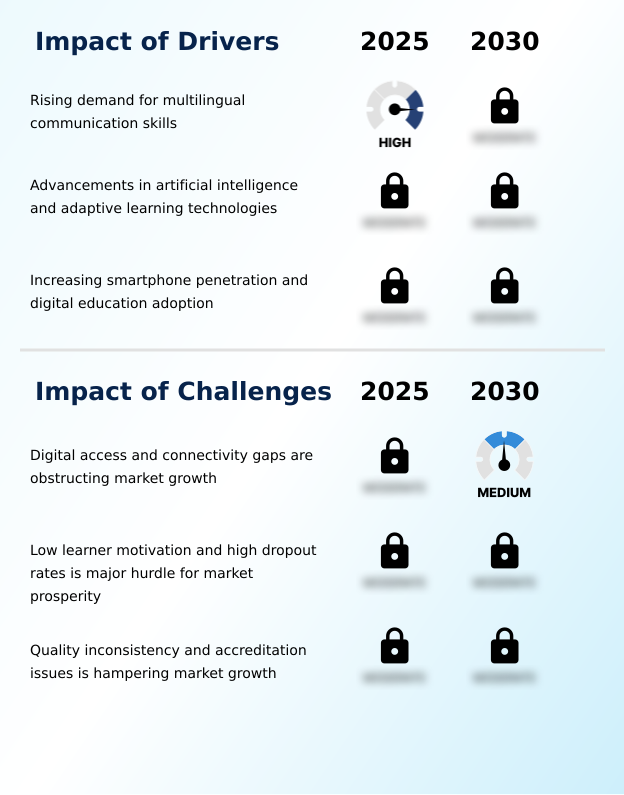
What are the key market drivers leading to the rise in the adoption of Online Language Learning Industry?
- The rising demand for multilingual communication skills is a key driver accelerating growth in the online language learning market.
- Technological advancements, particularly in AI, are a primary driver of market growth. AI-powered tutoring and adaptive learning algorithms create personalized learning paths, which have demonstrated a capacity to accelerate language acquisition by up to 50% compared to non-personalized methods.
- The implementation of sophisticated natural language processing tools enables more realistic and effective online linguistic acquisition.
- Furthermore, tools like speech recognition technology and pronunciation correction tools provide learners with the real-time feedback mechanisms necessary to build confidence and accuracy, improving pronunciation scores by an average of 30%.
- This evolution in language learning software is making digital fluency tools more effective than ever, pushing the boundaries of AI in language education and personalized language tuition.
What are the market trends shaping the Online Language Learning Industry?
- A prominent market trend is the rising adoption of gamification and immersive learning techniques, which significantly transform user engagement and learning retention.
- Market trends are heavily influenced by the push for greater learner engagement through immersive learning techniques. The integration of gamification elements and conversational role-play simulations has been shown to increase daily user activity by up to 40%. Providers are increasingly exploring virtual reality language environments and augmented reality learning modules to create realistic scenario-based exercises that enhance practical fluency.
- The success of mobile-first learning applications continues, with innovations in interactive language practice and online conversational practice making learning more accessible. This focus on edtech for language acquisition is a direct response to high dropout rates, with virtual immersion programs leading to a 25% improvement in learner retention over six months.
What challenges does the Online Language Learning Industry face during its growth?
- A key challenge affecting industry growth is the presence of digital access and connectivity gaps, which obstructs market expansion in certain regions.
- Key market challenges revolve around accessibility, learner retention, and quality assurance. While digital language education is expanding, ensuring consistent access requires features like offline learning modes. Monetization strategies are also a hurdle, with providers balancing freemium access systems against sustainable subscription-based models to fund continuous development.
- A significant challenge is sustaining motivation; platforms use learner performance analytics from progress tracking dashboards and app-based vocabulary builders to personalize engagement, which can reduce churn by 15%. However, ensuring quality and credibility remains difficult.
- The market needs more standardized automated assessment tools and adaptive language testing to validate proficiency, moving beyond simple metrics toward reliable certifications supported by robust cloud-hosted language labs and language upskilling platforms.
Exclusive Technavio Analysis on Customer Landscape
The online language learning market forecasting report includes the adoption lifecycle of the market, covering from the innovator’s stage to the laggard’s stage. It focuses on adoption rates in different regions based on penetration. Furthermore, the online language learning market report also includes key purchase criteria and drivers of price sensitivity to help companies evaluate and develop their market growth analysis strategies.
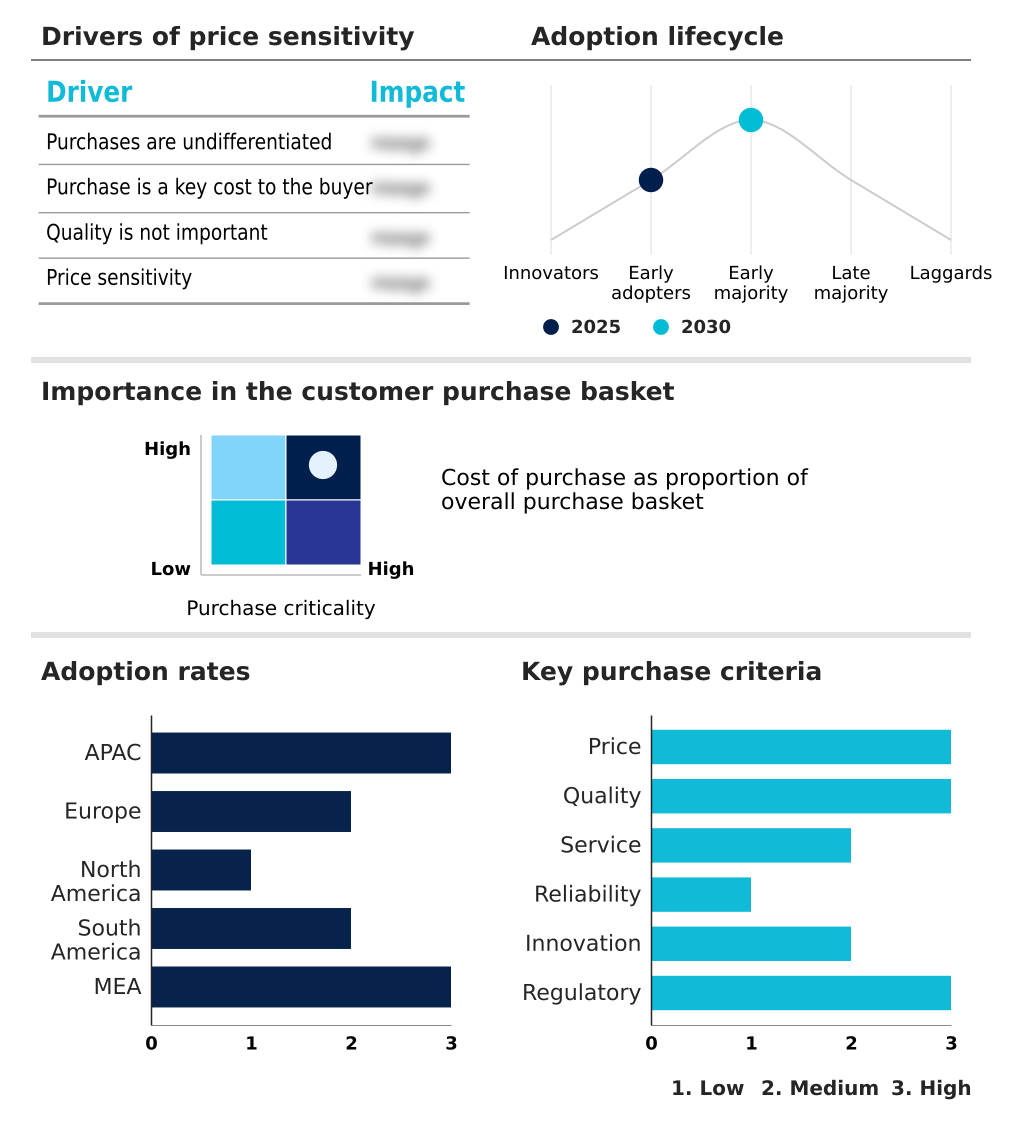
Customer Landscape of Online Language Learning Industry
Competitive Landscape
Companies are implementing various strategies, such as strategic alliances, online language learning market forecast, partnerships, mergers and acquisitions, geographical expansion, and product/service launches, to enhance their presence in the industry.
Babbel GmbH - Key offerings include comprehensive language learning platforms featuring app-based courses, live online classes with expert teachers, and tailored solutions for businesses, delivered through a unified digital ecosystem.
The industry research and growth report includes detailed analyses of the competitive landscape of the market and information about key companies, including:
- Babbel GmbH
- Berlitz Corp.
- Busuu Ltd.
- Cengage Learning Inc.
- Chegg Inc.
- Duolingo Inc.
- Educational Testing Service
- EF Education First Ltd.
- Houghton Mifflin Harcourt Co.
- inlingua International Ltd.
- italki HK Ltd.
- IXL Learning Inc.
- Lingoda GmbH
- McGraw Hill LLC
- New Oriental
- Preply Inc.
- Rosetta Stone LLC
- Sanako
- Think and Learn Pvt. Ltd.
- Voxy Inc.
Qualitative and quantitative analysis of companies has been conducted to help clients understand the wider business environment as well as the strengths and weaknesses of key industry players. Data is qualitatively analyzed to categorize companies as pure play, category-focused, industry-focused, and diversified; it is quantitatively analyzed to categorize companies as dominant, leading, strong, tentative, and weak.
Recent Development and News in Online language learning market
- In January 2025, Duolingo Inc. launched its advanced AI-powered 'Duolingo Max for Business,' a corporate language training solution with industry-specific modules and advanced progress analytics for enterprise clients.
- In November 2024, EF Education First Ltd. announced a strategic partnership with a major global technology firm to integrate its virtual language courses into the partner's enterprise collaboration platform, targeting multinational corporations.
- In March 2025, Chegg Inc. acquired a niche AI startup specializing in augmented reality for language learning, signaling its intent to build more immersive learning experiences within its platform.
- In September 2024, Babbel GmbH expanded its B2B offerings, 'Babbel for Business,' into several key markets in Southeast Asia, providing localized learning content for corporate clients in the region.
Dive into Technavio’s robust research methodology, blending expert interviews, extensive data synthesis, and validated models for unparalleled Online Language Learning Market insights. See full methodology.
| Market Scope | |
|---|---|
| Page number | 292 |
| Base year | 2025 |
| Historic period | 2020-2024 |
| Forecast period | 2026-2030 |
| Growth momentum & CAGR | Accelerate at a CAGR of 26.1% |
| Market growth 2026-2030 | USD 90846.7 million |
| Market structure | Fragmented |
| YoY growth 2025-2026(%) | 22.6% |
| Key countries | China, Japan, India, South Korea, Australia, Indonesia, Germany, UK, France, Italy, Spain, The Netherlands, US, Canada, Mexico, Brazil, Argentina, Chile, Saudi Arabia, UAE, South Africa, Israel and Turkey |
| Competitive landscape | Leading Companies, Market Positioning of Companies, Competitive Strategies, and Industry Risks |
Research Analyst Overview
- The Online Language Learning market is rapidly advancing beyond simple vocabulary drills, now defined by sophisticated, AI-driven ecosystems. A critical shift is the deep integration of adaptive learning algorithms and natural language processing tools to create truly personalized learning paths.
- These systems utilize real-time feedback mechanisms and learner performance analytics to dynamically adjust content, a process that improves learning efficiency by over 30% compared to static course structures. This technological pivot has direct boardroom implications, influencing investment decisions in corporate language training and multilingual workforce development.
- Platforms are now differentiated by their AI-powered tutoring capabilities and the quality of their conversational role-play simulations. The emphasis is on delivering measurable outcomes through features like pronunciation correction tools and language proficiency assessments, turning what was once a personal enrichment activity into a strategic tool for enterprise-level cross-cultural communication and global talent management.
What are the Key Data Covered in this Online Language Learning Market Research and Growth Report?
-
What is the expected growth of the Online Language Learning Market between 2026 and 2030?
-
USD 90.85 billion, at a CAGR of 26.1%
-
-
What segmentation does the market report cover?
-
The report is segmented by End-user (Courses, Solutions, and Apps), Language (English, Mandarin, Spanish, and Others), Deployment (Cloud-based, and On-premises) and Geography (APAC, Europe, North America, South America, Middle East and Africa)
-
-
Which regions are analyzed in the report?
-
APAC, Europe, North America, South America and Middle East and Africa
-
-
What are the key growth drivers and market challenges?
-
Rising demand for multilingual communication skills, Digital access and connectivity gaps are obstructing market growth
-
-
Who are the major players in the Online Language Learning Market?
-
Babbel GmbH, Berlitz Corp., Busuu Ltd., Cengage Learning Inc., Chegg Inc., Duolingo Inc., Educational Testing Service, EF Education First Ltd., Houghton Mifflin Harcourt Co., inlingua International Ltd., italki HK Ltd., IXL Learning Inc., Lingoda GmbH, McGraw Hill LLC, New Oriental, Preply Inc., Rosetta Stone LLC, Sanako, Think and Learn Pvt. Ltd. and Voxy Inc.
-
Market Research Insights
- Market dynamics are increasingly shaped by technological advancements that enhance the efficacy of digital language education. The integration of AI in language education improves user progress tracking, enabling a 35% more accurate identification of learning gaps compared to traditional methods.
- Corporate e-learning solutions are delivering substantial value, with some organizations reporting a 40% reduction in training expenditures after transitioning from in-person instruction to virtual language instruction. Furthermore, the adoption of mobile language learning platforms continues to expand, with app-based vocabulary builders and tools for online conversational practice driving user engagement.
- This shift toward more efficient and personalized language tuition is compelling providers to innovate continuously in the competitive language upskilling platforms space.
We can help! Our analysts can customize this online language learning market research report to meet your requirements.
 RIA -
RIA -