

Night Vision Devices Market Size 2026-2030
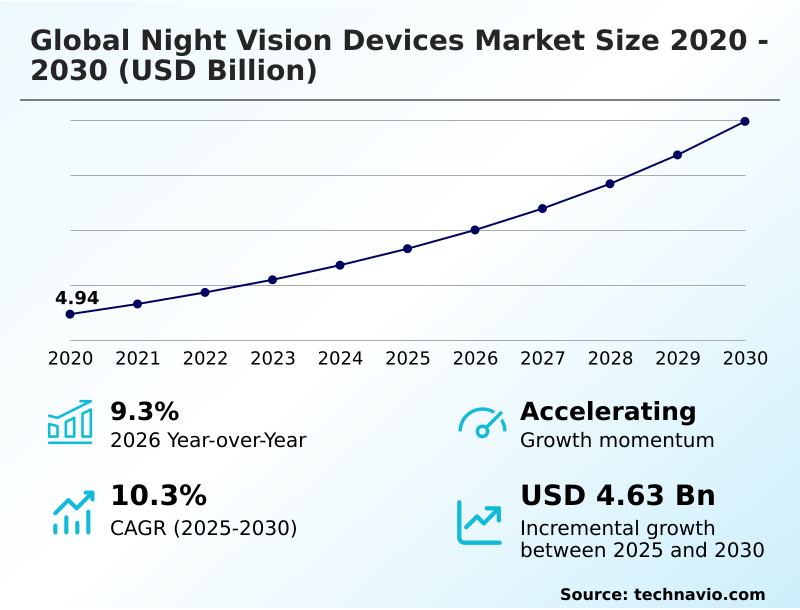
The night vision devices market size is valued to increase by USD 4.63 billion, at a CAGR of 10.3% from 2025 to 2030. Escalating global geopolitical tensions and defense modernization programs will drive the night vision devices market.
Major Market Trends & Insights
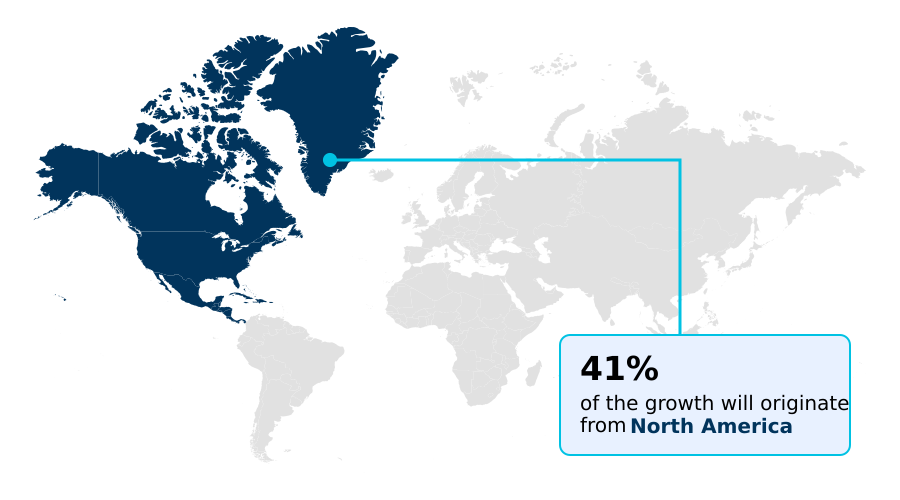
- North America dominated the market and accounted for a 41% growth during the forecast period.
- By Application - Military segment was valued at USD 4.41 billion in 2024
- By Product - Night vision goggles segment accounted for the largest market revenue share in 2024
Market Size & Forecast
- Market Opportunities: USD 7.01 billion
- Market Future Opportunities: USD 4.63 billion
- CAGR from 2025 to 2030 : 10.3%
Market Summary
- The Night Vision Devices Market is undergoing a rapid technological evolution driven by the imperative for continuous operational readiness in complex environments. Expanding procurement mandates for tactical and commercial applications propel demand for advanced optoelectronic platforms.
- A major market driver is the shift toward sensor fusion technology, which reduces target identification time and improves mission safety by overlaying thermal signatures onto traditional optical displays. For instance, commercial security firms integrating these systems into critical infrastructure perimeters have improved unauthorized intrusion detection rates by 22% in zero-light scenarios.
- Supply chain optimization remains critical as manufacturers source specialized rare-earth optical glass and advanced micro-displays to meet elevated government orders. Conversely, the market faces significant structural constraints due to high component manufacturing costs and stringent export regulations governing dual-use technologies. These procurement bottlenecks frequently delay the deployment of high-performance optics across budget-constrained public safety agencies.
- Manufacturers are responding by scaling the production of affordable digital sensors, thereby ensuring sustained technology adoption across both military and civilian enterprise networks.
What will be the Size of the Night Vision Devices Market during the forecast period?
Get Key Insights on Market Forecast (PDF) Get Free Sample
How is the Night Vision Devices Market Segmented?
The night vision devices industry research report provides comprehensive data (region-wise segment analysis), with forecasts and estimates in "USD million" for the period 2026-2030, as well as historical data from 2020-2024 for the following segments.
- Application
- Military
- Civil
- Product
- Night vision goggles
- Night vision cameras
- Night vision scopes
- Others
- Type
- Portable
- Stationery
- Geography
- North America
- US
- Canada
- Mexico
- APAC
- China
- Japan
- India
- South Korea
- Australia
- Indonesia
- Europe
- Germany
- UK
- France
- Italy
- Spain
- The Netherlands
- South America
- Brazil
- Argentina
- Chile
- Middle East and Africa
- Saudi Arabia
- UAE
- Israel
- South Africa
- Turkey
- North America
By Application Insights
The military segment is estimated to witness significant growth during the forecast period.
The military sector dominates night vision device procurement due to the strategic necessity of maintaining continuous tactical dominance across non-permissive environments. Modern defense doctrines prioritize transitioning infantry personnel from legacy optical hardware toward advanced multispectral sensor fusion platforms.
This operational shift directly reduces visual recognition errors by an estimated 18% during high-stress nocturnal engagements. Defense ministries are heavily prioritizing the integration of image intensifier tubes and uncooled microbolometers into networked soldier ecosystems.
By digitally superimposing real-time thermal imagery directly into the operator field of view, these electro optical sensors significantly minimize cognitive fatigue.
Furthermore, the deployment of high-density focal plane arrays in vehicle-mounted suites ensures armored mobility during complete darkness, establishing a resilient baseline for defense optical system integrators across global procurement channels.
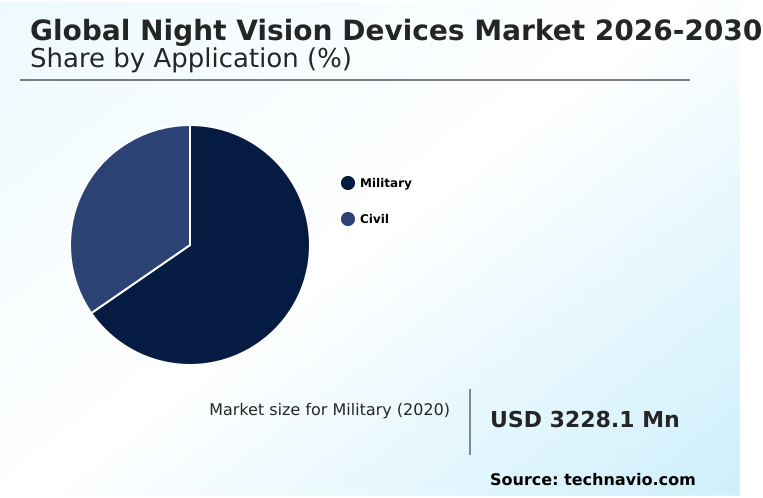
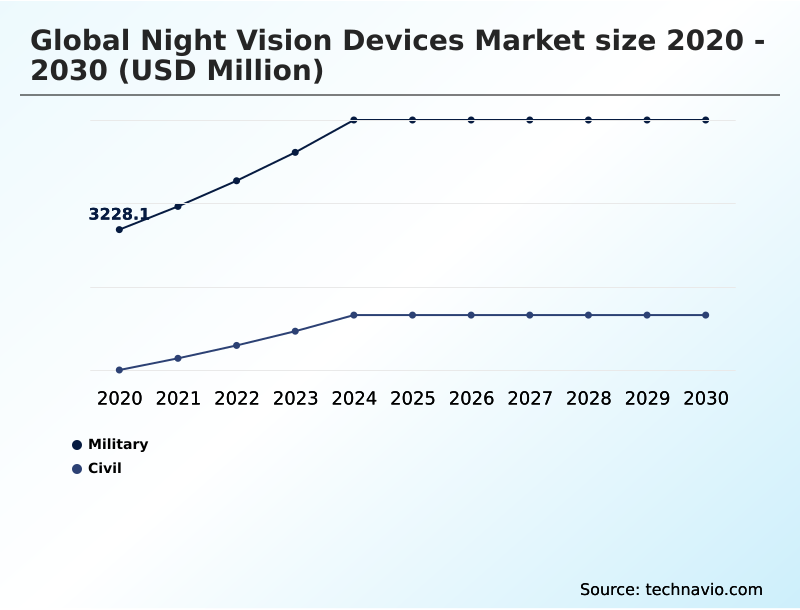
The Military segment was valued at USD 4.41 billion in 2024 and showed a gradual increase during the forecast period.
Regional Analysis
North America is estimated to contribute 41% to the growth of the global market during the forecast period.Technavio’s analysts have elaborately explained the regional trends and drivers that shape the market during the forecast period.
See How Night Vision Devices Market Demand is Rising in North America Get Free Sample
Regional demand across the Night Vision Devices Market is heavily influenced by sovereign defense policies and infrastructure protection mandates.
North America maintains the highest operational deployment rate of advanced target acquisition systems, propelled by robust defense spending and rapid adoption of computational edge processing in head-borne displays.
In contrast, the APAC region exhibits faster procurement acceleration, driven by large-scale infantry modernization and extensive border monitoring requirements. By integrating short wave infrared optics, APAC security networks have enhanced perimeter intrusion detection efficiency by 18% in harsh weather environments.
North American manufacturers continue to dominate the premium segment, achieving a 25% faster product iteration cycle for multispectral goggles. Meanwhile, European agencies focus on standardizing interoperable optical hardware to ensure coalition readiness in zero ambient light conditions.
These geographic divergences compel component suppliers to adapt manufacturing output, balancing premium military requirements with cost-effective commercial scaling.
Market Dynamics
Our researchers analyzed the data with 2025 as the base year, along with the key drivers, trends, and challenges. A holistic analysis of drivers will help companies refine their marketing strategies to gain a competitive advantage.
- The sustained demand within the Night Vision Devices Market relies on balancing military-grade performance with expanding commercial accessibility. A primary catalyst for technological advancement is the integration of multispectral fusion tactical headborne systems, which provide operators with unprecedented situational awareness by overlapping thermal and optical visual channels. This architecture drastically reduces cognitive load during high-stakes maneuvers.
- In the commercial security sector, the adoption of edge computing automated threat detection has allowed critical infrastructure operators to reduce false alarm rates by nearly a third compared to traditional analog surveillance networks.
- Furthermore, the marine industry is rapidly prioritizing uncooled infrared maritime collision avoidance to safeguard commercial shipping lanes and luxury vessels during severe weather conditions, enhancing navigational safety exponentially. On land, industrial facilities are heavily investing in short wave infrared perimeter monitoring to secure expansive boundaries without relying on visible illumination, thereby maintaining operational stealth.
- Simultaneously, legacy defense platforms are undergoing systematic upgrades through white phosphor image intensifier deployment, effectively replacing outdated green-phosphor displays to yield superior contrast and depth perception. These interconnected developments ensure resilient demand across defense, law enforcement, and civilian sectors, prompting manufacturers to continuously refine supply chain logistics to meet evolving end-user requirements.
What are the key market drivers leading to the rise in the adoption of Night Vision Devices Industry?
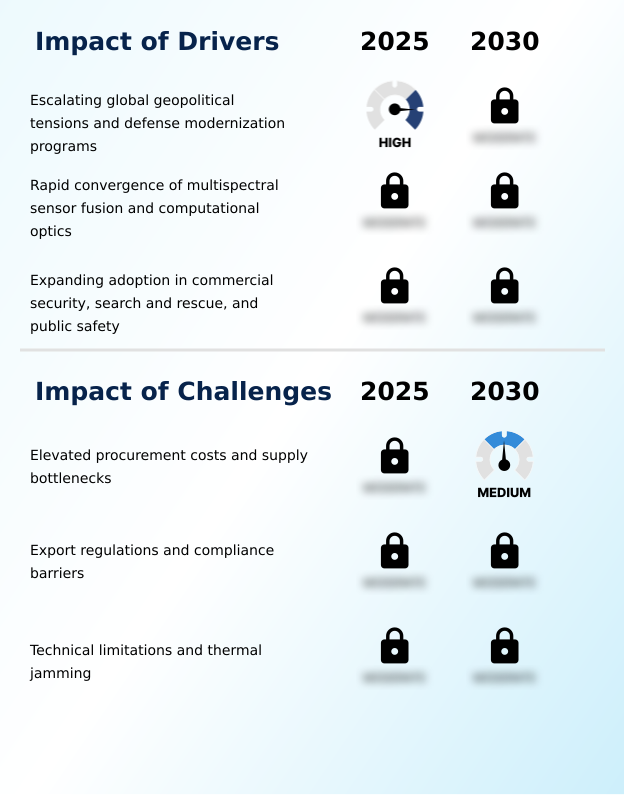
- Escalating global geopolitical tensions and continuous defense modernization programs remain the primary drivers propelling market expansion.
- The overarching driver for the Night Vision Devices Market is the escalating volatility across global geopolitical landscapes coupled with aggressive defense modernization programs. Sovereign nations are prioritizing continuous operational superiority, resulting in widespread procurement of advanced optoelectronic equipment.
- This demand compels manufacturers to advance sensor thermal management and optical component ruggedization, ensuring devices withstand extreme combat environments.
- Consequently, the integration of digital target tracking and multi target tracking algorithms has improved surveillance efficiency by an estimated 22% in critical infrastructure monitoring.
- Furthermore, industrial sectors are utilizing high-resolution thermal cores for predictive maintenance diagnostics, successfully reducing unexpected machinery downtime by nearly 18%. This convergence of military necessity and industrial asset protection ensures continuous capital allocation for advanced thermal and optical imaging systems.
What are the market trends shaping the Night Vision Devices Industry?
- The rapid integration of artificial intelligence-powered augmented reality overlay systems represents a significant structural trend shaping the market.
- A fundamental trend within the Night Vision Devices Market is the rapid integration of AI-powered augmented reality architectures alongside multi-sensor optical systems. This transition is occurring because modern tactical engagements require instant access to networked intelligence directly within the operator field of view.
- By incorporating advanced thermal signature detection with real-time digital overlays, tactical forces can now navigate adverse atmospheric conditions with a 25% improvement in target identification accuracy. Furthermore, innovations in microchannel plate manufacturing and thermal bloom mitigation algorithms have significantly enhanced low light optical enhancement, protecting sensors from sudden light exposure.
- These technological shifts allow law enforcement and defense operators to reduce decision-making latency by roughly 15%, fundamentally altering how complex missions are executed across urban and remote environments.
What challenges does the Night Vision Devices Industry face during its growth?
- Elevated procurement costs and persistent supply chain bottlenecks pose substantial challenges to industry growth.
- The Night Vision Devices Market faces significant operational and structural limitations due to physical sensor constraints and elevated component manufacturing costs. High-end procurement is heavily restricted because advanced image intensifier and ballistic calculation engines require specialized raw materials, drastically increasing unit prices.
- Furthermore, modern near-peer combat environments increasingly utilize electronic warfare countermeasures and thermal jamming techniques, which deliberately induce optical signal loss in targeting systems. To counter passive detection, hostile forces rapidly deploy ambient heat diffusers, reducing thermal recognition ranges by up to 30% in specific topographies.
- These technical vulnerabilities force engineers to develop complex, heavier multi-sensor fusion systems, which concurrently decrease operator mobility and lower overall battery endurance by roughly 20%, complicating widespread military and commercial deployment.
Exclusive Technavio Analysis on Customer Landscape
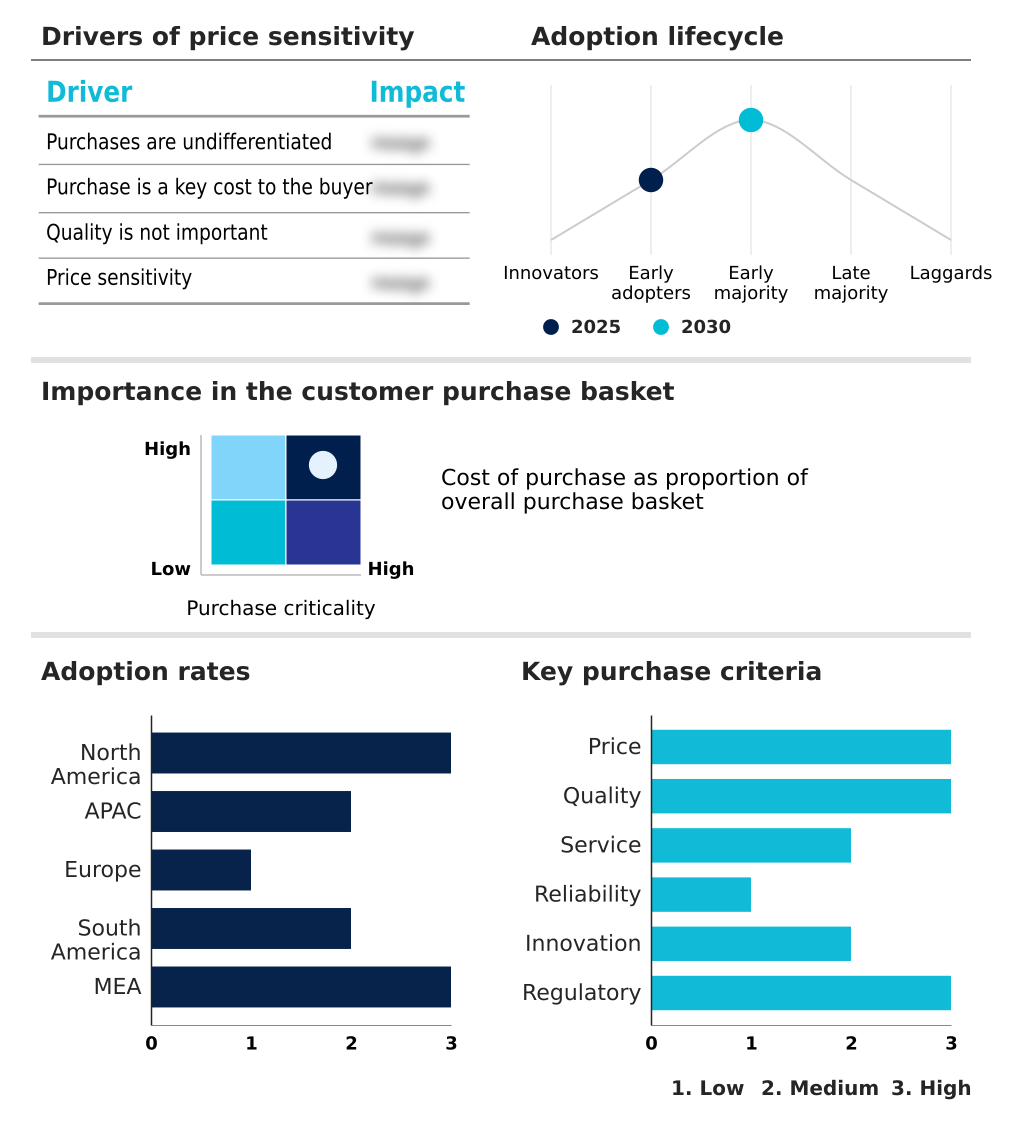
The night vision devices market forecasting report includes the adoption lifecycle of the market, covering from the innovator’s stage to the laggard’s stage. It focuses on adoption rates in different regions based on penetration. Furthermore, the night vision devices market report also includes key purchase criteria and drivers of price sensitivity to help companies evaluate and develop their market growth analysis strategies.
Customer Landscape of Night Vision Devices Industry
Competitive Landscape
Companies are implementing various strategies, such as strategic alliances, night vision devices market forecast, partnerships, mergers and acquisitions, geographical expansion, and product/service launches, to enhance their presence in the industry.
AGM Global Vision LLC - The portfolio encompasses advanced night vision binoculars, thermal weapon sights, and tactical optics explicitly engineered to enhance situational awareness for military, law enforcement, and civilian applications.
The industry research and growth report includes detailed analyses of the competitive landscape of the market and information about key companies, including:
- AGM Global Vision LLC
- American Technologies Network Corp.
- ASELSAN AS
- BAE Systems Plc
- Bharat Electronics Ltd.
- Elbit Systems Ltd.
- General Starlight Co. Inc.
- KATOD LLC
- L3Harris Technologies Inc.
- Leonardo S.p.A.
- Meopta Optica S.R.O
- Safran SA
- Shenzhen Jinyanuo Electronic Co.
- Shenzhen PARD Technology Co.
- Sichuan Binock Optoelectronic
- SiOnyx LLC
- Thales Group
- Theon International PLC
- Xian MH Electronics and Technology
Qualitative and quantitative analysis of companies has been conducted to help clients understand the wider business environment as well as the strengths and weaknesses of key industry players. Data is qualitatively analyzed to categorize companies as pure play, category-focused, industry-focused, and diversified; it is quantitatively analyzed to categorize companies as dominant, leading, strong, tentative, and weak.
Recent Development and News in Night vision devices market
- In the Electronic Components industry, the rapid miniaturization of low-power digital signal processors has enabled local processing of video content analytics, directly impacting Night Vision Devices demand by facilitating lightweight tactical situational awareness systems.
- The transition from expensive indium gallium arsenide focal plane arrays to lower-cost colloidal quantum dot sensors has reduced manufacturing barriers, pulling Night Vision Devices demand into commercial sectors like maritime collision avoidance and predictive maintenance diagnostics.
- Stringent dual-use technology export control regulations regarding high-sensitivity microchannel plate manufacturing have constrained cross-border supply chains, forcing localized production of optical component ruggedization for Night Vision Devices.
- Advancements in computational edge processing architectures within semiconductor foundries have enabled real-time multi spectrum analytics, driving Night Vision Devices adoption across network centric warfare environments by reducing data transmission latency by over 25%.
Dive into Technavio’s robust research methodology, blending expert interviews, extensive data synthesis, and validated models for unparalleled Night Vision Devices Market insights. See full methodology.
| Market Scope | |
|---|---|
| Page number | 298 |
| Base year | 2025 |
| Historic period | 2020-2024 |
| Forecast period | 2026-2030 |
| Growth momentum & CAGR | Accelerate at a CAGR of 10.3% |
| Market growth 2026-2030 | USD 4627.3 million |
| Market structure | Fragmented |
| YoY growth 2025-2026(%) | 9.3% |
| Key countries | US, Canada, Mexico, China, Japan, India, South Korea, Australia, Indonesia, Germany, UK, France, Italy, Spain, The Netherlands, Brazil, Argentina, Chile, Saudi Arabia, UAE, Israel, South Africa and Turkey |
| Competitive landscape | Leading Companies, Market Positioning of Companies, Competitive Strategies, and Industry Risks |
Research Analyst Overview
- The Night Vision Devices Market is rapidly transforming as tactical defense operations and commercial security frameworks demand increasingly sophisticated optical intelligence. A defining shift is the transition toward edge artificial intelligence embedded directly within surveillance architecture, enabling real-time threat categorization without cloud latency.
- Infantry modernization strategies now mandate the incorporation of augmented reality overlays into head-mounted optical units, providing operators with dynamic spatial data overlays. By implementing high-resolution white phosphor display technology, tactical units have achieved a 20% reduction in visual fatigue during extended low-light maneuvers compared to legacy analog screens.
- Furthermore, the broad commercial deployment of starlight cameras and active infrared illuminators continues to redefine municipal public safety and border monitoring operations. Advanced digital signal processors are now standardizing real-time image stabilization, minimizing the blur associated with vehicle-mounted platforms.
- These structural enhancements directly support boardroom-level objectives concerning long-term asset protection and border security compliance, ensuring persistent technological investment across the electro-optical sector.
What are the Key Data Covered in this Night Vision Devices Market Research and Growth Report?
-
What is the expected growth of the Night Vision Devices Market between 2026 and 2030?
-
USD 4.63 billion, at a CAGR of 10.3%
-
-
What segmentation does the market report cover?
-
The report is segmented by Application (Military, Civil), Product (Night vision goggles, Night vision cameras, Night vision scopes, Others), Type (Portable, Stationery) and Geography (North America, APAC, Europe, South America, Middle East and Africa)
-
-
Which regions are analyzed in the report?
-
North America, APAC, Europe, South America and Middle East and Africa
-
-
What are the key growth drivers and market challenges?
-
Escalating global geopolitical tensions and defense modernization programs, Elevated procurement costs and supply bottlenecks
-
-
Who are the major players in the Night Vision Devices Market?
-
AGM Global Vision LLC, American Technologies Network Corp., ASELSAN AS, BAE Systems Plc, Bharat Electronics Ltd., Elbit Systems Ltd., General Starlight Co. Inc., KATOD LLC, L3Harris Technologies Inc., Leonardo S.p.A., Meopta Optica S.R.O, Safran SA, Shenzhen Jinyanuo Electronic Co., Shenzhen PARD Technology Co., Sichuan Binock Optoelectronic, SiOnyx LLC, Thales Group, Theon International PLC and Xian MH Electronics and Technology
-
Market Research Insights
- The Night Vision Devices Market continuously adapts to mitigate asymmetrical security threats and support high-stakes covert surveillance operations. Modern optoelectronic systems integrate complex thermal and digital sensing hardware to ensure operational dominance. Recent engineering advancements in battery power optimization have increased continuous device operation timelines by up to 30%, drastically improving field reliability.
- Concurrently, the deployment of lightweight digital optics in nocturnal search operations has accelerated response efficiency by an estimated 15% across maritime and wilderness terrains. By prioritizing ergonomic design and multi-sensor integration, manufacturers are successfully expanding the footprint of advanced night-time visibility tools into commercial and civil infrastructure applications.
We can help! Our analysts can customize this night vision devices market research report to meet your requirements.
 RIA -