


Lithium-ion Battery Market Size 2026-2030
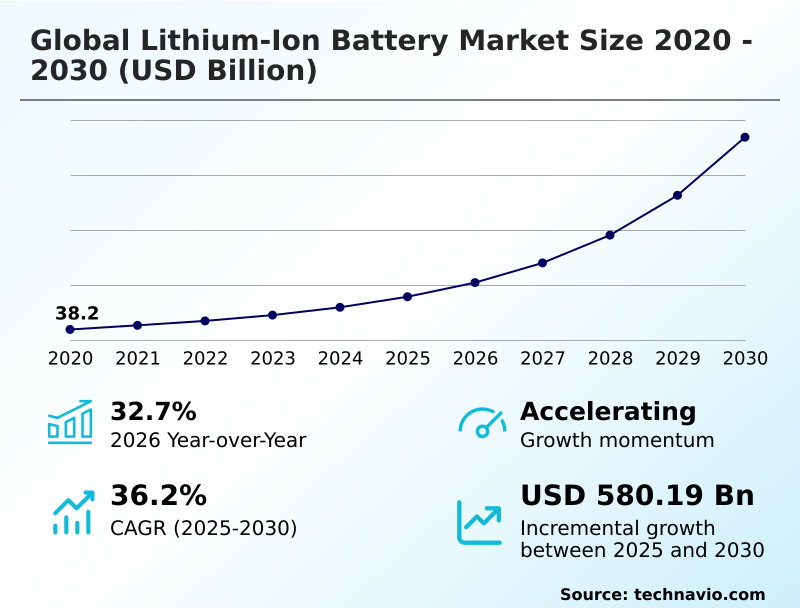
The lithium-ion battery market size is valued to increase by USD 580.19 billion, at a CAGR of 36.2% from 2025 to 2030. Accelerating electric vehicle adoption and infrastructure expansion will drive the lithium-ion battery market.
Major Market Trends & Insights
- APAC dominated the market and accounted for a 50.5% growth during the forecast period.
- By Type - Lithium nickel manganese cobalt segment was valued at USD 53.30 billion in 2024
- By Application - Automotive segment accounted for the largest market revenue share in 2024
Market Size & Forecast
- Market Opportunities: USD 699.29 billion
- Market Future Opportunities: USD 580.19 billion
- CAGR from 2025 to 2030 : 36.2%
Market Summary
- The lithium-ion battery market is the linchpin of the global energy transition, primarily driven by the dual imperatives of transport electrification and grid modernization. Demand is bifurcated between high-density chemistries for electric vehicles and robust, long-cycle-life solutions for stationary energy storage systems.
- A prevailing trend is the strategic shift toward safer and more cost-effective materials, which reduces dependence on volatile commodity markets. However, the industry grapples with significant supply chain risks stemming from the high geopolitical concentration of critical minerals. For instance, an automotive OEM navigating this landscape must balance performance with resilience.
- This involves diversifying its portfolio to include both high-performance cells for premium models and dependable alternatives for standard-range vehicles, while simultaneously investing in regionalized battery circular economy initiatives to secure a stable, long-term supply of essential materials. This strategic recalibration of cell to pack design is essential for maintaining competitiveness and mitigating operational disruptions in a volatile global environment.
What will be the Size of the Lithium-ion Battery Market during the forecast period?
Get Key Insights on Market Forecast (PDF) Get Free Sample
How is the Lithium-ion Battery Market Segmented?
The lithium-ion battery industry research report provides comprehensive data (region-wise segment analysis), with forecasts and estimates in "USD million" for the period 2026-2030, as well as historical data from 2020-2024 for the following segments.
- Type
- Lithium nickel manganese cobalt
- Lithium titanate
- Lithium iron phosphate
- Lithium cobalt oxide
- Application
- Automotive
- Consumer electronics
- Others
- Power output
- High
- Medium
- Low
- Geography
- APAC
- China
- Japan
- South Korea
- Europe
- Germany
- France
- Italy
- North America
- US
- Canada
- Mexico
- South America
- Brazil
- Argentina
- Middle East and Africa
- South Africa
- Saudi Arabia
- UAE
- Rest of World (ROW)
- APAC
By Type Insights
The lithium nickel manganese cobalt segment is estimated to witness significant growth during the forecast period.
The lithium nickel manganese cobalt segment is foundational to the high-performance electric vehicle industry, where energy density and driving range are primary performance indicators.
This chemistry allows manufacturers to fine-tune the ratio of nickel, manganese, and cobalt to achieve specific targets for automotive battery solutions, from cost optimization to maximum power output.
Research in high nickel cathode formulations has significantly enhanced structural stability, addressing historical challenges of capacity degradation. These advancements in cathode materials are essential for luxury and high-performance automotive segments.
Innovations in doping and coating technologies enable manufacturers to reduce cobalt reliance, mitigating supply chain risks. Breakthroughs in polymer binders now allow for manufacturing adjustments that reduce internal resistance by up to 40%, boosting charging efficiency.
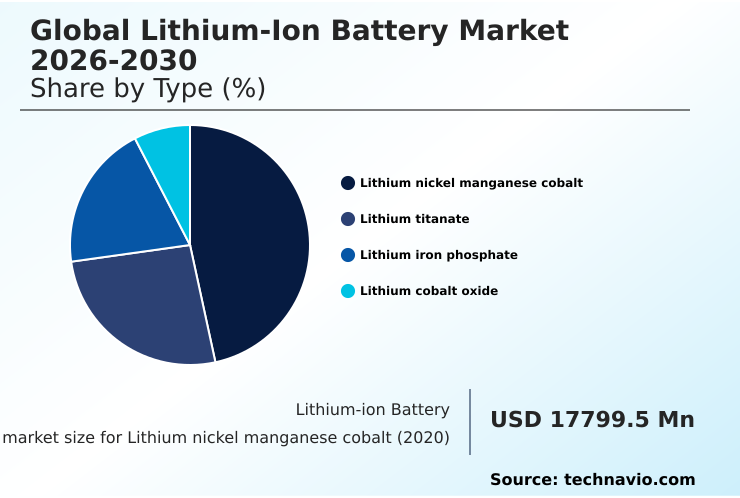
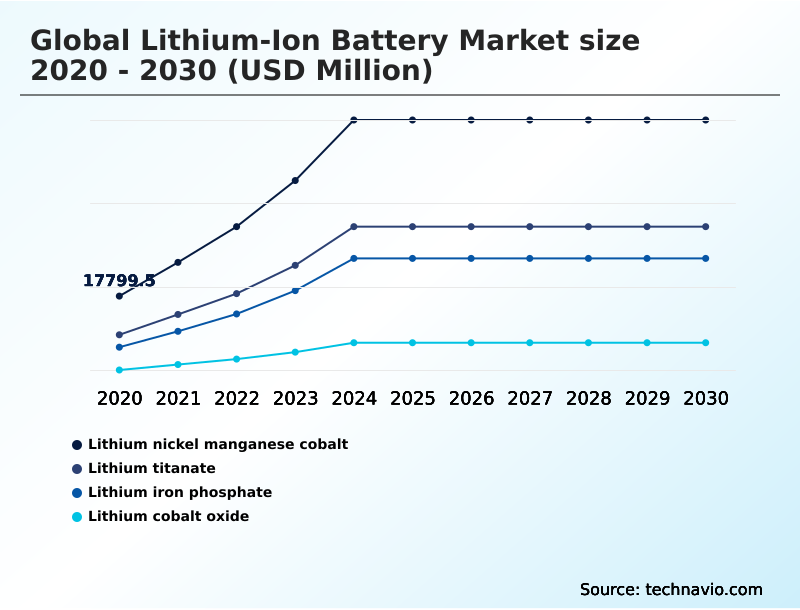
The Lithium nickel manganese cobalt segment was valued at USD 53.30 billion in 2024 and showed a gradual increase during the forecast period.
Regional Analysis
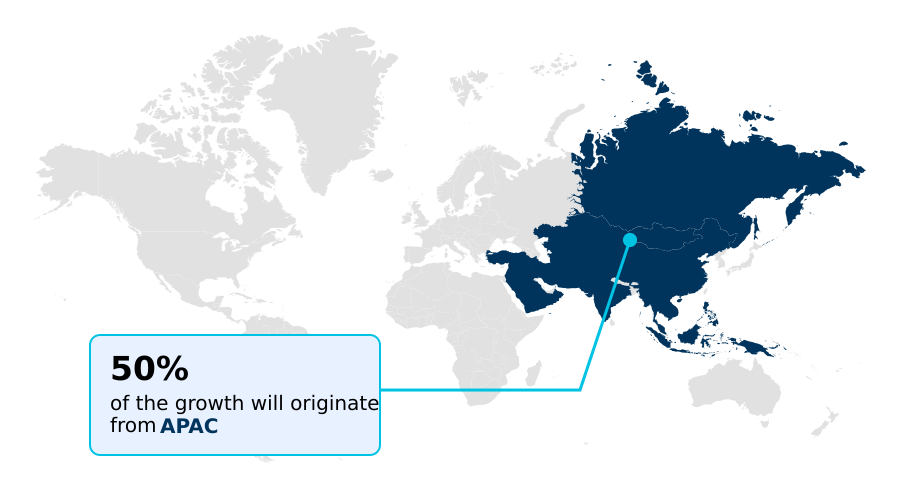
APAC is estimated to contribute 50.5% to the growth of the global market during the forecast period.Technavio’s analysts have elaborately explained the regional trends and drivers that shape the market during the forecast period.
See How Lithium-ion Battery Market Demand is Rising in APAC Get Free Sample
The geographic landscape is transitioning from a centralized model to a multi-polar ecosystem. APAC, which is forecast to contribute over 50% of incremental market growth, maintains its dominance through highly integrated supply chains for key components.
However, North America and Europe are rapidly closing the gap by localizing production of automotive battery solutions.
This strategic onshoring is accelerated by federal incentives aimed at building resilient domestic supply chains for precursor cathode materials and mitigating geopolitical risks associated with cobalt free blade battery technologies.
In Europe, the focus extends to grid stability, with nations like Germany adding over 6 GWh of new storage capacity in a single year to support renewable energy integration.
This regionalization fosters innovation in areas like high voltage architectures and thermal management systems, creating distinct competitive advantages beyond APAC.
Market Dynamics
Our researchers analyzed the data with 2025 as the base year, along with the key drivers, trends, and challenges. A holistic analysis of drivers will help companies refine their marketing strategies to gain a competitive advantage.
- Navigating the global lithium-ion battery market 2026-2030 requires a nuanced understanding of its divergent application requirements and supply-side complexities. The demands of the global lithium-ion battery market 2026-2030 for automotive, which prioritizes energy density and fast charging, contrast sharply with the needs of the global lithium-ion battery market 2026-2030 for grid storage, where longevity and cost-effectiveness are paramount.
- This divergence dictates choices among global lithium-ion battery market 2026-2030 chemistries, with high-performance nickel-based cells serving premium vehicles while LFP technology dominates stationary applications. These decisions are intrinsically linked to the global lithium-ion battery market 2026-2030 supply chain, which remains vulnerable due to its dependence on a few key regions for raw materials.
- To mitigate this risk, leading firms are heavily investing in the global lithium-ion battery market 2026-2030 recycling processes to establish regional, closed-loop systems. For operational planning, companies that integrate recycled materials into their production achieve a significantly higher raw material security index compared to those solely reliant on virgin mineral imports.
- This strategic shift not only enhances supply stability but also aligns with evolving regulatory mandates, positioning these firms for sustainable, long-term success.
What are the key market drivers leading to the rise in the adoption of Lithium-ion Battery Industry?
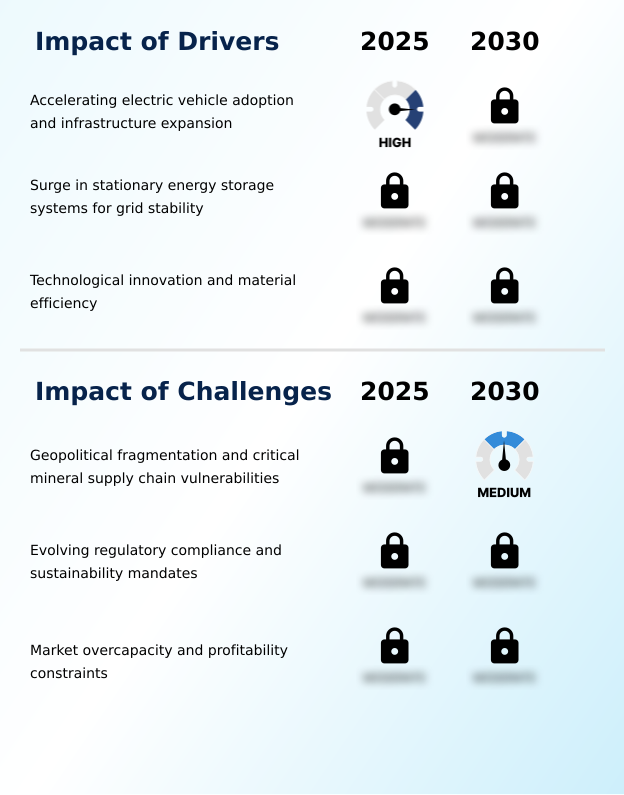
- Accelerating electric vehicle adoption, coupled with the expansion of supporting infrastructure, serves as a key driver for market growth.
- Market momentum is propelled by the global transition toward electric mobility, supported by government mandates and significant private investment in fast charging infrastructure and stationary energy storage systems.
- A secondary driver is the rapid expansion of grid-scale storage to manage renewable energy intermittency, with deployments in major markets set to increase by over 50% year-over-year.
- The third crucial driver is continuous technological innovation in areas like nickel based chemistries. For example, advanced visualization techniques for polymer binders within electrodes are enabling manufacturing adjustments that reduce internal resistance by up to 40%.
- This directly improves charging efficiency and extends the cycle life of automotive battery solutions and other high-performance applications, enhancing the value proposition of closed loop supply chains.
What are the market trends shaping the Lithium-ion Battery Industry?
- The market is experiencing a significant trend with the pervasive transition toward lithium iron phosphate chemistries. This shift is reshaping product strategies and supply chains across key applications.
- Key market trends are reshaping the competitive landscape. A primary shift is the accelerated adoption of specific chemistries, which now account for 65% of new energy storage deployments due to their enhanced safety and cost-effectiveness, driving innovation in cell to pack design.
- This pivot supports the institutionalization of a battery circular economy, where regulations mandating extended producer responsibility are becoming standard. Advanced hydrometallurgical processing facilities are achieving material recovery rates exceeding 95%, transforming end-of-life products into a secure source for cathode materials.
- Concurrently, the integration of AI is optimizing manufacturing and enabling new business models such as battery as a service and second life energy storage. This synergy between hardware and software improves production yields and facilitates sophisticated grid scale energy management for all domain energy solutions.
What challenges does the Lithium-ion Battery Industry face during its growth?
- Geopolitical fragmentation and vulnerabilities within critical mineral supply chains present a key challenge to the industry's growth trajectory.
- The market confronts significant structural challenges that temper its growth potential. The geopolitical concentration of critical minerals creates systemic vulnerabilities for supply chains dependent on lithium cobalt oxide and other specialized chemistries, complicating the production of high purity sulfuric acid. Evolving regulations, such as mandates for a 70% recycling rate, impose heavy operational burdens and force costly product redesigns.
- Furthermore, structural overcapacity, with global nameplate capacity exceeding demand by an estimated 900 GWh, has ignited fierce price competition. This pressure on margins erodes profitability and discourages long-term R&D investment in next-generation technologies like solid state batteries, threatening the viability of all but the largest, most integrated manufacturers and hindering the development of smart grid frameworks.
Exclusive Technavio Analysis on Customer Landscape
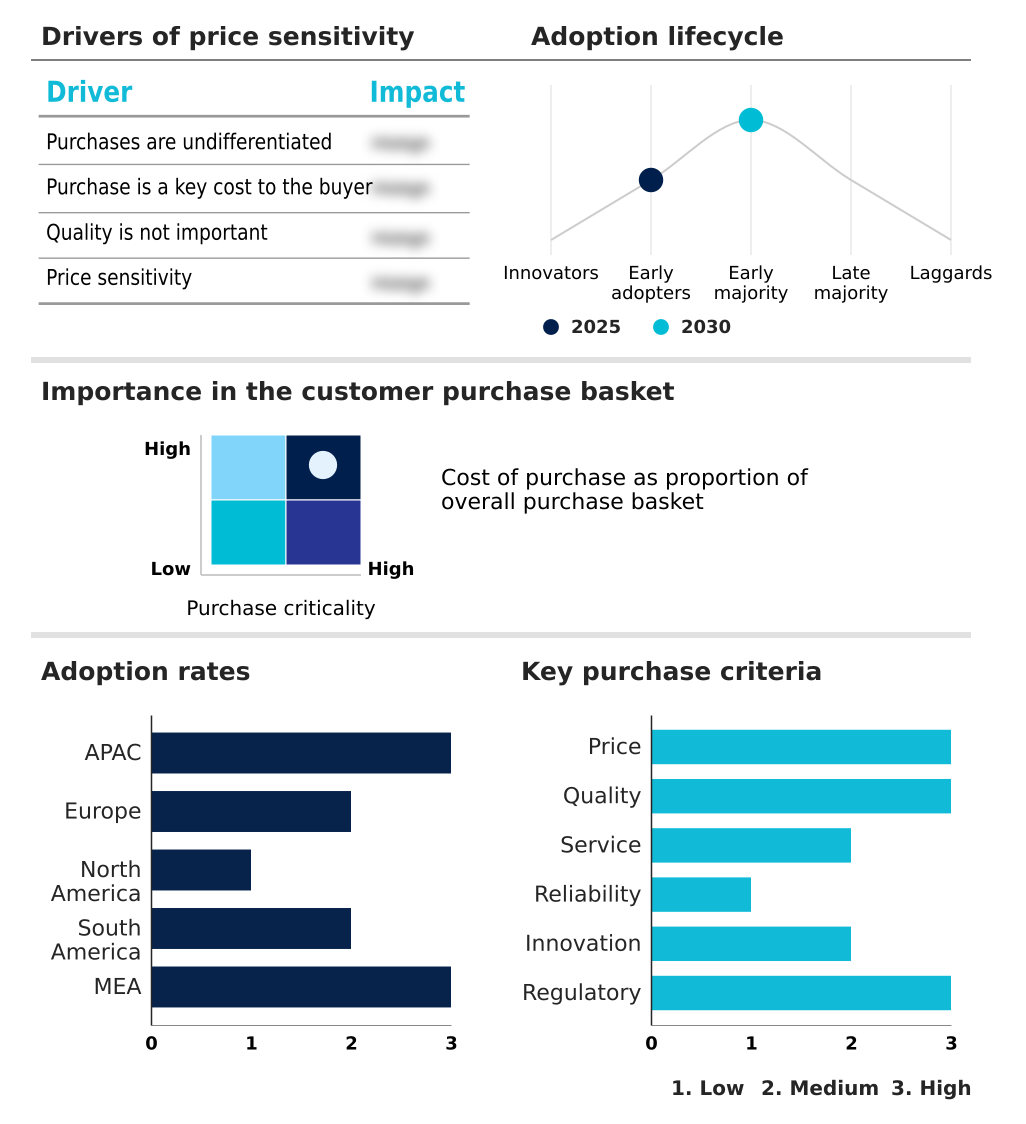
The lithium-ion battery market forecasting report includes the adoption lifecycle of the market, covering from the innovator’s stage to the laggard’s stage. It focuses on adoption rates in different regions based on penetration. Furthermore, the lithium-ion battery market report also includes key purchase criteria and drivers of price sensitivity to help companies evaluate and develop their market growth analysis strategies.
Customer Landscape of Lithium-ion Battery Industry
Competitive Landscape
Companies are implementing various strategies, such as strategic alliances, lithium-ion battery market forecast, partnerships, mergers and acquisitions, geographical expansion, and product/service launches, to enhance their presence in the industry.
Analog Devices Inc. - Specializes in high-precision battery management systems and power management ICs, delivering advanced solutions for sophisticated energy storage applications.
The industry research and growth report includes detailed analyses of the competitive landscape of the market and information about key companies, including:
- Analog Devices Inc.
- AVL List GmbH
- BMS Powersafe
- Elithion Inc.
- Ewert Energy Systems Inc.
- Flash Battery Srl
- Gentherm Inc.
- Infineon Technologies AG
- Johnson Matthey Plc
- Kurui New Energy Co. Ltd.
- Lithium Balance AS
- LithiumHub
- Nuvation Energy
- Panasonic Holdings Corp.
- PowerTech Systems
- Renesas Electronics Corp.
- STAFL Systems LLC
- Texas Instruments Inc.
- Toshiba Corp.
- Victron Energy BV
Qualitative and quantitative analysis of companies has been conducted to help clients understand the wider business environment as well as the strengths and weaknesses of key industry players. Data is qualitatively analyzed to categorize companies as pure play, category-focused, industry-focused, and diversified; it is quantitatively analyzed to categorize companies as dominant, leading, strong, tentative, and weak.
Recent Development and News in Lithium-ion battery market
- In January 2025, General Motors entered into a substantial agreement with Vianode to secure synthetic graphite anode materials, enhancing the domestic supply chain for battery components.
- In November 2024, Panasonic Energy announced a supply agreement with Zoox to provide cylindrical cells for its robotaxi fleets, marking a strategic entry into the autonomous mobility segment.
- In December 2024, Adani Group initiated a 3.53 GWh battery storage project in India, underscoring the growing requirement for high-output systems to manage renewable energy integration.
- In February 2025, the United States Energy Information Administration reported that developers planned to add significant utility-scale battery storage to the power grid, illustrating a strategic shift toward treating storage as a vital utility asset.
Dive into Technavio’s robust research methodology, blending expert interviews, extensive data synthesis, and validated models for unparalleled Lithium-ion Battery Market insights. See full methodology.
| Market Scope | |
|---|---|
| Page number | 305 |
| Base year | 2025 |
| Historic period | 2020-2024 |
| Forecast period | 2026-2030 |
| Growth momentum & CAGR | Accelerate at a CAGR of 36.2% |
| Market growth 2026-2030 | USD 580185.7 million |
| Market structure | Fragmented |
| YoY growth 2025-2026(%) | 32.7% |
| Key countries | China, Japan, South Korea, India, Taiwan, Indonesia, Germany, France, Poland, Italy, UK, The Netherlands, US, Canada, Mexico, Brazil, Argentina, Chile, South Africa, Saudi Arabia, UAE, Israel and Turkey |
| Competitive landscape | Leading Companies, Market Positioning of Companies, Competitive Strategies, and Industry Risks |
Research Analyst Overview
- The lithium-ion battery market’s trajectory is shaped by intense innovation across its core components and chemistries. For high-performance applications, development remains focused on lithium nickel manganese cobalt and high nickel cathode designs, which offer superior energy density but carry supply chain risks.
- In contrast, mass-market applications are rapidly adopting lithium iron phosphate and, in specialized cases, lithium titanate, prioritizing safety, longevity, and cost over peak performance. This bifurcation presents a critical boardroom-level decision regarding product strategy and risk management.
- A key factor influencing this is the evolving regulatory landscape, with mandates requiring up to a 70% recycling rate forcing a fundamental rethinking of product design. Companies must now engineer for disassembly, integrating cell to pack architectures and investing in hydrometallurgical processing.
- This strategic imperative impacts the entire value chain, from R&D in solid state electrolyte and polymer binders to mitigating thermal runaway and implementing a digital battery passport to ensure compliance and supply chain transparency.
What are the Key Data Covered in this Lithium-ion Battery Market Research and Growth Report?
-
What is the expected growth of the Lithium-ion Battery Market between 2026 and 2030?
-
USD 580.19 billion, at a CAGR of 36.2%
-
-
What segmentation does the market report cover?
-
The report is segmented by Type (Lithium nickel manganese cobalt, Lithium titanate, Lithium iron phosphate, and Lithium cobalt oxide), Application (Automotive, Consumer electronics, and Others), Power Output (High, Medium, and Low) and Geography (APAC, Europe, North America, South America, Middle East and Africa)
-
-
Which regions are analyzed in the report?
-
APAC, Europe, North America, South America and Middle East and Africa
-
-
What are the key growth drivers and market challenges?
-
Accelerating electric vehicle adoption and infrastructure expansion, Geopolitical fragmentation and critical mineral supply chain vulnerabilities
-
-
Who are the major players in the Lithium-ion Battery Market?
-
Analog Devices Inc., AVL List GmbH, BMS Powersafe, Elithion Inc., Ewert Energy Systems Inc., Flash Battery Srl, Gentherm Inc., Infineon Technologies AG, Johnson Matthey Plc, Kurui New Energy Co. Ltd., Lithium Balance AS, LithiumHub, Nuvation Energy, Panasonic Holdings Corp., PowerTech Systems, Renesas Electronics Corp., STAFL Systems LLC, Texas Instruments Inc., Toshiba Corp. and Victron Energy BV
-
Market Research Insights
- Market dynamics are defined by a strategic diversification in both technology and business models. The adoption of specific chemistries is increasingly application-driven, with certain types now accounting for 65% of new stationary deployments due to superior safety and longevity, enabling advanced grid scale energy management.
- This specialization supports the institutionalization of a battery circular economy, where extended producer responsibility mandates are fostering a market for second life energy storage. Advanced recovery techniques now reclaim over 95% of critical materials, bolstering supply chain resilience. Concurrently, new models like battery as a service are emerging, powered by sophisticated battery health monitoring platforms.
- These systems integrate with smart grid frameworks to optimize asset performance and create new revenue streams, moving the industry beyond simple hardware sales toward integrated, service-oriented power management integrated circuit solutions.
We can help! Our analysts can customize this lithium-ion battery market research report to meet your requirements.
 RIA -
RIA -