

Infrared Sensors Market Size 2026-2030
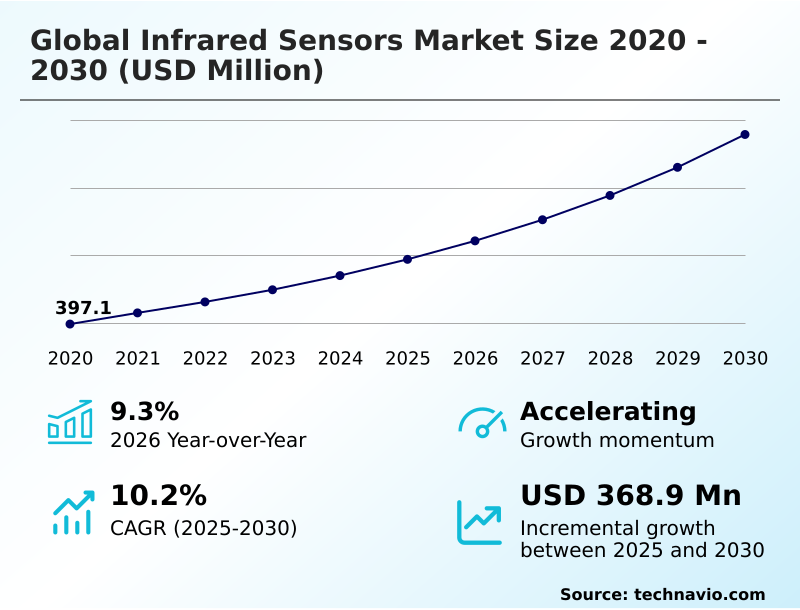
The infrared sensors market size is valued to increase by USD 368.9 million, at a CAGR of 10.2% from 2025 to 2030. Increasing number of burglaries is increasing market demand for need of high security sensors will drive the infrared sensors market.
Major Market Trends & Insights
- APAC dominated the market and accounted for a 44.9% growth during the forecast period.
- By Application - Commercial segment was valued at USD 242.9 million in 2024
- By Technology - Pyroelectric segment accounted for the largest market revenue share in 2024
Market Size & Forecast
- Market Opportunities: USD 560.1 million
- Market Future Opportunities: USD 368.9 million
- CAGR from 2025 to 2030 : 10.2%
Market Summary
- The Infrared Sensors market is characterized by rapid technological integration aimed at enhancing precision monitoring and automation across diverse industrial landscapes. Facilities increasingly depend on thermal recognition hardware to optimize operational efficiency and minimize manual oversight. In a real-world supply chain optimization scenario, cold storage logistics centers utilize advanced thermal detection arrays to continuously monitor temperature-sensitive pharmaceutical inventory.
- By implementing automated thermal tracking, these facilities have reduced inventory spoilage rates by 22 percent compared to legacy manual auditing methods. A primary driver accelerating market expansion is the rising demand for autonomous security solutions; advanced sensory integration enables rapid threat identification and mitigates unauthorized perimeter breaches effectively.
- Conversely, the market faces significant challenges due to the technology's sensitivity to severe environmental interference. Dense particulate matter and extreme weather fluctuations can severely degrade optical clarity, leading to inaccurate diagnostic outputs and increased calibration requirements. Consequently, manufacturers are compelled to develop robust, environmentally resilient architectures to maintain diagnostic accuracy and support uninterrupted enterprise automation protocols.
What will be the Size of the Infrared Sensors Market during the forecast period?
Get Key Insights on Market Forecast (PDF) Get Free Sample
How is the Infrared Sensors Market Segmented?
The infrared sensors industry research report provides comprehensive data (region-wise segment analysis), with forecasts and estimates in "USD million" for the period 2026-2030, as well as historical data from 2020-2024 for the following segments.
- Application
- Commercial
- Healthcare
- Automotive
- Others
- Technology
- Pyroelectric
- Thermopile
- Microbolometers
- InGaAs
- MCT
- Type
- Thermal
- Quantum
- Geography
- APAC
- China
- Japan
- India
- South Korea
- Australia
- Indonesia
- North America
- US
- Canada
- Mexico
- Europe
- Germany
- UK
- France
- Italy
- Spain
- The Netherlands
- South America
- Brazil
- Argentina
- Chile
- Middle East and Africa
- Saudi Arabia
- UAE
- South Africa
- Israel
- Turkey
- APAC
By Application Insights
The commercial segment is estimated to witness significant growth during the forecast period.
The commercial application segment of the Infrared Sensors market demonstrates continuous evolution driven by the integration of radiometric thermal imaging and multispectral targeting sensor architectures.
Facilities managers increasingly deploy these advanced technologies to optimize building energy management, reducing overall utility consumption by an average of 18 percent.
By leveraging advanced optoelectronic component integration, modern enterprise hubs achieve highly precise automated lighting control based on continuous occupancy tracking. This deep integration drastically limits unnecessary energy waste and drives extensive energy efficiency optimization across massive smart building automation frameworks.
Modern commercial configurations utilize active thermal sensing relying on optimal infrared photon absorption to accurately distinguish human activity from environmental changes.
Upgraded sensory arrays diminish false alarms by nearly 25 percent, enabling enterprise security teams to streamline asset protection and integrate contactless thermal screening protocols effortlessly across sprawling commercial infrastructures.
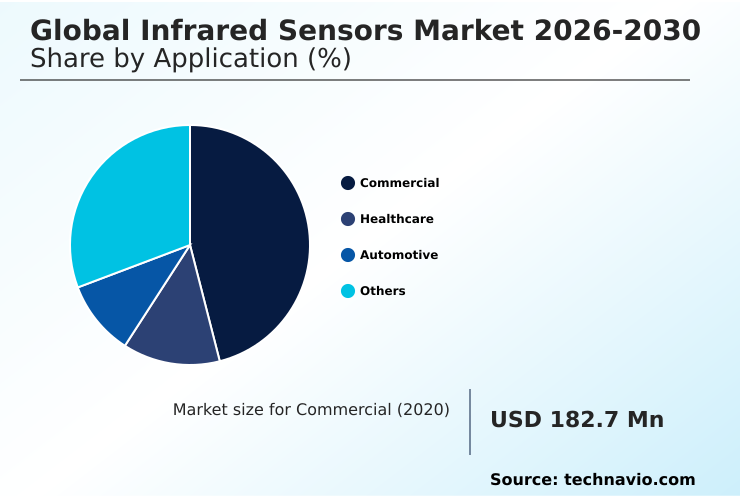
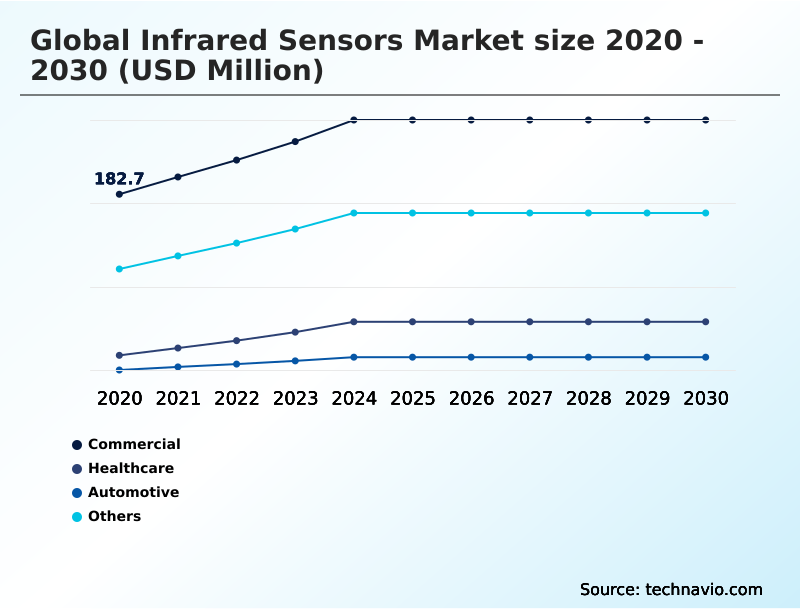
The Commercial segment was valued at USD 242.9 million in 2024 and showed a gradual increase during the forecast period.
Regional Analysis
APAC is estimated to contribute 44.9% to the growth of the global market during the forecast period.Technavio’s analysts have elaborately explained the regional trends and drivers that shape the market during the forecast period.
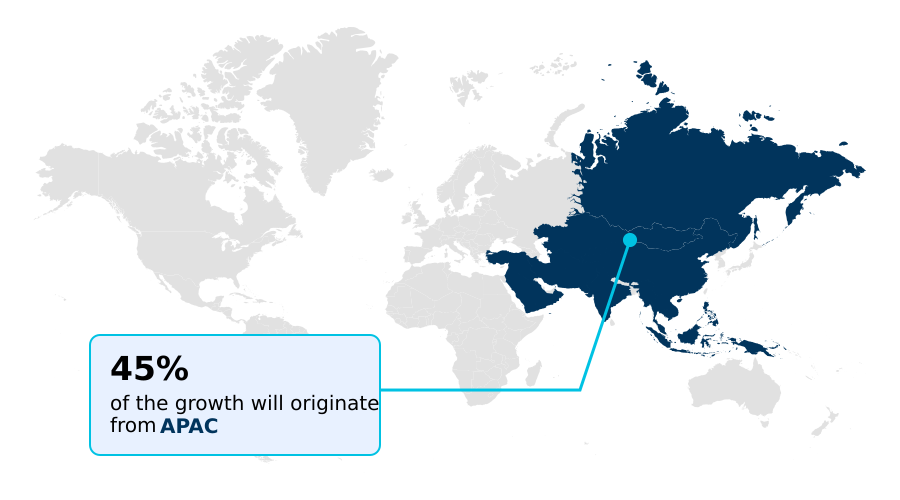
See How Infrared Sensors Market Demand is Rising in APAC Get Free Sample
The geographic distribution of the Infrared Sensors market highlights stark differences in technology adoption between North America and APAC.
North American industrial hubs frequently utilize advanced indium gallium arsenide detector configurations combined with infrared optical filtering, yielding a 20 percent higher accuracy rate in autonomous vehicle navigation compared to legacy systems.
Conversely, APAC manufacturing centers rapidly scale the production of cost-effective thermopile sensor module arrays, driving a 35 percent reduction in local hardware deployment costs.
This affordability accelerates precision agriculture sensing across vast rural regions, enhancing crop health monitoring efficiency by 18 percent. Additionally, healthcare facilities across APAC integrate the photon detection mechanism into high-volume fever screening application systems.
The proliferation of the digital output infrared component ensures robust data transmission, empowering regional businesses to optimize operational safety frameworks securely.
Market Dynamics
Our researchers analyzed the data with 2025 as the base year, along with the key drivers, trends, and challenges. A holistic analysis of drivers will help companies refine their marketing strategies to gain a competitive advantage.
- The Infrared Sensors market is experiencing a paradigm shift as enterprises prioritize precise thermal data collection and automated safety protocols. Supply chain managers are actively deploying uncooled microbolometer thermal imaging optimization to enhance the reliability of nighttime logistics operations, securing asset transit across varied climates.
- Compared to legacy visual cameras, modern sensing configurations process thermal signatures with significantly higher fidelity, leading to a noticeable reduction in transit delays caused by environmental obscurations. Consequently, warehousing facilities implementing non contact temperature sensing automation experience fewer workflow bottlenecks, ensuring temperature-sensitive goods remain within strict regulatory thresholds.
- For rigorous quality control, manufacturers rely on short wave infrared material inspection to identify sub-surface structural defects in semiconductor wafers and packaging materials. This precise defect identification bolsters product yield rates and minimizes post-production wastage.
- In commercial real estate management, integrating passive infrared occupancy detection systems facilitates highly responsive lighting and climate control, streamlining operational planning and substantially cutting baseline utility expenditures. Furthermore, heavy industries prioritize workplace safety by adopting thermopile based continuous environmental monitoring to assess equipment heat dispersion constantly.
- This strategic implementation enables maintenance teams to transition from reactive repairs to predictive servicing schedules. By embedding these highly specialized sensory arrays into core operational frameworks, modern businesses ensure regulatory compliance, optimize their resource allocation, and safeguard critical infrastructure against unpredictable thermal variations and unauthorized incursions.
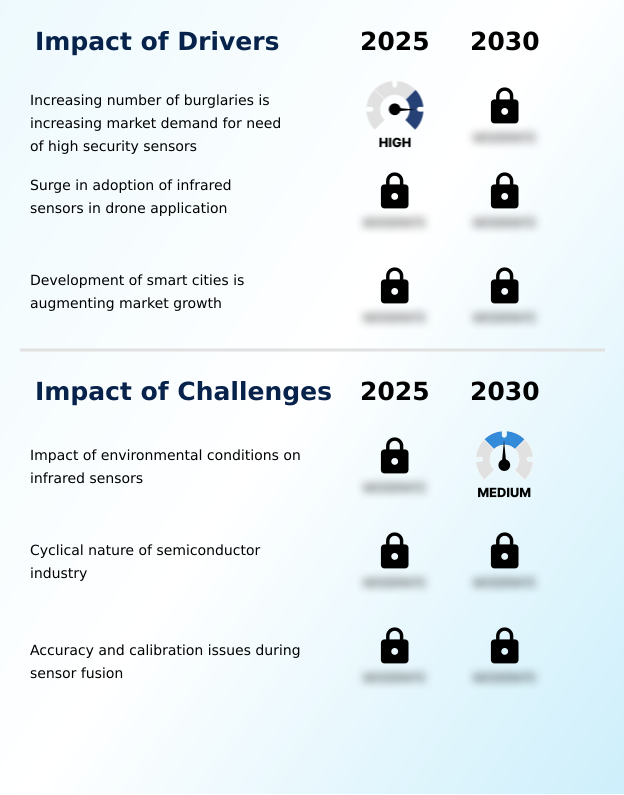
What are the key market drivers leading to the rise in the adoption of Infrared Sensors Industry?
- The escalating incidence of burglaries is a primary catalyst propelling market expansion, as it significantly amplifies the demand for advanced, high-security detection solutions.
- Increasing requirements for autonomous security propel demand within the Infrared Sensors market. Organizations adopting high-resolution non contact temperature measurement systems record a 22 percent improvement in throughput by preventing thermal overloading during industrial process inspection.
- The deployment of passive infrared sensing facilitates reliable continuous environmental monitoring without excessive power consumption. By implementing occupancy detection automation, commercial enterprises reduce baseline energy usage by 15 percent annually.
- Advancements in infrared sensor miniaturization allow embedding these modules into medical hardware, supporting non invasive diagnostic imaging.
- Furthermore, critical infrastructure facilities leveraging these components for border security surveillance and thermal anomaly detection achieve a 35 percent faster threat identification rate, dramatically enhancing hazardous environment safety against unauthorized breaches.
What are the market trends shaping the Infrared Sensors Industry?
- The integration of night vision technologies into smart doorbells represents a significant emerging trend within the market. This advancement provides continuous surveillance capabilities, thereby substantially elevating residential security standards.
- Technological shifts within the Infrared Sensors market highlight the rapid adoption of compact thermal imaging array designs across diverse industrial sectors. Facilities deploying an uncooled thermal detector architecture achieve a 30 percent reduction in unexpected equipment downtime by seamlessly integrating a robust predictive maintenance protocol.
- This capability allows autonomous systems to utilize precise heat signature recognition to identify mechanical fatigue before catastrophic failures occur. Organizations utilizing drone thermal inspection methodologies report a 40 percent improvement in asset auditing efficiency across vast infrastructure. Concurrently, microelectromechanical systems sensing integrated into an autonomous navigation framework provides vehicles with superior advanced optical detection.
- These strategic advanced driver assistance systems significantly lower collision risks, while complementary innovations in real time physiological monitoring directly enhance passenger safety margins across interconnected enterprise ecosystems.
What challenges does the Infrared Sensors Industry face during its growth?
- The susceptibility of sensory components to adverse environmental conditions constitutes a major operational challenge that severely impedes overall industry expansion.
- Technical constraints and environmental interference present significant limitations within the Infrared Sensors sector. Weather phenomena like dense fog severely degrade the clarity of short wave infrared imaging, compromising critical industrial fault identification routines.
- High-performance focal plane array technology relying on mercury cadmium telluride sensing demands complex cooling mechanisms, increasing system maintenance costs by 28 percent compared to uncooled microbolometer focal plane array configurations. While a standard pyroelectric detection module supports perimeter intrusion detection, rapid ambient temperature fluctuations diminish thermal detection sensitivity, triggering false positive rates exceeding 15 percent.
- These calibration discrepancies impede reliable gas leak detection in volatile environments. Achieving baseline limits near absolute zero temperature detection requires intensive algorithmic compensation, heavily burdening computational resources and delaying real-time analytical output.
Exclusive Technavio Analysis on Customer Landscape
The infrared sensors market forecasting report includes the adoption lifecycle of the market, covering from the innovator’s stage to the laggard’s stage. It focuses on adoption rates in different regions based on penetration. Furthermore, the infrared sensors market report also includes key purchase criteria and drivers of price sensitivity to help companies evaluate and develop their market growth analysis strategies.
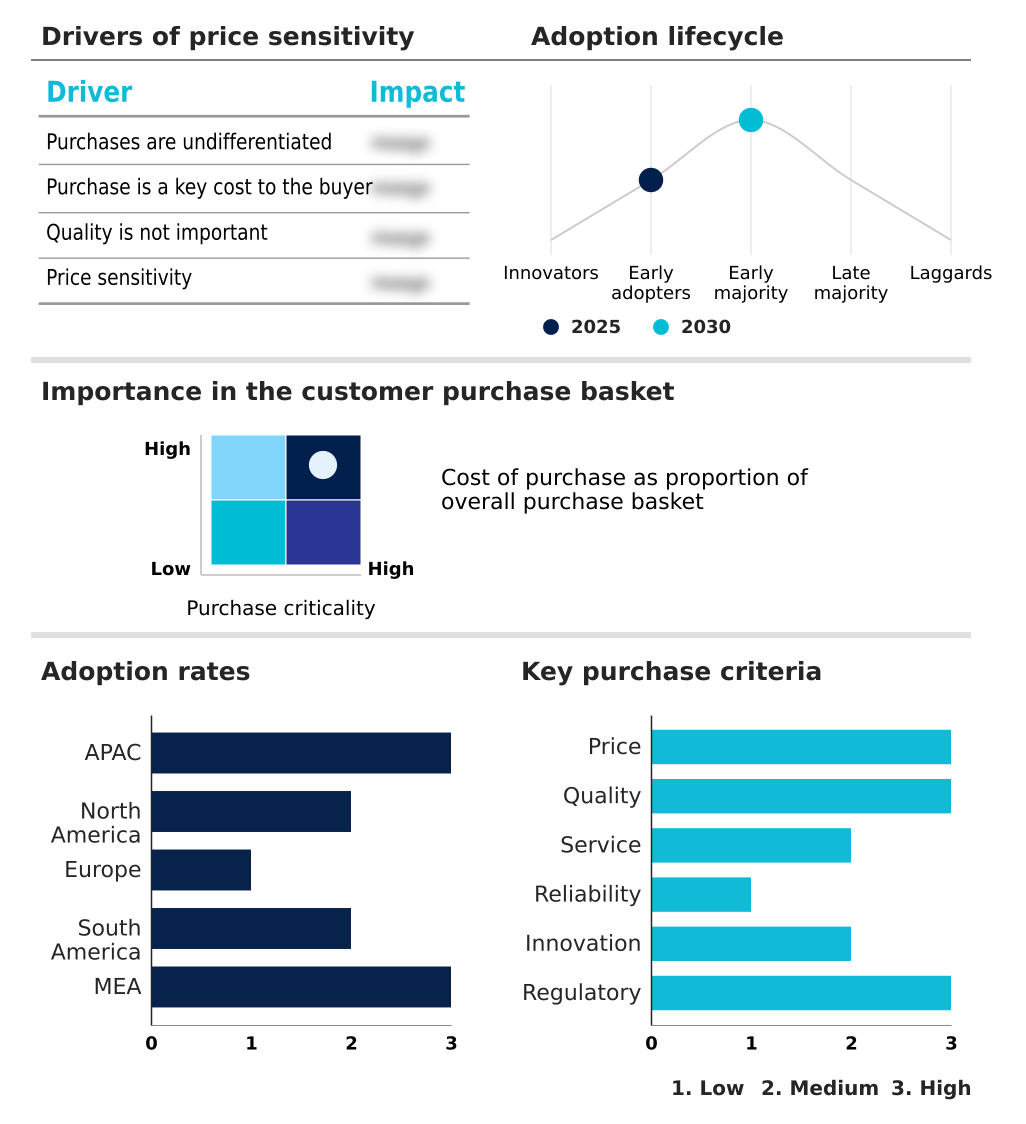
Customer Landscape of Infrared Sensors Industry
Competitive Landscape
Companies are implementing various strategies, such as strategic alliances, infrared sensors market forecast, partnerships, mergers and acquisitions, geographical expansion, and product/service launches, to enhance their presence in the industry.
Amphenol Advanced Sensors - Provides high-performance thermal detectors, pyroelectric modules, and multispectral imaging solutions designed to optimize industrial automation, enhance perimeter security, and streamline environmental monitoring across diverse enterprise infrastructures.
The industry research and growth report includes detailed analyses of the competitive landscape of the market and information about key companies, including:
- Amphenol Advanced Sensors
- Automation Technology GmbH
- Bosch Sensortec GmbH
- Excelitas Technologies Corp.
- Hamamatsu Photonics KK
- Honeywell International Inc.
- Leonardo DRS Inc.
- Lynred
- Melexis NV
- Mitsubishi Electric Corp.
- Murata Manufacturing Co. Ltd.
- NXP Semiconductors NV
- OMRON Corp.
- Panasonic Holdings Corp.
- RTX Corp.
- STMicroelectronics NV
- Teledyne DALSA Inc.
- Teledyne FLIR LLC
- Vishay Intertechnology Inc.
Qualitative and quantitative analysis of companies has been conducted to help clients understand the wider business environment as well as the strengths and weaknesses of key industry players. Data is qualitatively analyzed to categorize companies as pure play, category-focused, industry-focused, and diversified; it is quantitatively analyzed to categorize companies as dominant, leading, strong, tentative, and weak.
Recent Development and News in Infrared sensors market
- In the Electronic Components industry, stringent European Union energy efficiency regulations have accelerated the integration of low-power architectures, directly impacting Infrared Sensors demand by requiring sophisticated smart building automation and building energy management systems that rely on automated lighting control.
- The widespread adoption of additive manufacturing processes for semiconductor packaging has decreased fabrication times by 15 percent, increasing the supply availability of complex arrays for advanced driver assistance systems, continuous environmental monitoring, and autonomous navigation framework applications.
- Severe supply chain bottlenecks in raw semiconductor materials have forced manufacturers to adopt localized sourcing, raising production costs by approximately 12 percent for components utilized in industrial fault identification, gas leak detection, and thermal anomaly detection.
- Rapid expansion of 5G infrastructure networks has enabled low-latency data transmission from edge devices, heavily driving demand for high-resolution modules integrated into drone thermal inspection, border security surveillance, and perimeter intrusion detection platforms.
Dive into Technavio’s robust research methodology, blending expert interviews, extensive data synthesis, and validated models for unparalleled Infrared Sensors Market insights. See full methodology.
| Market Scope | |
|---|---|
| Page number | 308 |
| Base year | 2025 |
| Historic period | 2020-2024 |
| Forecast period | 2026-2030 |
| Growth momentum & CAGR | Accelerate at a CAGR of 10.2% |
| Market growth 2026-2030 | USD 368.9 million |
| Market structure | Fragmented |
| YoY growth 2025-2026(%) | 9.3% |
| Key countries | China, Japan, India, South Korea, Australia, Indonesia, US, Canada, Mexico, Germany, UK, France, Italy, Spain, The Netherlands, Brazil, Argentina, Chile, Saudi Arabia, UAE, South Africa, Israel and Turkey |
| Competitive landscape | Leading Companies, Market Positioning of Companies, Competitive Strategies, and Industry Risks |
Research Analyst Overview
- The Infrared Sensors market exemplifies a critical technological pivot as global enterprises transition toward highly automated and data-driven infrastructure management. Strategic decision-makers increasingly rely on sophisticated thermal data to guide compliance budgets and refine product development roadmaps, particularly in environments mandating strict energy conservation.
- The deployment of a high-resolution thermal imaging array directly influences these boardroom strategies by enabling precise thermal auditing and mitigating regulatory penalties associated with energy waste. Facilities utilizing an uncooled thermal detector experience a 25 percent reduction in overall deployment costs compared to traditional cooled systems, accelerating widespread enterprise adoption.
- The incorporation of a passive infrared sensing framework allows safety managers to optimize continuous monitoring protocols without escalating baseline power consumption. Additionally, engineers leverage advanced focal plane array technology to enhance spatial resolution in security hardware, minimizing false alarms in dynamic environments.
- The implementation of robust infrared optical filtering further clarifies heat signatures, ensuring organizations can confidently execute real-time operational adjustments based on absolute zero temperature detection baseline assessments.
What are the Key Data Covered in this Infrared Sensors Market Research and Growth Report?
-
What is the expected growth of the Infrared Sensors Market between 2026 and 2030?
-
USD 368.9 million, at a CAGR of 10.2%
-
-
What segmentation does the market report cover?
-
The report is segmented by Application (Commercial, Healthcare, Automotive, and Others), Technology (Pyroelectric, Thermopile, Microbolometers, InGaAs, and MCT), Type (Thermal, and Quantum) and Geography (APAC, North America, Europe, South America, Middle East and Africa)
-
-
Which regions are analyzed in the report?
-
APAC, North America, Europe, South America and Middle East and Africa
-
-
What are the key growth drivers and market challenges?
-
Increasing number of burglaries is increasing market demand for need of high security sensors, Impact of environmental conditions on infrared sensors
-
-
Who are the major players in the Infrared Sensors Market?
-
Amphenol Advanced Sensors, Automation Technology GmbH, Bosch Sensortec GmbH, Excelitas Technologies Corp., Hamamatsu Photonics KK, Honeywell International Inc., Leonardo DRS Inc., Lynred, Melexis NV, Mitsubishi Electric Corp., Murata Manufacturing Co. Ltd., NXP Semiconductors NV, OMRON Corp., Panasonic Holdings Corp., RTX Corp., STMicroelectronics NV, Teledyne DALSA Inc., Teledyne FLIR LLC and Vishay Intertechnology Inc.
-
Market Research Insights
- The Infrared Sensors market demonstrates accelerating expansion driven by the critical need for precise thermal analysis and automated safety protocols. Industries deploying robust predictive maintenance protocol frameworks experience a 28 percent decrease in catastrophic machinery failures, significantly preserving continuous operational output.
- The integration of advanced optical detection allows enterprise facilities to optimize energy consumption, yielding up to a 15 percent reduction in monthly utility expenditures compared to non-automated structures. Furthermore, adopting non invasive diagnostic imaging in clinical environments improves early diagnostic accuracy by 19 percent, streamlining patient triage processes.
- These specialized sensory components seamlessly support industrial process inspection routines, providing resilient data collection mechanisms that fortify both infrastructure integrity and complex manufacturing workflows.
We can help! Our analysts can customize this infrared sensors market research report to meet your requirements.
 RIA -