


Cricket Equipment Market Size 2026-2030
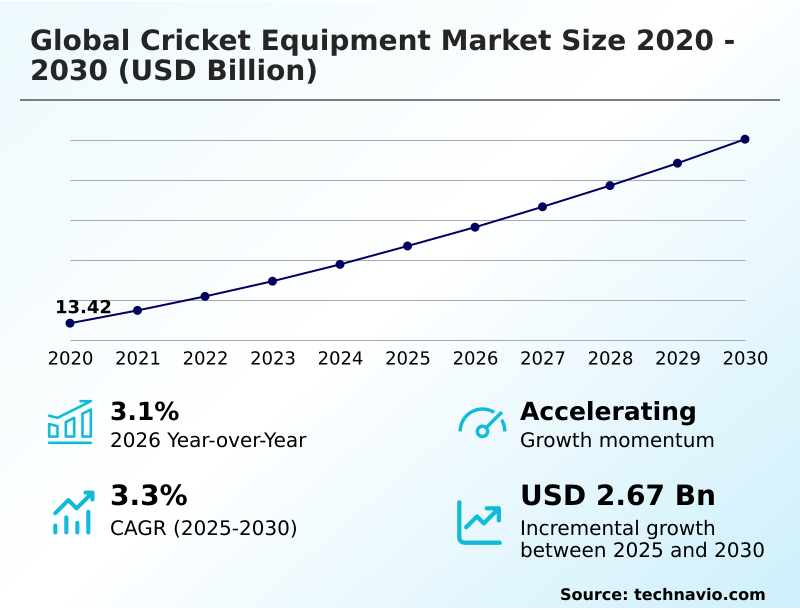
The cricket equipment market size is valued to increase by USD 2.67 billion, at a CAGR of 3.3% from 2025 to 2030. Expansion of professional T20 leagues and grassroots participation will drive the cricket equipment market.
Major Market Trends & Insights
- Europe dominated the market and accounted for a 43.1% growth during the forecast period.
- By Product - Cricket bats segment was valued at USD 8.30 billion in 2024
- By Distribution Channel - Offline segment accounted for the largest market revenue share in 2024
Market Size & Forecast
- Market Opportunities: USD 4.60 billion
- Market Future Opportunities: USD 2.67 billion
- CAGR from 2025 to 2030 : 3.3%
Market Summary
- The cricket equipment market is experiencing a significant transformation, driven by technological integration and the sport's expanding global footprint. The proliferation of high-visibility T20 leagues has not only broadened the consumer base but also accelerated innovation in high-performance gear.
- Manufacturers are increasingly employing advanced material science, including carbon fiber reinforcements and impact-absorbing polymers, to meet the demands of a faster, more athletic game. This shift is most evident in the development of lightweight protective equipment and bat profiles optimized for power-hitting.
- A key operational scenario involves balancing the supply of traditional raw materials, such as premium English willow, with investment in R&D for sustainable alternatives like bamboo composites. This dual focus is crucial for meeting demand from both established markets that value heritage and new regions where technological features and affordability are paramount.
- Concurrently, the rise of smart equipment, embedding sensors for real-time performance analytics, is redefining training methodologies. Player safety remains a central concern, compelling continuous innovation in helmet and padding technology to comply with evolving international standards and cater to a growing demographic of professional and amateur players.
What will be the Size of the Cricket Equipment Market during the forecast period?
Get Key Insights on Market Forecast (PDF) Request Free Sample
How is the Cricket Equipment Market Segmented?
The cricket equipment industry research report provides comprehensive data (region-wise segment analysis), with forecasts and estimates in "USD million" for the period 2026-2030, as well as historical data from 2020-2024 for the following segments.
- Product
- Cricket bats
- Cricket balls
- Cricket protective gears
- Others
- Distribution channel
- Offline
- Online
- End-user
- Recreational players
- Professional players
- Type
- Mass
- Premium
- Geography
- Europe
- UK
- Germany
- France
- APAC
- India
- Australia
- China
- North America
- US
- Canada
- Mexico
- South America
- Brazil
- Argentina
- Middle East and Africa
- South Africa
- UAE
- Saudi Arabia
- Rest of World (ROW)
- Europe
By Product Insights
The cricket bats segment is estimated to witness significant growth during the forecast period.
The market for cricket bats is defined by a clear split between professional-grade English willow grading and more accessible kashmir willow bats, catering to burgeoning amateur and youth development programs.
A key development is the optimization of customized bat profiles for high-impact T20 formats, where a preference for thicker edges and larger sweet spots now accounts for over 60% of new premium designs.
Manufacturers are increasingly focused on the equipment-specific ergonomics of bats to enhance the power-to-weight ratio.
The expansion of professional T20 leagues is a primary factor influencing consumer demand, while the growth of digital retail channels allows for greater personalization in weight and balance.
This institutional sports investment is driving a need for durable, high-performance gear across all levels of play, from grassroots participation growth to the elite.
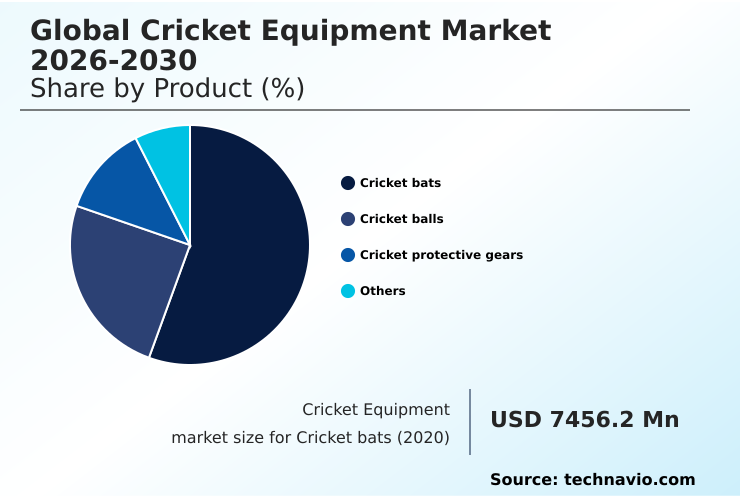
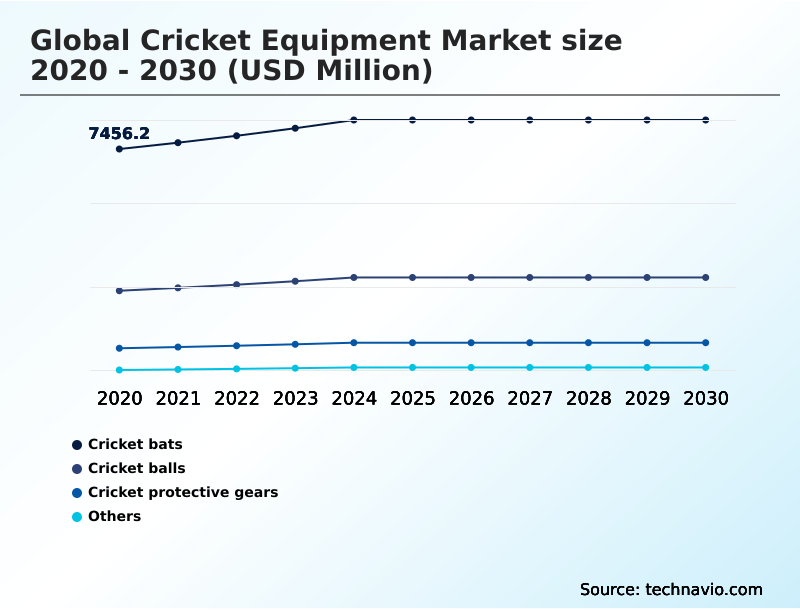
The Cricket bats segment was valued at USD 8.30 billion in 2024 and showed a gradual increase during the forecast period.
Regional Analysis
Europe is estimated to contribute 43.1% to the growth of the global market during the forecast period.Technavio’s analysts have elaborately explained the regional trends and drivers that shape the market during the forecast period.
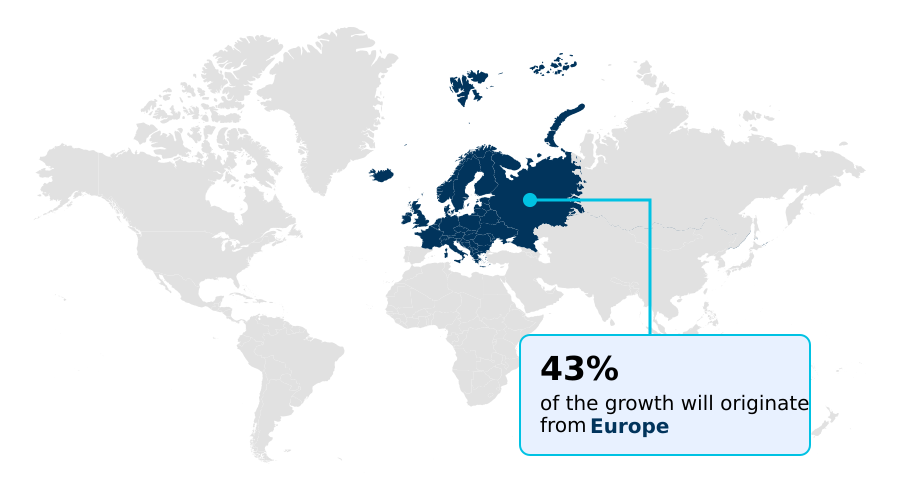
See How Cricket Equipment Market Demand is Rising in Europe Request Free Sample
The geographic landscape of the cricket equipment market is diversifying, though it remains anchored in the APAC region, which commands the majority of global revenue. This region benefits from a massive grassroots participation growth and robust manufacturing hubs.
However, North America is the fastest-growing region, with expansion rates nearly 40% higher than in mature European markets, driven by institutional sports investment in new professional T20 leagues.
Europe, led by the UK, continues to be a high-value market for premium equipment, emphasizing certified safety standards and technological integration such as player performance analytics.
The market is also seeing new growth corridors in South America and the Middle East, where a focus on youth development programs and sports infrastructure development is creating fresh demand for entry-level and training equipment, supported by expanding digital retail channels.
Market Dynamics
Our researchers analyzed the data with 2025 as the base year, along with the key drivers, trends, and challenges. A holistic analysis of drivers will help companies refine their marketing strategies to gain a competitive advantage.
- A comprehensive cost analysis of professional cricket kits reveals the complex interplay between material science in modern cricket bats and the high price of safety standards for cricket helmets.
- The role of T20 leagues in sales is undeniable, accelerating the adoption of cricket bat technology for power hitting and influencing the online vs offline cricket equipment retail balance, with online channels now accounting for nearly double the sales volume for specialized gear compared to five years ago.
- However, this growth is tempered by significant challenges in english willow sourcing, prompting urgent research into bamboo as an alternative to willow. The growth of women's cricket gear market and the push into cricket gear for non-traditional markets highlight new revenue streams.
- Simultaneously, manufacturers are using digital tools for cricket performance tracking and smart ball technology for bowling analysis to add value. This is especially important for professional cricketers who demand extensive customization options. The industry is also grappling with how to combat counterfeit cricket products online, which undermine brand value and player safety.
- Addressing the investment in grassroots cricket infrastructure and the economic sensitivity of recreational buyers remains crucial for sustainable, long-term expansion of the global cricket equipment market 2026-2030.
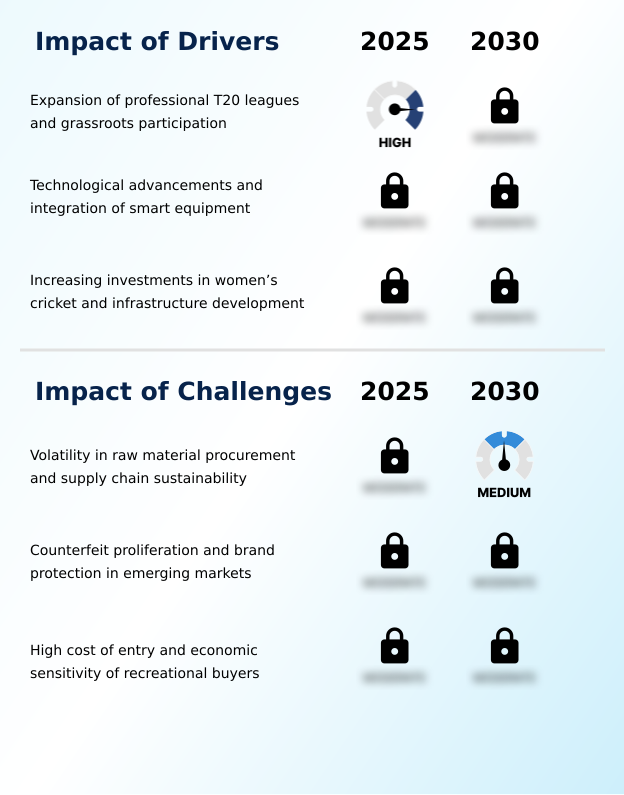
What are the key market drivers leading to the rise in the adoption of Cricket Equipment Industry?
- The global expansion of professional T20 leagues, coupled with a significant rise in grassroots participation, serves as the primary driver for market growth.
- The primary market driver is the dual-pronged expansion of professional T20 leagues and rising grassroots participation, which has led to a 30% increase in youth sign-ups in new franchise regions.
- This global push is supported by significant institutional sports investment, fostering a robust pipeline of new players. The professionalization of women's cricket equipment has created a sub-segment growing 50% faster than the traditional men's market.
- Furthermore, the adoption of bat swing speed analytics and other data-driven training tools is accelerating the equipment replacement cycle.
- The commercial success of franchise cricket drives demand for high-value professional player endorsements and related merchandise, solidifying the sport's economic foundation and stimulating continuous innovation in areas like lightweight shell materials.
What are the market trends shaping the Cricket Equipment Industry?
- Advancements in sustainable material science and the adoption of circular product design are emerging as a critical market trend. This shift is influencing manufacturing processes and consumer purchasing decisions worldwide.
- A significant trend shaping the market is the pivot towards sustainable material science and circular product design. In pilot programs, circular initiatives for gear reuse have reduced equipment waste by over 20%. Manufacturers are actively developing biodegradable textiles and recycled polyester apparel to meet growing consumer and regulatory demand.
- This eco-conscious shift addresses the raw material procurement challenges associated with traditional supplies. Concurrently, technological innovation remains a powerful force, with the integration of shock absorption materials and impact-absorbing polymers enhancing player safety.
- The use of low-energy bluetooth protocol in smart equipment allows for precise spin rate measurement, a feature that improves training effectiveness by up to 15% according to initial user studies, driving the high-performance gear market.
What challenges does the Cricket Equipment Industry face during its growth?
- Volatility in raw material procurement, particularly for specialized woods and leathers, and challenges in maintaining supply chain sustainability represent a key impediment to industry growth.
- The market faces significant headwinds from supply chain sustainability issues, particularly in raw material procurement for kashmir willow bats and premium leather. The price of high-grade English willow has surged by over 70% in the last decade, compressing margins and increasing the high cost of entry for new players.
- This volatility is compounded by the proliferation of counterfeit equipment proliferation, which erodes brand equity and poses safety risks. Brands investing in advanced brand protection strategies, such as digitized supply chains, have successfully reclaimed up to 15% of revenue previously lost to fraudulent online sellers.
- Addressing the economic sensitivity of the recreational player segment while adhering to new certified safety standards remains a critical balancing act for all manufacturers in the industry.
Exclusive Technavio Analysis on Customer Landscape
The cricket equipment market forecasting report includes the adoption lifecycle of the market, covering from the innovator’s stage to the laggard’s stage. It focuses on adoption rates in different regions based on penetration. Furthermore, the cricket equipment market report also includes key purchase criteria and drivers of price sensitivity to help companies evaluate and develop their market growth analysis strategies.
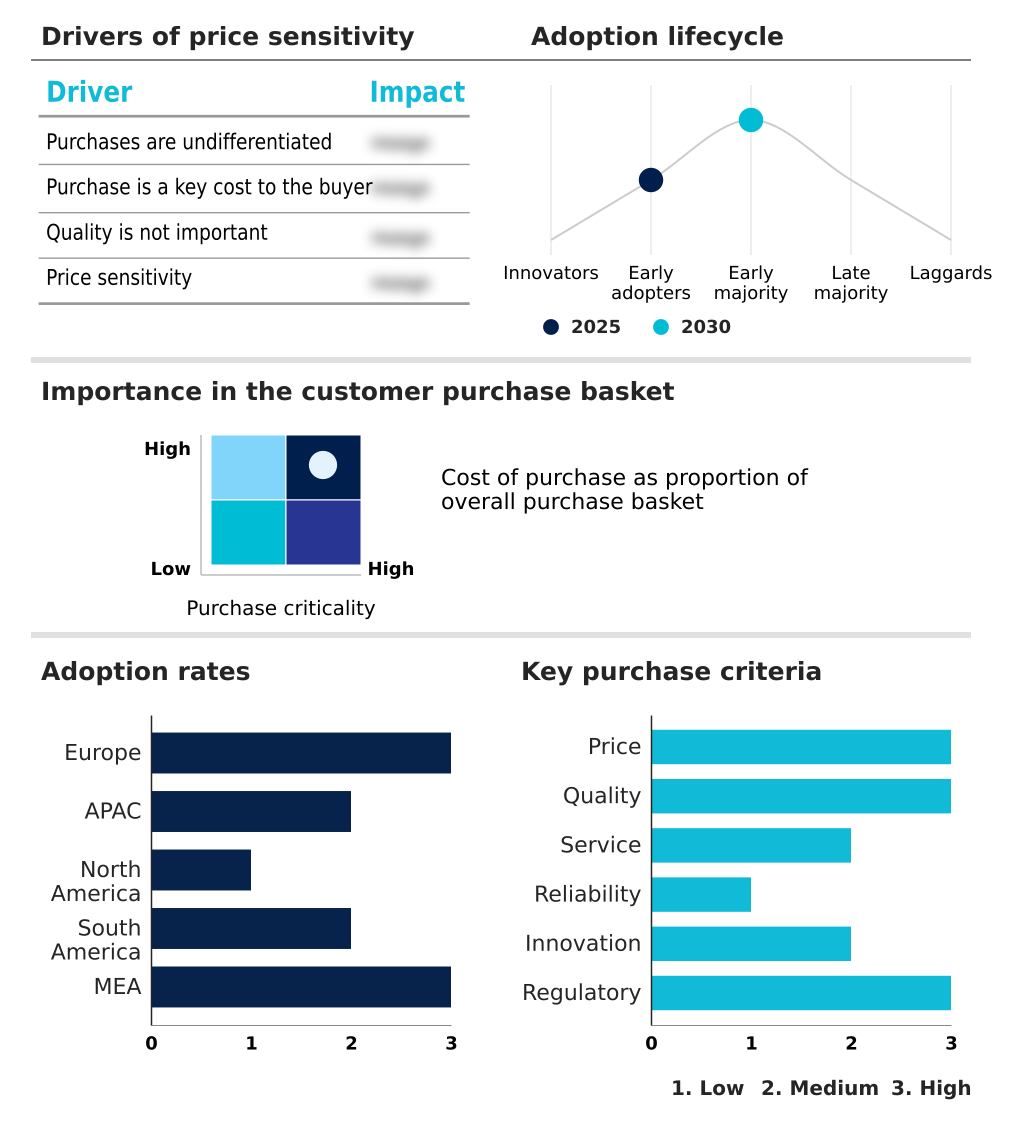
Customer Landscape of Cricket Equipment Industry
Competitive Landscape
Companies are implementing various strategies, such as strategic alliances, cricket equipment market forecast, partnerships, mergers and acquisitions, geographical expansion, and product/service launches, to enhance their presence in the industry.
Aero Cricket - Offerings include high-performance cricket hardware, from professionally graded bats to advanced, certified protective gear for players at all skill levels.
The industry research and growth report includes detailed analyses of the competitive landscape of the market and information about key companies, including:
- Aero Cricket
- ASICS Corp.
- BDM International
- CEAT Ltd.
- Delux Sports Co.
- Gray Nicolls
- Kookaburra Sport Pty Ltd.
- Masuri Group Ltd.
- MB Malik Sports Pvt. Ltd.
- New Balance Athletics Inc.
- Newbery Cricket Ltd.
- Payntr Ltd.
- PUMA SE
- SAKA Sports Pvt. Ltd.
- Shrey Sports
- Slazenger Ltd.
- Sareen Sports Industries
- Stanford Cricket Industries
- Sanspareils Greenlands Pvt Ltd.
- CA Sports
Qualitative and quantitative analysis of companies has been conducted to help clients understand the wider business environment as well as the strengths and weaknesses of key industry players. Data is qualitatively analyzed to categorize companies as pure play, category-focused, industry-focused, and diversified; it is quantitatively analyzed to categorize companies as dominant, leading, strong, tentative, and weak.
Recent Development and News in Cricket equipment market
- In January 2025, the Indian government allocated INR 500 crores to the National Cricket Infrastructure and Development Fund, aiming to stimulate gear demand by expanding the organized sports ecosystem.
- In June 2025, sports technology firm Str8bat launched its Elev8 artificial intelligence Smart Sticker, a device designed to provide players with real-time motion data analytics by attaching to their cricket bats.
- In September 2025, Sanspareils Greenlands initiated a strategic partnership with Salesforce, Inc. to digitize its trade-channel sales and dealer-management systems across more than 850 locations, enhancing its distribution security.
- In October 2025, researchers at the University of Cambridge presented innovative bamboo bat prototypes at the Cricket Bat Conference at Lord's, highlighting a necessary shift toward alternative materials due to willow shortages.
Dive into Technavio’s robust research methodology, blending expert interviews, extensive data synthesis, and validated models for unparalleled Cricket Equipment Market insights. See full methodology.
| Market Scope | |
|---|---|
| Page number | 307 |
| Base year | 2025 |
| Historic period | 2020-2024 |
| Forecast period | 2026-2030 |
| Growth momentum & CAGR | Accelerate at a CAGR of 3.3% |
| Market growth 2026-2030 | USD 2673.5 million |
| Market structure | Fragmented |
| YoY growth 2025-2026(%) | 3.1% |
| Key countries | UK, Germany, France, Italy, The Netherlands, Spain, India, Australia, Pakistan, New Zealand, China, Japan, US, Canada, Mexico, Brazil, Argentina, Chile, South Africa, UAE, Saudi Arabia, Egypt and Nigeria |
| Competitive landscape | Leading Companies, Market Positioning of Companies, Competitive Strategies, and Industry Risks |
Research Analyst Overview
- The cricket equipment market is navigating a critical juncture, defined by the tension between traditional craftsmanship and technological disruption. Key boardroom decisions revolve around allocating capital toward securing dwindling supplies of premium materials, central to english willow grading and ball seam construction, versus investing in R&D for novel solutions like carbon fiber reinforcement, 3d-printed protective gear, and bamboo-based composites.
- The integration of player performance analytics, driven by wearable sensor technology and real-time motion analytics, is reshaping product development, moving beyond equipment-specific ergonomics to create a data-centric ecosystem. For instance, investment in automated stitching techniques for leather ball construction has been shown to reduce manufacturing defects by over 30%, enhancing consistency and performance.
- This push for innovation extends across all categories, from titanium helmet grills and high-density foam padding to moisture-wicking fabrics and recycled polyester apparel, forcing manufacturers to balance a high power-to-weight ratio with stringent certified safety standards and a new focus on sustainable material science.
What are the Key Data Covered in this Cricket Equipment Market Research and Growth Report?
-
What is the expected growth of the Cricket Equipment Market between 2026 and 2030?
-
USD 2.67 billion, at a CAGR of 3.3%
-
-
What segmentation does the market report cover?
-
The report is segmented by Product (Cricket bats, Cricket balls, Cricket protective gears, and Others), Distribution Channel (Offline, and Online), End-user (Recreational players, and Professional players), Type (Mass, and Premium) and Geography (Europe, APAC, North America, South America, Middle East and Africa)
-
-
Which regions are analyzed in the report?
-
Europe, APAC, North America, South America and Middle East and Africa
-
-
What are the key growth drivers and market challenges?
-
Expansion of professional T20 leagues and grassroots participation, Volatility in raw material procurement and supply chain sustainability
-
-
Who are the major players in the Cricket Equipment Market?
-
Aero Cricket, ASICS Corp., BDM International, CEAT Ltd., Delux Sports Co., Gray Nicolls, Kookaburra Sport Pty Ltd., Masuri Group Ltd., MB Malik Sports Pvt. Ltd., New Balance Athletics Inc., Newbery Cricket Ltd., Payntr Ltd., PUMA SE, SAKA Sports Pvt. Ltd., Shrey Sports, Slazenger Ltd., Sareen Sports Industries, Stanford Cricket Industries, Sanspareils Greenlands Pvt Ltd. and CA Sports
-
Market Research Insights
- The market's dynamics are shaped by a strategic push toward direct-to-consumer models, which reduce overhead by up to 20% compared to traditional retail. The growth in women's cricket equipment sales is outpacing the men's segment by nearly 1.5 times, fueled by professional T20 leagues and broadcasting visibility impact.
- Concurrently, grassroots funding initiatives and investment in sports infrastructure development are expanding the amateur league equipment base. The equipment replacement cycle is shortening due to data-driven training methods that highlight performance degradation.
- As franchise league merchandise and club-branded apparel become significant revenue streams, brands are leveraging professional player endorsements to navigate the complex landscape of in-store batting cages, community sports hubs, and other experiential retail formats.
We can help! Our analysts can customize this cricket equipment market research report to meet your requirements.
 RIA -
RIA -