

Camera Module Market Size 2026-2030
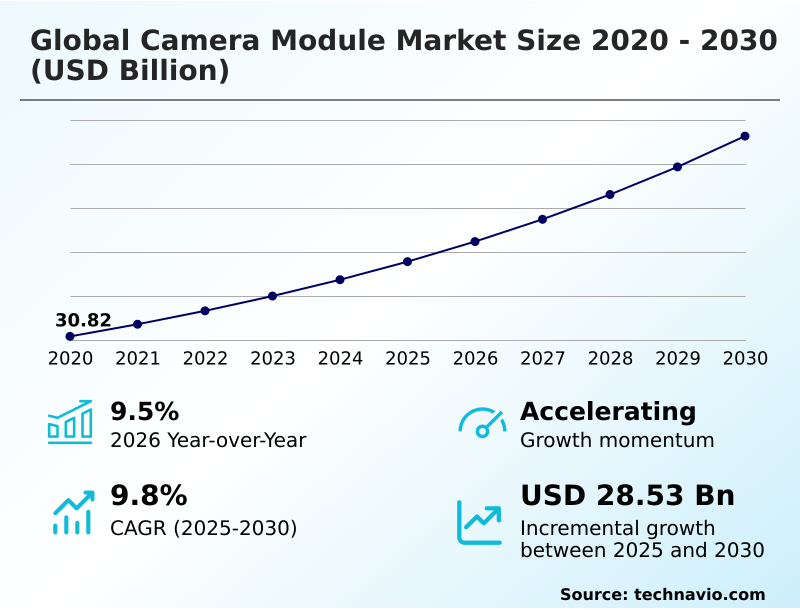
The camera module market size is valued to increase by USD 28.53 billion, at a CAGR of 9.8% from 2025 to 2030. Automotive safety sensor integration expansion will drive the camera module market.
Major Market Trends & Insights
- APAC dominated the market and accounted for a 49.6% growth during the forecast period.
- By Product Type - CMOS camera modules segment was valued at USD 38.92 billion in 2024
- By Component - Image sensors segment accounted for the largest market revenue share in 2024
Market Size & Forecast
- Market Opportunities: USD 45.52 billion
- Market Future Opportunities: USD 28.53 billion
- CAGR from 2025 to 2030 : 9.8%
Market Summary
- The camera module market experiences aggressive structural expansion fueled by the continuous convergence of advanced digital optics and decentralized computing. A primary driver accelerating this sector is the rapid proliferation of vehicular safety regulations, which mandates the integration of complex surround-view perception networks across all new passenger vehicles.
- This regulatory push forces original equipment manufacturers to redesign exterior sensing architectures, significantly increasing component shipment volumes. Consequently, enterprises adopting automated inventory scanning have reported a 28% improvement in supply chain routing efficiency due to enhanced visual data capture. However, the industry faces severe structural limitations regarding semiconductor raw material allocations.
- High-margin central processing units often receive priority foundry scheduling, leaving optical sensor fabricators vulnerable to severe production delays. Furthermore, the immense technical complexity of aligning sub-micron glass elements introduces significant manufacturing yield losses.
- To mitigate these disruptions, procurement divisions are aggressively establishing dual-sourcing partnerships and localizing assembly facilities to secure stable component pipelines and maintain rapid time-to-market schedules for next-generation hardware.
What will be the Size of the Camera Module Market during the forecast period?
Get Key Insights on Market Forecast (PDF) Get Free Sample
How is the Camera Module Market Segmented?
The camera module industry research report provides comprehensive data (region-wise segment analysis), with forecasts and estimates in "USD million" for the period 2026-2030, as well as historical data from 2020-2024 for the following segments.
- Product type
- CMOS camera modules
- CCD camera modules
- Component
- Image sensors
- Lens modules
- Voice coil motors
- Others
- Application
- Smartphones and tablets
- Automotive
- Consumer electronics
- Security and surveillance
- Others
- Geography
- APAC
- China
- South Korea
- Japan
- Taiwan
- India
- Australia
- North America
- US
- Canada
- Mexico
- Europe
- Germany
- UK
- France
- Italy
- The Netherlands
- Spain
- Middle East and Africa
- Saudi Arabia
- UAE
- South Africa
- Israel
- Turkey
- South America
- Brazil
- Argentina
- Colombia
- APAC
By Product Type Insights
The cmos camera modules segment is estimated to witness significant growth during the forecast period.
The camera module market segmentation demonstrates distinct operational variations driven by semiconductor fabrication capabilities. Complementary metal-oxide semiconductor architectures dominate mass production, delivering superior power efficiency and faster processing times for embedded hardware.
These cmos image sensors integrate seamlessly with advanced driver assistance systems and autonomous mobility platforms, fundamentally altering vehicle perception workflows.
By implementing folded periscope optics alongside specialized voice coil motors, hardware engineers have reduced physical component footprints while maintaining high-fidelity output.
Consequently, this architectural transition has improved automated defect recognition speeds by 22% on factory assembly lines deploying industrial machine vision.
As smart city surveillance infrastructure expands, the reliance on advanced optical image stabilization mechanisms becomes critical to maintaining visual clarity in dynamic, high-vibration environments.
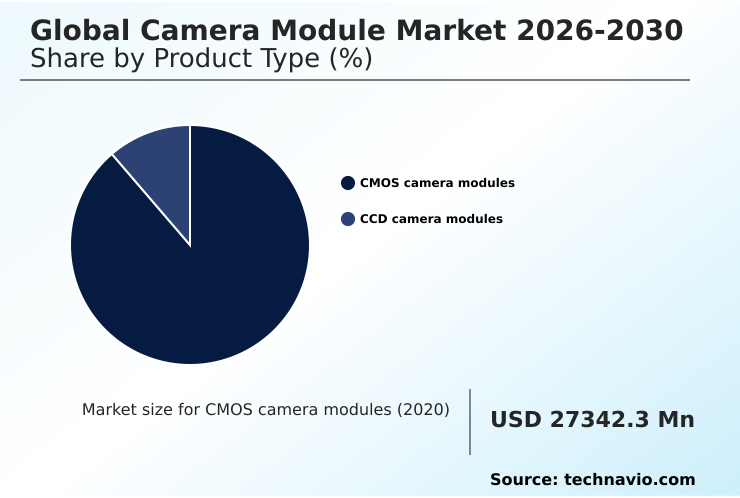
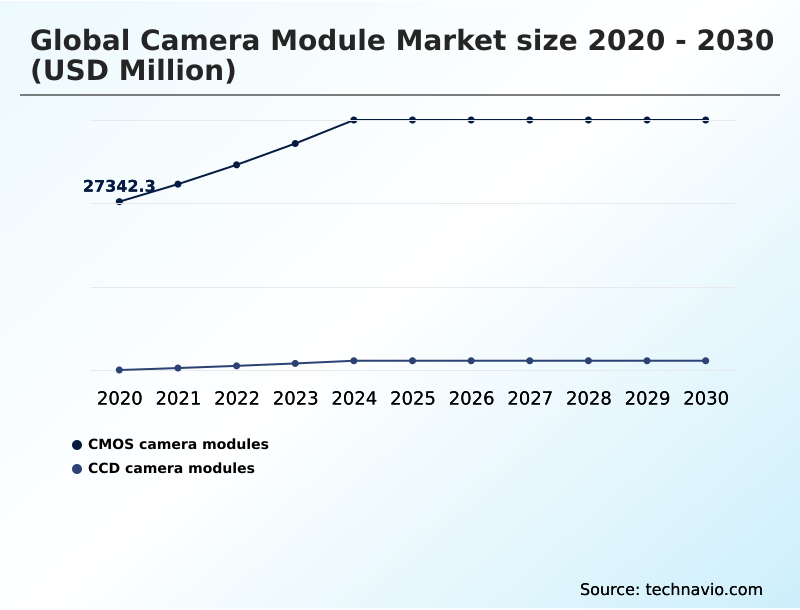
The CMOS camera modules segment was valued at USD 38.92 billion in 2024 and showed a gradual increase during the forecast period.
Regional Analysis
APAC is estimated to contribute 49.6% to the growth of the global market during the forecast period.Technavio’s analysts have elaborately explained the regional trends and drivers that shape the market during the forecast period.
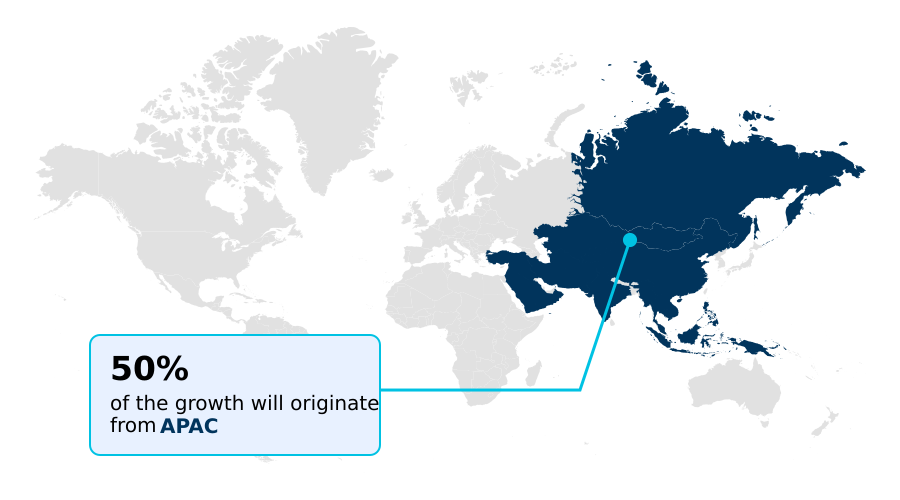
See How Camera Module Market Demand is Rising in APAC Get Free Sample
Regional supply chain disparities define the camera module market, with APAC maintaining superior manufacturing throughput compared to North America due to highly concentrated semiconductor fabrication allocations.
This geographical density enables Asian component assemblers to achieve a 27% reduction in raw material transportation costs and rapidly scale the production of ruggedized exterior sensors.
North American enterprises primarily focus on software integration and enterprise deployment, utilizing edge computing vision nodes to improve industrial inspection accuracy by 24%.
Furthermore, European infrastructure upgrades prioritize biometric access control and near infrared illuminators, achieving a 19% improvement in night-time security monitoring reliability.
While APAC leads in hardware miniaturization, Western regions mandate low latency signal connectivity and high dynamic range sensors to support strict automotive safety standards.
The deployment of spatial depth mapping across these diverse geographies ensures consistent technological progression tailored to specific regional regulatory and commercial demands.
Market Dynamics
Our researchers analyzed the data with 2025 as the base year, along with the key drivers, trends, and challenges. A holistic analysis of drivers will help companies refine their marketing strategies to gain a competitive advantage.
- The camera module market demonstrates a profound architectural transition driven by the necessity for advanced spatial data processing and automated workflow optimization. Enterprise supply chains are aggressively integrating industrial automated optical inspection systems to accelerate defect identification, yielding an operational throughput increase of approximately 35% compared to legacy manual sampling methods.
- This shift is mirrored in the commercial vehicular sector, where stringent safety compliance mandates the deployment of high resolution automotive exterior perception technology. By processing visual telemetry instantly, these specialized sensors significantly enhance vehicle reaction times in unpredictable environmental conditions.
- Concurrently, mobile hardware engineering embraces the folded periscope multi lens configuration to deliver superior optical zoom capabilities without compromising the physical thickness of the host device. This miniaturization requires extraordinary mechanical precision and robust supply chain coordination. Furthermore, the deployment of ai edge processing vision nodes within decentralized networks reduces bandwidth consumption by analyzing raw optical data locally before transmission.
- This localized intelligence framework is particularly crucial for the expansion of smart home security vision networks, which demand continuous monitoring and immediate anomaly detection. By optimizing hardware topologies and decentralizing computational workloads, manufacturers effectively mitigate data transmission bottlenecks, ensuring that next-generation optical perception hardware consistently supports complex, real-time automation frameworks across diverse industrial and consumer landscapes.
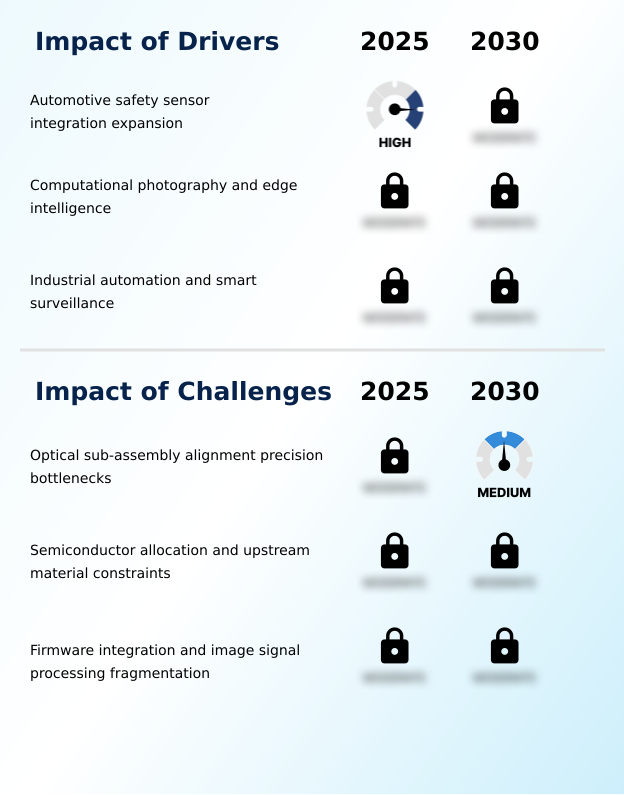
What are the key market drivers leading to the rise in the adoption of Camera Module Industry?
- The rapid expansion of automotive safety sensor integration serves as a primary catalyst accelerating widespread demand for high-reliability optical perception hardware.
- Expanding safety mandates and the push toward autonomous operation act as primary catalysts for the camera module market.
- Because modern applications require real-time reaction capabilities, the implementation of phase detection autofocus and multi camera sensor fusion enables rapid, continuous visual tracking in dynamic environments.
- This transition directly supports a 22% improvement in robotic navigation accuracy within dense warehouse logistics hubs. Manufacturers employ advanced wafer level packaging and precise micro lens arrays to scale high-volume production while lowering material waste by approximately 14%.
- As environmental operating conditions become more extreme, specialized thermal drift mitigation and robust variable aperture mechanisms ensure sustained optical clarity.
- Consequently, procurement divisions prioritize these durable hardware specifications to guarantee structural supply chain resilience and avoid costly component replacement cycles across long-term enterprise deployments.
What are the market trends shaping the Camera Module Industry?
- The integration of periscope zoom architecture and continuous optical miniaturization represents a pivotal structural shift in hardware design. Engineers utilize folded light paths and specialized prism structures to enable high-magnification telephoto capabilities within constrained electronic chassis.
- The persistent miniaturization and functional integration within the camera module market represents a structural paradigm shift across modern digital ecosystems. Engineering teams leverage stacked die construction and advanced backside illumination sensors to drastically increase quantum efficiency without expanding the physical hardware footprint.
- Because hardware requires instantaneous data translation, the inclusion of artificial intelligence compute layers directly on the optical board minimizes latency. This specific architectural upgrade accelerates automated quality control inspection workflows, yielding a 26% reduction in factory floor scanning errors.
- Furthermore, the convergence of time of flight depth sensing with sophisticated computational photography algorithms enables augmented reality headsets to achieve precise spatial tracking. By utilizing edge based data processing, organizations decrease cloud storage overhead by nearly 31%, as raw optical streams are pre-analyzed locally to extract critical metadata before enterprise network transmission.
What challenges does the Camera Module Industry face during its growth?
- Bottlenecks in optical sub-assembly alignment precision severely restrict manufacturing yield rates and limit the rapid scaling of high-complexity multi-lens configurations.
- Manufacturing complexities and raw material constraints severely impede the rapid scaling of the camera module market. Because engineers must fit highly complex optical arrays into an ultra thin device chassis, the physical tolerance for mechanical error shrinks to sub-micron levels.
- This spatial restriction complicates the integration of responsive liquid lens diaphragms and sophisticated hybrid plastic glass lenses, leading to significant yield losses during initial prototyping. To counteract these alignment deviations, assembly facilities deploy stringent active alignment techniques and high-speed automated optical inspection protocols, which unfortunately elevate baseline capital expenditure by 18% compared to legacy production lines.
- Furthermore, ensuring seamless compatibility between proprietary digital signal processors and predictive maintenance vision software requires extensive firmware calibration. This continuous optimization burden limits dynamic range enhancement development, restricting deployment speed for mid-tier industrial applications.
Exclusive Technavio Analysis on Customer Landscape
The camera module market forecasting report includes the adoption lifecycle of the market, covering from the innovator’s stage to the laggard’s stage. It focuses on adoption rates in different regions based on penetration. Furthermore, the camera module market report also includes key purchase criteria and drivers of price sensitivity to help companies evaluate and develop their market growth analysis strategies.

Customer Landscape of Camera Module Industry
Competitive Landscape
Companies are implementing various strategies, such as strategic alliances, camera module market forecast, partnerships, mergers and acquisitions, geographical expansion, and product/service launches, to enhance their presence in the industry.
Arducam - The unified product portfolio features high-resolution serial and mobile industry processor interface adapter boards, alongside custom machine vision hardware designed for complex automation and precision monitoring applications.
The industry research and growth report includes detailed analyses of the competitive landscape of the market and information about key companies, including:
- Arducam
- CammSys Corp.
- Continental AG
- econ Systems
- Hon Hai Precision Ltd.
- Intel Corp.
- Kyocera Corp.
- Leopard Imaging Inc.
- LG Innotek Co. Ltd.
- Luxshare Precision Co. Ltd.
- Magna International Inc.
- OFILM Group Co. Ltd
- OmniVision Technologies Inc.
- Partron Co. Ltd
- Primax Electronics Ltd.
- Samsung Electronics Co. Ltd.
- Sharp Corp.
- Sony Group Corp.
- STMicroelectronics NV
- Sunny Optical Technology Group
Qualitative and quantitative analysis of companies has been conducted to help clients understand the wider business environment as well as the strengths and weaknesses of key industry players. Data is qualitatively analyzed to categorize companies as pure play, category-focused, industry-focused, and diversified; it is quantitatively analyzed to categorize companies as dominant, leading, strong, tentative, and weak.
Recent Development and News in Camera module market
- In the Electronic Components industry, the widespread adoption of heterogeneous integration in semiconductor fabrication has enabled denser chip-level processing, directly impacting camera module demand by facilitating on-device neural processing without expanding physical hardware footprints.
- Strict automotive safety regulations mandating multi-channel exterior perception systems have accelerated the deployment of ruggedized vision sensors, permanently shifting procurement strategies toward weather-resistant optical components for commercial fleet safety compliance.
- Global semiconductor foundry capacity realignments prioritizing high-margin processor production have constrained raw silicon availability, causing structural delays in the mass production of specialized image sensors and driving component costs upward across global supply chains.
- The rapid expansion of fully automated smart factory networks has elevated the requirement for low-latency visual data transmission, compelling component manufacturers to standardize high-speed mobile industry processor interfaces for seamless industrial integration.
Dive into Technavio’s robust research methodology, blending expert interviews, extensive data synthesis, and validated models for unparalleled Camera Module Market insights. See full methodology.
| Market Scope | |
|---|---|
| Page number | 312 |
| Base year | 2025 |
| Historic period | 2020-2024 |
| Forecast period | 2026-2030 |
| Growth momentum & CAGR | Accelerate at a CAGR of 9.8% |
| Market growth 2026-2030 | USD 28528.3 million |
| Market structure | Fragmented |
| YoY growth 2025-2026(%) | 9.5% |
| Key countries | China, South Korea, Japan, Taiwan, India, Australia, US, Canada, Mexico, Germany, UK, France, Italy, The Netherlands, Spain, Saudi Arabia, UAE, South Africa, Israel, Turkey, Brazil, Argentina and Colombia |
| Competitive landscape | Leading Companies, Market Positioning of Companies, Competitive Strategies, and Industry Risks |
Research Analyst Overview
- The camera module market operates at the critical intersection of advanced optical engineering and decentralized semiconductor processing. Rapid structural evolution compels hardware developers to integrate localized computing layers directly onto sensor substrates, transforming passive image capture devices into highly autonomous decision-making tools.
- This technological pivot directly influences boardroom-level product strategies, particularly as original equipment manufacturers navigate stringent global data privacy mandates. By processing visual information locally, smart optical hardware minimizes external data transmission, reducing network bandwidth consumption and fortifying cybersecurity compliance frameworks.
- Consequently, manufacturing facilities upgrading to intelligent optical sorting lines have recorded a 32% acceleration in production throughput alongside measurable reductions in operational downtime. The persistent demand for extreme miniaturization and complex multi-sensor architectures challenges traditional manufacturing yields, forcing supply chains to adopt highly automated, sub-micron alignment procedures.
- As industrial automation, augmented reality, and vehicular safety applications converge, precise optical perception hardware remains an indispensable operational asset, dictating future hardware investments and fundamental system design parameters across all digital ecosystems.
What are the Key Data Covered in this Camera Module Market Research and Growth Report?
-
What is the expected growth of the Camera Module Market between 2026 and 2030?
-
USD 28.53 billion, at a CAGR of 9.8%
-
-
What segmentation does the market report cover?
-
The report is segmented by Product Type (CMOS camera modules, and CCD camera modules), Component (Image sensors, Lens modules, Voice coil motors, and Others), Application (Smartphones and tablets, Automotive, Consumer electronics, Security and surveillance, and Others) and Geography (APAC, North America, Europe, Middle East and Africa, South America)
-
-
Which regions are analyzed in the report?
-
APAC, North America, Europe, Middle East and Africa and South America
-
-
What are the key growth drivers and market challenges?
-
Automotive safety sensor integration expansion, Optical sub-assembly alignment precision bottlenecks
-
-
Who are the major players in the Camera Module Market?
-
Arducam, CammSys Corp., Continental AG, econ Systems, Hon Hai Precision Ltd., Intel Corp., Kyocera Corp., Leopard Imaging Inc., LG Innotek Co. Ltd., Luxshare Precision Co. Ltd., Magna International Inc., OFILM Group Co. Ltd, OmniVision Technologies Inc., Partron Co. Ltd, Primax Electronics Ltd., Samsung Electronics Co. Ltd., Sharp Corp., Sony Group Corp., STMicroelectronics NV and Sunny Optical Technology Group
-
Market Research Insights
- The camera module market is rapidly evolving as enterprise digital transformation mandates highly accurate visual data processing. Organizations deploying smart optical sensors have realized a 35% reduction in manual inspection bottlenecks and a 19% improvement in predictive maintenance accuracy.
- By shifting computational workloads directly to the sensor level, automated logistics hubs achieve 40% faster latency response times compared to traditional centralized computing models. This structural transition toward decentralized data processing enhances operational bandwidth efficiency while minimizing cloud storage expenses.
- Procurement strategies reflect this shift, with supply chain managers prioritizing highly integrated, power-efficient optical components to support robust industrial automation and advanced mobile connectivity frameworks.
We can help! Our analysts can customize this camera module market research report to meet your requirements.
 RIA -