


Business English Language Training Market Size 2026-2030
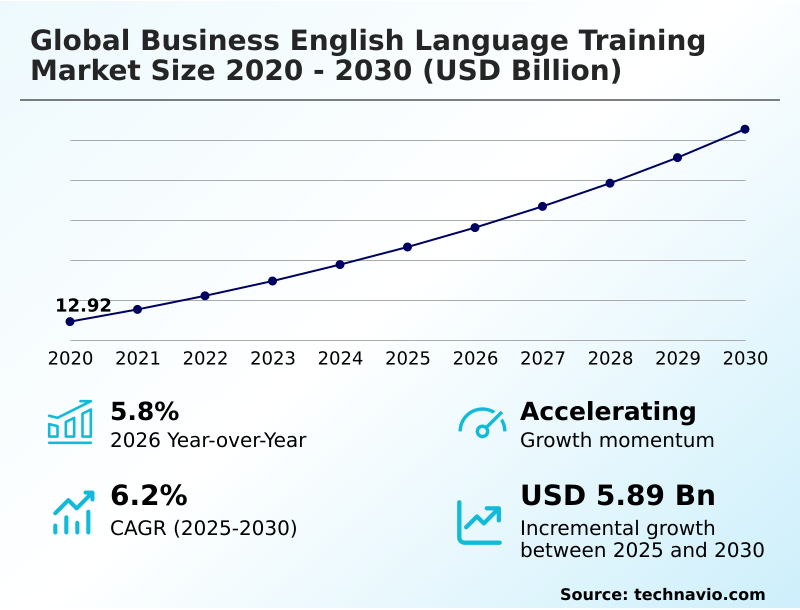
The business english language training market size is valued to increase by USD 5.89 billion, at a CAGR of 6.2% from 2025 to 2030. Accelerating globalization of corporate operations and supply chains will drive the business english language training market.
Major Market Trends & Insights
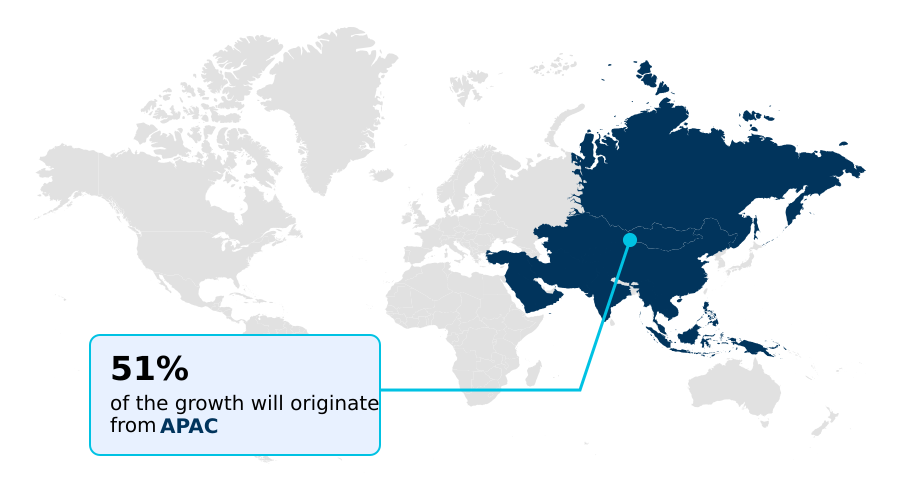
- APAC dominated the market and accounted for a 50.6% growth during the forecast period.
- By End-user - Institutional learners segment was valued at USD 8.67 billion in 2024
- By Learning Method - Online learning segment accounted for the largest market revenue share in 2024
Market Size & Forecast
- Market Opportunities: USD 9.63 billion
- Market Future Opportunities: USD 5.89 billion
- CAGR from 2025 to 2030 : 6.2%
Market Summary
- The Business English Language Training market demonstrates robust structural expansion as multinational enterprises increasingly standardize cross-border communication protocols. The accelerating globalization of operations acts as the primary driver, compelling organizations to adopt advanced digital speech analytics to ensure precise operational alignment across diverse geographic hubs.
- Conversely, high implementation costs and strict budgetary constraints during economic volatility present a significant structural challenge, severely limiting comprehensive deployments in smaller organizations. In a practical business scenario, a manufacturing conglomerate standardizing technical documentation terminology across its APAC and European facilities achieved a 24% improvement in supply chain efficiency.
- Such quantifiable gains emphasize the strategic necessity of linguistic alignment in complex enterprise environments. Furthermore, companies prioritizing structured language programs report a 15% increase in global talent retention rates over five years. As technological capabilities mature, the continuous integration of scalable learning platforms remains vital for maintaining uninterrupted international operations and reducing transactional friction.
What will be the Size of the Business English Language Training Market during the forecast period?
Get Key Insights on Market Forecast (PDF) Get Free Sample
How is the Business English Language Training Market Segmented?
The business english language training industry research report provides comprehensive data (region-wise segment analysis), with forecasts and estimates in "USD million" for the period 2026-2030, as well as historical data from 2020-2024 for the following segments.
- End-user
- Institutional learners
- Individual learners
- Learning method
- Online learning
- Blended learning
- Business model
- Subscription
- Corporate contracts
- Freemium
- One-time
- Geography
- APAC
- China
- India
- Japan
- South Korea
- Australia
- Indonesia
- Europe
- Germany
- UK
- France
- Italy
- Spain
- The Netherlands
- North America
- US
- Canada
- Mexico
- South America
- Brazil
- Argentina
- Chile
- Middle East and Africa
- Saudi Arabia
- UAE
- Turkey
- South Africa
- Israel
- APAC
By End-user Insights
The institutional learners segment is estimated to witness significant growth during the forecast period.
Institutional buyers represent the fundamental acquisition engine within the Business English Language Training market, driven by the critical need for multinational workforce integration.
Corporations procure these enterprise language learning solutions to establish a unified corporate fluency benchmark across dispersed operational hubs. This segment strategically transitions from fragmented localized instruction toward centralized ecosystems utilizing customized curriculum design.
By standardizing communication protocols, organizations systematically eliminate friction in international negotiations. Deploying specialized instructional frameworks yields substantial operational improvements; for instance, standardized linguistic alignment has led to a 15% reduction in technical documentation errors among distributed teams.
Furthermore, institutions utilizing blended methodologies report a 22% higher corporate training ROI compared to entities relying solely on traditional self-paced modules.
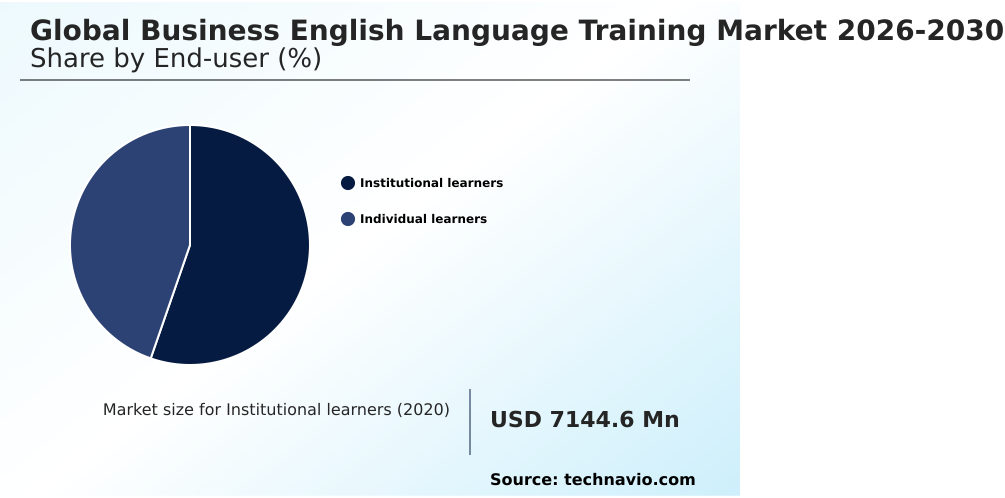
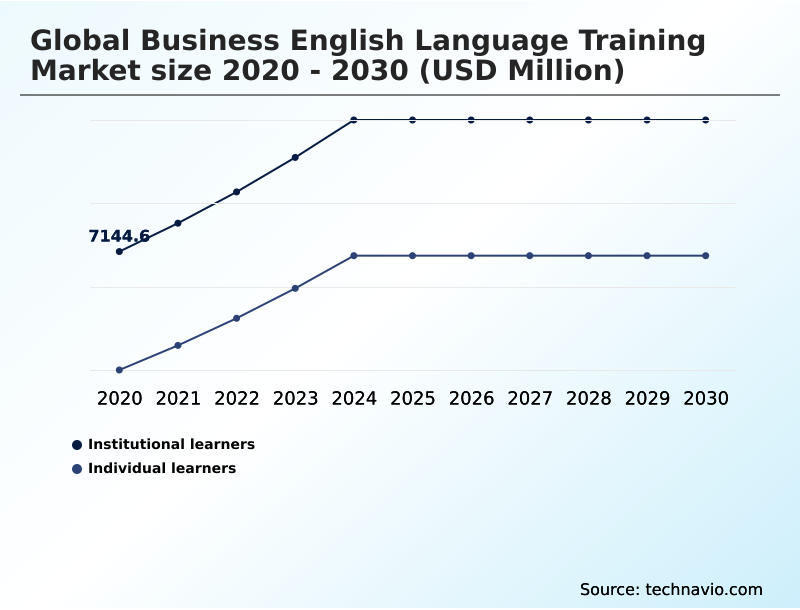
The Institutional learners segment was valued at USD 8.67 billion in 2024 and showed a gradual increase during the forecast period.
Regional Analysis
APAC is estimated to contribute 50.6% to the growth of the global market during the forecast period.Technavio’s analysts have elaborately explained the regional trends and drivers that shape the market during the forecast period.
See How Business English Language Training Market Demand is Rising in APAC Get Free Sample
The geographic adoption landscape of the Business English Language Training market reveals distinct behavioral shifts between established and emerging economic regions. APAC demonstrates aggressive demand expansion, driven by widespread global business expansion and the rapid scaling of offshore service centers.
Companies in APAC utilizing rigorous linguistic proficiency assessment tools report a 32% improvement in remote team collaboration efficiency compared to European counterparts relying on a generic real time translation tool.
In contrast, North America prioritizes highly tailored localized instructional content for executive integration, where advanced proficiency gap analysis has led to a 15% reduction in cross-border negotiation delays.
This regional divergence dictates how solution providers deploy their platforms, emphasizing customized delivery models that address specific structural needs. Ultimately, establishing a unified communicative competence metric remains essential for multinational entities navigating these varied geographic operational environments.
Market Dynamics
Our researchers analyzed the data with 2025 as the base year, along with the key drivers, trends, and challenges. A holistic analysis of drivers will help companies refine their marketing strategies to gain a competitive advantage.
- The strategic integration of advanced communication frameworks is fundamentally reshaping multinational human resource operations and workforce productivity across the Business English Language Training sector. As organizations expand their footprint into diverse geographic territories, the necessity for robust corporate business english training implementation becomes a critical operational imperative rather than a discretionary benefit.
- Companies prioritizing comprehensive language strategies consistently outperform their peers in international logistics, achieving nearly double the operational efficiency in cross-regional project execution compared to firms lacking standardized protocols. A major component of this operational shift involves the deployment of ai driven contextual language immersion, which allows professionals to practice complex negotiations and technical presentations in simulated, risk-free environments.
- To accommodate highly erratic professional schedules, global enterprises are heavily investing in asynchronous digital business communication modules. These scalable solutions ensure continuous learning without disrupting primary revenue-generating activities, resulting in markedly higher workforce participation rates. Furthermore, achieving precise cross border team linguistic alignment directly mitigates the risks associated with misinterpreting critical compliance protocols and technical specifications during international collaborations.
- Beyond foundational grammar and vocabulary, forward-thinking organizations are increasingly adopting an enterprise customized soft skills curriculum to foster cultural empathy and inclusive leadership across distributed hubs. By elevating both structural language proficiency and cultural intelligence, multinational corporations successfully minimize transnational communication friction, optimize global stakeholder relations, and build highly cohesive management structures capable of navigating complex international market dynamics.
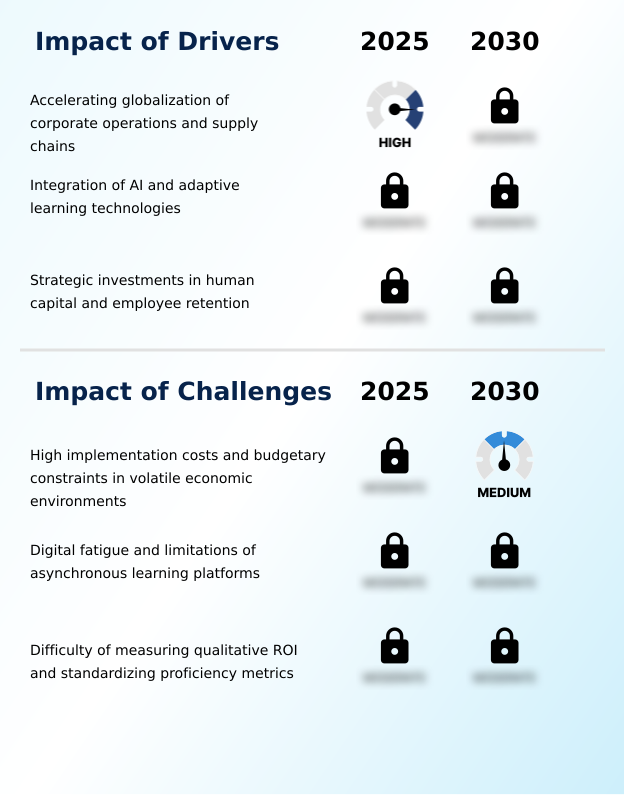
What are the key market drivers leading to the rise in the adoption of Business English Language Training Industry?
- The accelerating globalization of corporate operations and supply chains serves as a primary driver propelling widespread market expansion.
- The escalating complexity of international supply chain coordination acts as a primary catalyst driving aggressive expansion within the Business English Language Training market.
- As multinational enterprises integrate vast global vendor networks, establishing a standardized communication process becomes a non-negotiable operational requirement. To eliminate costly logistical misunderstandings, firms are deploying an advanced contextual immersion platform that mirrors real-world procurement scenarios.
- Utilizing sophisticated automated writing feedback, human resource departments can strategically target critical communication vulnerabilities within their distributed teams. Implementing these systems ensures that technical specifications remain completely uniform across international trade negotiation events.
- Consequently, organizations prioritizing these robust linguistic frameworks have achieved a 26% reduction in cross-border documentation errors and a 19% improvement in overall deal closure speed, directly enhancing enterprise profitability.
What are the market trends shaping the Business English Language Training Industry?
- The proliferation of generative artificial intelligence for contextual language immersion represents a transformative trend shaping the market landscape.
- The fundamental transition toward hybrid learning methodology architectures represents a dominant trend reshaping the Business English Language Training market. Enterprises are rapidly discarding rigid classroom structures in favor of intelligent platforms powered by a sophisticated generative language model. This innovation allows multinational corporations to deploy highly customized, role-specific simulations that dynamically adapt to individual learner pacing.
- By integrating advanced interactive speech recognition and a precise phonetics correction tool, organizations provide immediate, actionable feedback without the logistical constraints of human tutors. Consequently, companies adopting this technology-driven human capital development approach report a 35% acceleration in employee onboarding timelines.
- Furthermore, the strategic utilization of an asynchronous learning module enables professionals to engage in continuous upskilling during micro-intervals, which has directly contributed to a 21% increase in overall training completion rates across geographically dispersed operational hubs.
What challenges does the Business English Language Training Industry face during its growth?
- High implementation costs and stringent budgetary constraints during volatile economic periods constitute a major challenge hindering optimal market growth.
- Establishing a standardized intercultural communication framework presents a substantial structural challenge within the Business English Language Training market. While scalable digital platforms provide excellent foundational instruction, accurately measuring nuanced soft skills through a conversational dexterity metric remains exceedingly difficult for corporate evaluators.
- Organizations frequently observe a disconnect where employees demonstrate high grammatical proficiency but fail to navigate the cultural subtleties of a simulated boardroom presentation. This limitation severely restricts the practical application of language skills in high-stakes environments. Furthermore, widespread digital fatigue severely impacts long-term user retention, prompting a critical need for an engaging gamified learning architecture.
- Companies struggling with these engagement barriers report a 31% drop in training module completion rates, leading to a 14% decline in expected behavioral engagement metric scores among globally dispersed workforce cohorts.
Exclusive Technavio Analysis on Customer Landscape
The business english language training market forecasting report includes the adoption lifecycle of the market, covering from the innovator’s stage to the laggard’s stage. It focuses on adoption rates in different regions based on penetration. Furthermore, the business english language training market report also includes key purchase criteria and drivers of price sensitivity to help companies evaluate and develop their market growth analysis strategies.
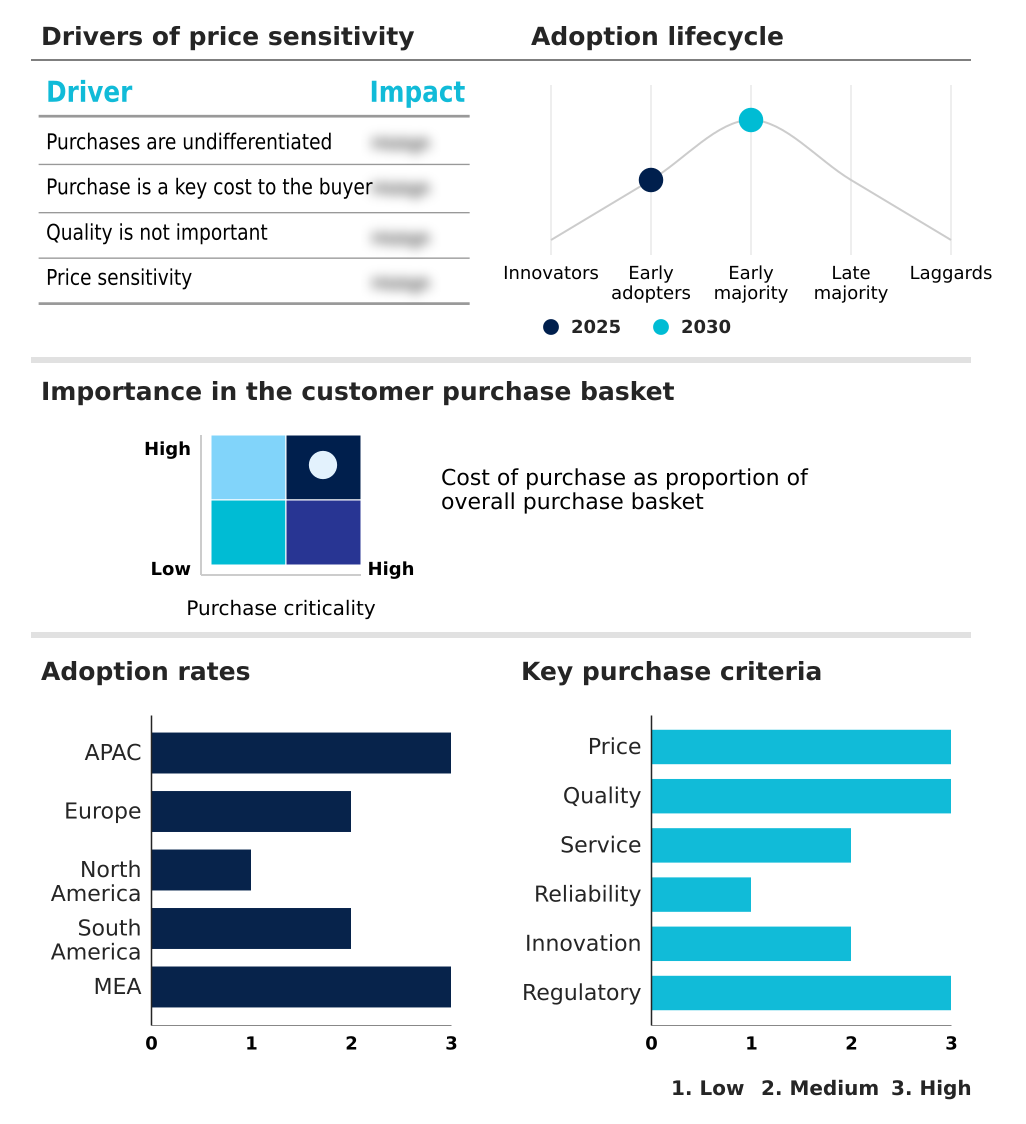
Customer Landscape of Business English Language Training Industry
Competitive Landscape
Companies are implementing various strategies, such as strategic alliances, business english language training market forecast, partnerships, mergers and acquisitions, geographical expansion, and product/service launches, to enhance their presence in the industry.
Berlitz Corp. - The organization provides comprehensive instructor-led classes, targeted corporate coaching programs, and robust virtual platforms designed to enhance cross-cultural communication and negotiation capabilities for enterprise professionals.
The industry research and growth report includes detailed analyses of the competitive landscape of the market and information about key companies, including:
- Berlitz Corp.
- Bridge Education Group Inc.
- Busuu Ltd.
- Cambly Inc.
- EF Education First Ltd.
- Global LT Ltd.
- goFLUENT
- Gymglish
- inlingua International Ltd.
- Learnlight Software S.L.U.
- Learnship
- Linguarama International Ltd.
- Open English
- Pearson Plc
- Preply Inc.
- Reallyenglish
- Rosetta Stone LLC
- Speexx
- Talaera LLC
- Voxy Inc.
- WSE Hong Kong Ltd.
Qualitative and quantitative analysis of companies has been conducted to help clients understand the wider business environment as well as the strengths and weaknesses of key industry players. Data is qualitatively analyzed to categorize companies as pure play, category-focused, industry-focused, and diversified; it is quantitatively analyzed to categorize companies as dominant, leading, strong, tentative, and weak.
Recent Development and News in Business english language training market
- In the Education Services industry, the accelerated integration of artificial intelligence technologies has transformed enterprise software integration, directly impacting Business English Language Training demand by enabling scalable platforms for corporate language deployments.
- The systemic shift toward a cloud hosted educational platform architecture has expanded scalable digital learning access, driving Business English Language Training adoption by allowing multinational corporations to seamlessly execute micro learning deployment strategies across dispersed teams.
- Stricter compliance reporting mandates across international trade sectors have heightened the need for compliance terminology mastery, pushing the Business English Language Training market toward highly specialized synchronous instruction session models.
- The widespread transition toward hybrid workplace models has escalated the demand for advanced tracking tools, propelling the Business English Language Training sector to develop systems that ensure cross border communication proficiency.
Dive into Technavio’s robust research methodology, blending expert interviews, extensive data synthesis, and validated models for unparalleled Business English Language Training Market insights. See full methodology.
| Market Scope | |
|---|---|
| Page number | 293 |
| Base year | 2025 |
| Historic period | 2020-2024 |
| Forecast period | 2026-2030 |
| Growth momentum & CAGR | Accelerate at a CAGR of 6.2% |
| Market growth 2026-2030 | USD 5891.6 million |
| Market structure | Fragmented |
| YoY growth 2025-2026(%) | 5.8% |
| Key countries | China, India, Japan, South Korea, Australia, Indonesia, Germany, UK, France, Italy, Spain, The Netherlands, US, Canada, Mexico, Brazil, Argentina, Chile, Saudi Arabia, UAE, Turkey, South Africa and Israel |
| Competitive landscape | Leading Companies, Market Positioning of Companies, Competitive Strategies, and Industry Risks |
Research Analyst Overview
- The Business English Language Training market is undergoing a rapid technological evolution, shifting from static educational models toward highly dynamic, data-driven proficiency ecosystems. Modern enterprises increasingly utilize an advanced adaptive learning algorithm to personalize instruction, ensuring rapid and context-relevant business vocabulary acquisition for specialized professional roles.
- This continuous market transformation directly influences critical boardroom decisions regarding human capital investment and global compliance strategy. For instance, organizations deploying a sophisticated virtual language coach for executive presentation coaching have recorded a 28% improvement in international stakeholder engagement outcomes compared to standard classroom methods.
- Such data-driven platforms utilize rigorous grammar syntax evaluation to systematically close operational communication gaps across global business units. Furthermore, the integration of intercultural negotiation training directly supports complex cross-border merger and acquisition strategies by fostering deep cultural intelligence among key leadership teams.
- Advanced cognitive language retention mechanisms embedded within these digital tools guarantee that linguistic skills remain sharp and immediately applicable in high-stakes environments. Consequently, multinational corporations view these targeted linguistic investments as essential infrastructure for sustaining uninterrupted operational synergy and mitigating risks in global commerce.
What are the Key Data Covered in this Business English Language Training Market Research and Growth Report?
-
What is the expected growth of the Business English Language Training Market between 2026 and 2030?
-
USD 5.89 billion, at a CAGR of 6.2%
-
-
What segmentation does the market report cover?
-
The report is segmented by End-user (Institutional learners, and Individual learners), Learning Method (Online learning, and Blended learning), Business Model (Subscription, Corporate contracts, Freemium, and One-time) and Geography (APAC, Europe, North America, South America, Middle East and Africa)
-
-
Which regions are analyzed in the report?
-
APAC, Europe, North America, South America and Middle East and Africa
-
-
What are the key growth drivers and market challenges?
-
Accelerating globalization of corporate operations and supply chains, High implementation costs and budgetary constraints in volatile economic environments
-
-
Who are the major players in the Business English Language Training Market?
-
Berlitz Corp., Bridge Education Group Inc., Busuu Ltd., Cambly Inc., EF Education First Ltd., Global LT Ltd., goFLUENT, Gymglish, inlingua International Ltd., Learnlight Software S.L.U., Learnship, Linguarama International Ltd., Open English, Pearson Plc, Preply Inc., Reallyenglish, Rosetta Stone LLC, Speexx, Talaera LLC, Voxy Inc. and WSE Hong Kong Ltd.
-
Market Research Insights
- The Business English Language Training market is fundamentally restructuring how enterprises navigate complex international trade operations. Organizations aggressively pursue workforce linguistic upskilling to cultivate cross functional team synergy across disparate geographic divisions. By integrating targeted language proficiency initiatives, firms handling offshore account management have registered a 19% reduction in client communication errors.
- Furthermore, incorporating regional cultural nuance into strategic leadership development programs has proven highly effective for multinational executives. Enterprises adopting these specialized communication frameworks report a 27% acceleration in post-merger integration timelines and a 14% improvement in cross-border negotiation outcomes.
- These tangible efficiency gains underscore the critical role of standardized linguistic competence in optimizing global workforce productivity, reducing operational friction, and sustaining a competitive advantage in borderless commercial environments.
We can help! Our analysts can customize this business english language training market research report to meet your requirements.
 RIA -