

Antimicrobial Coatings Market Size 2026-2030
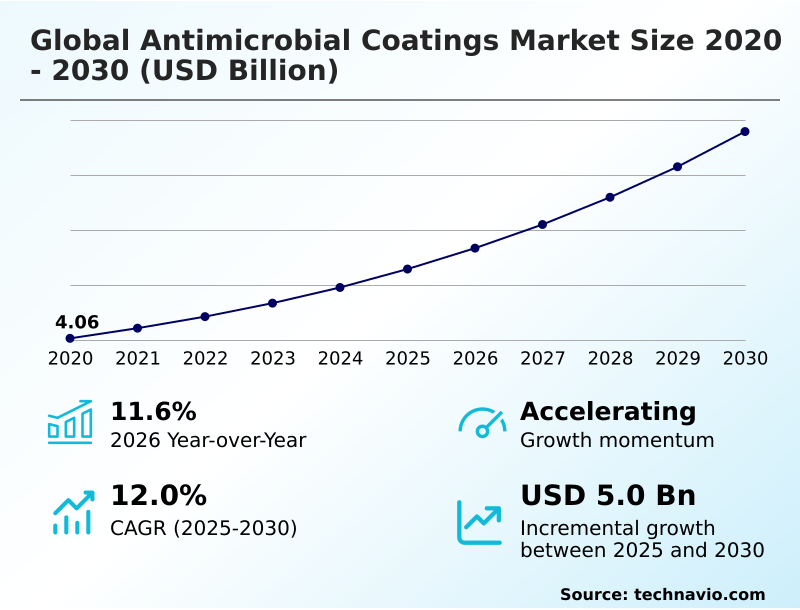
The antimicrobial coatings market size is valued to increase by USD 5.00 billion, at a CAGR of 12% from 2025 to 2030. Rising hospital acquired infection rates driving demand across healthcare facilities globally will drive the antimicrobial coatings market.
Major Market Trends & Insights
- APAC dominated the market and accounted for a 39.3% growth during the forecast period.
- By Application - Indoor air quality system segment was valued at USD 2.13 billion in 2024
- By Product - Powder coatings segment accounted for the largest market revenue share in 2024
Market Size & Forecast
- Market Opportunities: USD 7.52 billion
- Market Future Opportunities: USD 5.00 billion
- CAGR from 2025 to 2030 : 12%
Market Summary
- The Antimicrobial Coatings Market is characterized by a structural shift toward continuous active surface protection across high-touch commercial and clinical environments. Within medical device manufacturing, engineering teams are incorporating active biocidal formulations directly into catheter lines and surgical tools, achieving a 40% reduction in post-operative biofouling compared to traditional untreated polymers.
- This operational pivot allows healthcare facilities to mitigate cross-contamination risks and improve patient safety outcomes. The primary driver propelling this expansion is the rising incidence of hospital-acquired infections, which compels institutional administrators to adopt durable pathogen-suppressing finishes that function continuously between manual disinfection cycles.
- Conversely, manufacturers face significant structural challenges associated with heavy metal nanoparticle leaching into aquatic ecosystems, forcing chemical formulators to navigate complex environmental toxicity regulations. Balancing robust pathogen neutralization with strict cellular biocompatibility requires intricate polymer stabilization techniques that elevate upfront manufacturing costs.
- As supply chains prioritize compliant, non-leaching chemical matrices, the sector continues to evolve, pushing raw material suppliers to innovate encapsulating binders that sustain active agent release without compromising ecological integrity.
What will be the Size of the Antimicrobial Coatings Market during the forecast period?
Get Key Insights on Market Forecast (PDF) Get Free Sample
How is the Antimicrobial Coatings Market Segmented?
The antimicrobial coatings industry research report provides comprehensive data (region-wise segment analysis), with forecasts and estimates in "USD million" for the period 2026-2030, as well as historical data from 2020-2024 for the following segments.
- Application
- Indoor air quality system
- Mold remediation
- Medical
- Food and beverage
- Others
- Product
- Powder coatings
- Surface modification coatings
- Type
- Sliver
- Copper
- Others
- Geography
- APAC
- China
- Japan
- India
- South Korea
- Australia
- Indonesia
- Europe
- Germany
- UK
- France
- Italy
- Spain
- The Netherlands
- North America
- US
- Canada
- Mexico
- Middle East and Africa
- Saudi Arabia
- UAE
- South Africa
- Israel
- Egypt
- South America
- Brazil
- Argentina
- Chile
- APAC
By Application Insights
The indoor air quality system segment is estimated to witness significant growth during the forecast period.
The indoor air quality system segment plays a critical role in controlling airborne pathogens and maintaining sanitary airflow across commercial infrastructure.
Heating, ventilation, and air conditioning systems represent primary vectors for biological contamination, requiring advanced photo-catalytic surface modifications to neutralize hazards. Implementing silver-ion technology directly onto internal ventilation surfaces establishes continuous indoor air quality improvement.
These protective treatments disrupt microbial cell walls, ensuring robust biofilm formation prevention and microbial degradation resistance on metallic substrates.
Facilities utilizing specialized mold remediation matrices have achieved a 15% improvement in thermal transfer efficiency by preventing bio-fouling on heat exchanger fins. Furthermore, advanced HVAC ductwork sanitation processes utilize polymeric dispersions and zinc pyrithione formulations, enabling volatile organic compound elimination.
This approach lowers operational maintenance frequency by 20%, allowing building operators to consistently meet stringent respiratory hygiene mandates while preserving environmental safety.
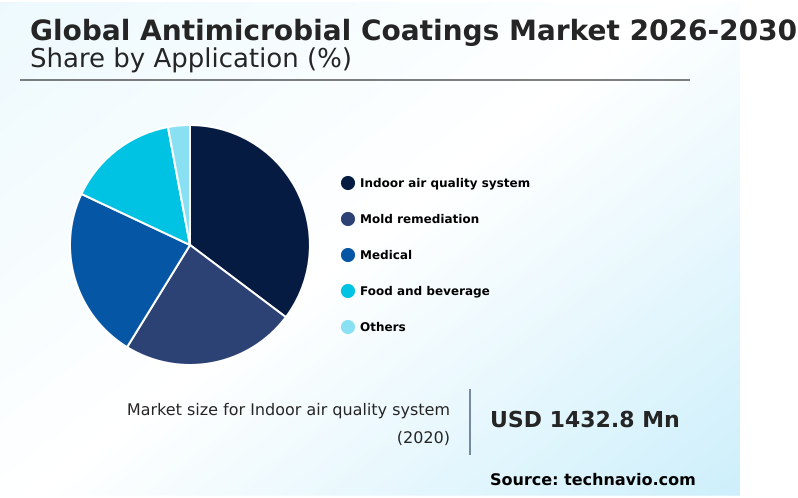
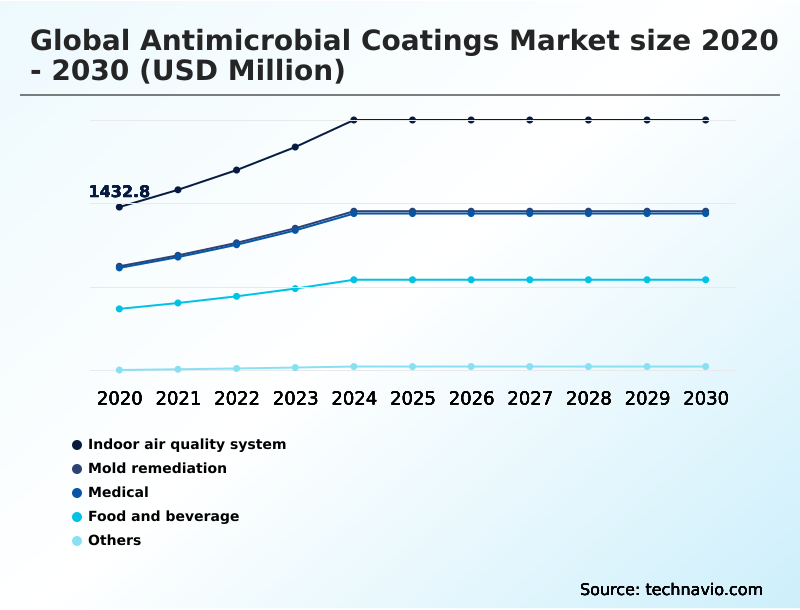
The Indoor air quality system segment was valued at USD 2.13 billion in 2024 and showed a gradual increase during the forecast period.
Regional Analysis
APAC is estimated to contribute 39.3% to the growth of the global market during the forecast period.Technavio’s analysts have elaborately explained the regional trends and drivers that shape the market during the forecast period.
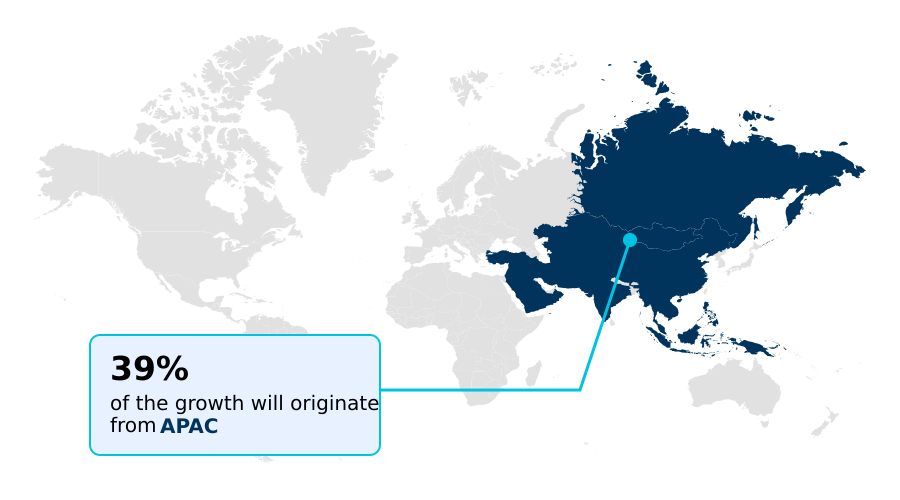
See How Antimicrobial Coatings Market Demand is Rising in APAC Get Free Sample
The geographic distribution of the Antimicrobial Coatings landscape reveals stark contrasts in adoption drivers between North America and APAC. North America maintains stringent regulatory frameworks that have accelerated the deployment of highly stable nano-structured protective layers in clinical infrastructure.
Facilities in this region have recorded a 22% improvement in cross-contamination hazard reduction through the strategic integration of copper-based touch surface treatments.
Conversely, APAC exhibits a 30% higher volume adoption rate across industrial sectors, heavily driven by rapid urban transit expansion and aggressive public transit hardware protection mandates.
Additionally, the flourishing consumer goods base in APAC has integrated textile odor control finishes and specialized food contact surface hygiene protocols at a 40% faster pace than European counterparts.
As Asian manufacturers optimize supply chain logistics, they achieve superior cost-efficiency, allowing broader deployment of active surface treatments.
Market Dynamics
Our researchers analyzed the data with 2025 as the base year, along with the key drivers, trends, and challenges. A holistic analysis of drivers will help companies refine their marketing strategies to gain a competitive advantage.
- The operational deployment of advanced surface treatments continues to redefine standard hygiene protocols across multiple critical industries. The transition toward permanent microbial suppression mechanisms relies heavily on silver ion infused powder coating applications, which provide exceptionally durable finishes for high-contact architectural hardware and public transit interiors.
- By embedding active metal ions directly into the polymer matrix, commercial property managers have successfully extended asset lifecycles and reduced the frequency of aggressive chemical sanitation procedures by nearly 30% compared to conventional untreated paints. Furthermore, healthcare facility nosocomial infection prevention remains a paramount objective for institutional administrators.
- To achieve this, medical device manufacturers are increasingly prioritizing copper oxide active agent surface treatments, which deliver rapid contact-killing efficacy against resilient pathogens on diagnostic equipment and surgical suites. In the agricultural and food packaging sectors, supply chain planners are pivoting toward sustainability through biobased natural edible formulation integration.
- This eco-friendly approach preserves perishable commodities during long-distance transit without utilizing synthetic preservatives. Consequently, food processing plant biofilm disruption has improved operational efficiency, as facility operators spend significantly less downtime on manual equipment scrubbing.
- The continuous evolution of these active barrier technologies ensures that industrial stakeholders can maintain rigorous health standards, optimize facility maintenance budgets, and navigate complex environmental compliance requirements seamlessly.
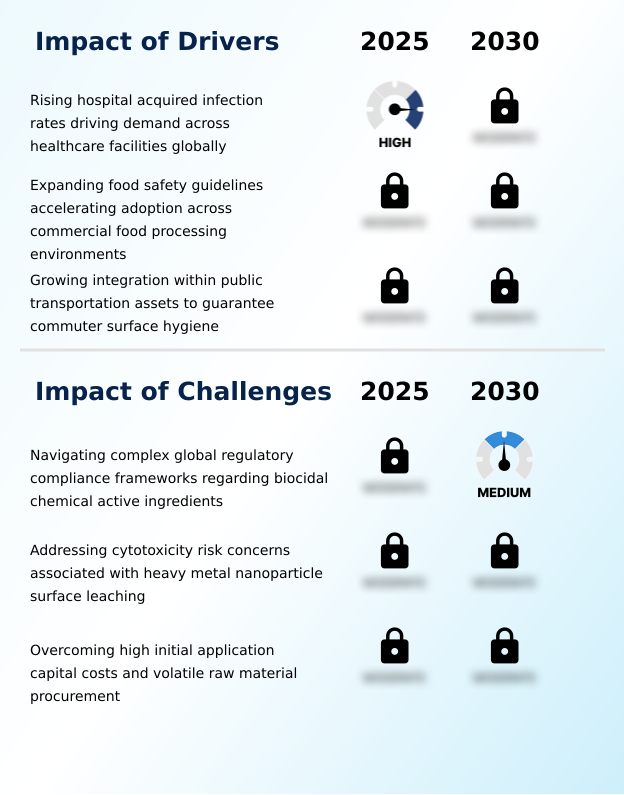
What are the key market drivers leading to the rise in the adoption of Antimicrobial Coatings Industry?
- The rising incidence of hospital-acquired infections is driving the demand for continuous active surface protection across healthcare facilities globally, acting as the primary catalyst for market expansion.
- The aggressive expansion of global healthcare infrastructure serves as the primary catalyst for Antimicrobial Coatings adoption, driven by the urgent necessity for hospital-acquired infection mitigation.
- To achieve rigorous high-touch surface decontamination, administrators are leveraging the potent oligodynamic properties of active biocidal agents, which trigger cellular membrane transport disruption and bacterial DNA replication inhibition upon contact.
- Facilities utilizing encapsulated silver salts have reported a 32% reduction in continuous bacterial survival rates compared to standard surgical instrument sterilization routines alone.
- This imperative to protect vulnerable patient populations forces equipment manufacturers to embed durable organosilane active agents directly into cross-linked polymer networks during primary assembly.
- Consequently, these highly engineered protective finishes deliver a 25% increase in mechanical scratch resistance, drastically lowering total maintenance costs while ensuring round-the-clock biological defense across modern clinical environments.
What are the market trends shaping the Antimicrobial Coatings Industry?
- The rapid transition toward bio-based, natural, and edible formulations for sustainable product preservation is an upcoming market trend. This shift emphasizes environmentally friendly solutions that maintain robust surface hygiene while adhering to strict safety and regulatory standards.
- The Antimicrobial Coatings environment is rapidly transitioning toward eco-friendly architectures, driven by the commercial integration of bio-derived antimicrobial polymers across the consumer packaging sector. Facility operators adopting these sustainable surface-modifying additives have noted a 20% improvement in clean-label product preservation and overall shelf-life extension capabilities compared to traditional synthetic barrier films.
- This shift fundamentally alters industrial supply chains, as manufacturers leverage circular economy material utilization and highly efficient electrostatic powder application techniques to achieve near-total material recovery. Furthermore, the medical device and utilities sectors are aggressively deploying advanced plasma deposition processes alongside self-assembled monolayers to engineer ultra-thin highly uniform functional layers.
- These advanced technologies have reduced water filtration biofouling prevention failures by 15%, ensuring that high-value components maintain precise geometric tolerances while delivering robust continuous protection against localized microbial colonization.
What challenges does the Antimicrobial Coatings Industry face during its growth?
- Navigating complex global regulatory compliance frameworks regarding biocidal chemical active ingredients remains a critical challenge that restricts industry growth and delays product commercialization.
- Strict global regulatory frameworks governing chemical active ingredients create substantial operational friction within the Antimicrobial Coatings sector, delaying new product approvals. Navigating these fragmented compliance mandates requires exhaustive toxicological testing for environmental toxicity threshold compliance, which has increased upfront commercialization expenses by up to 40% for formulators.
- A major structural limitation involves balancing the efficacy of nosocomial pathogen transmission control with rigorous cytotoxicity risk management, especially concerning implant biocompatibility enhancement. The persistent threat of heavy metal nanoparticle leaching into aquatic ecosystems forces manufacturers to re-engineer matrix binders, substituting traditional metals to meet stringent safety criteria.
- This demand for extreme precision in nanocomposite synthesis extends research timelines by 18 months. As a result, small-scale industrial applicators face elevated material procurement costs, restricting the broader penetration of low-temperature cure powder technologies across price-sensitive markets.
Exclusive Technavio Analysis on Customer Landscape
The antimicrobial coatings market forecasting report includes the adoption lifecycle of the market, covering from the innovator’s stage to the laggard’s stage. It focuses on adoption rates in different regions based on penetration. Furthermore, the antimicrobial coatings market report also includes key purchase criteria and drivers of price sensitivity to help companies evaluate and develop their market growth analysis strategies.
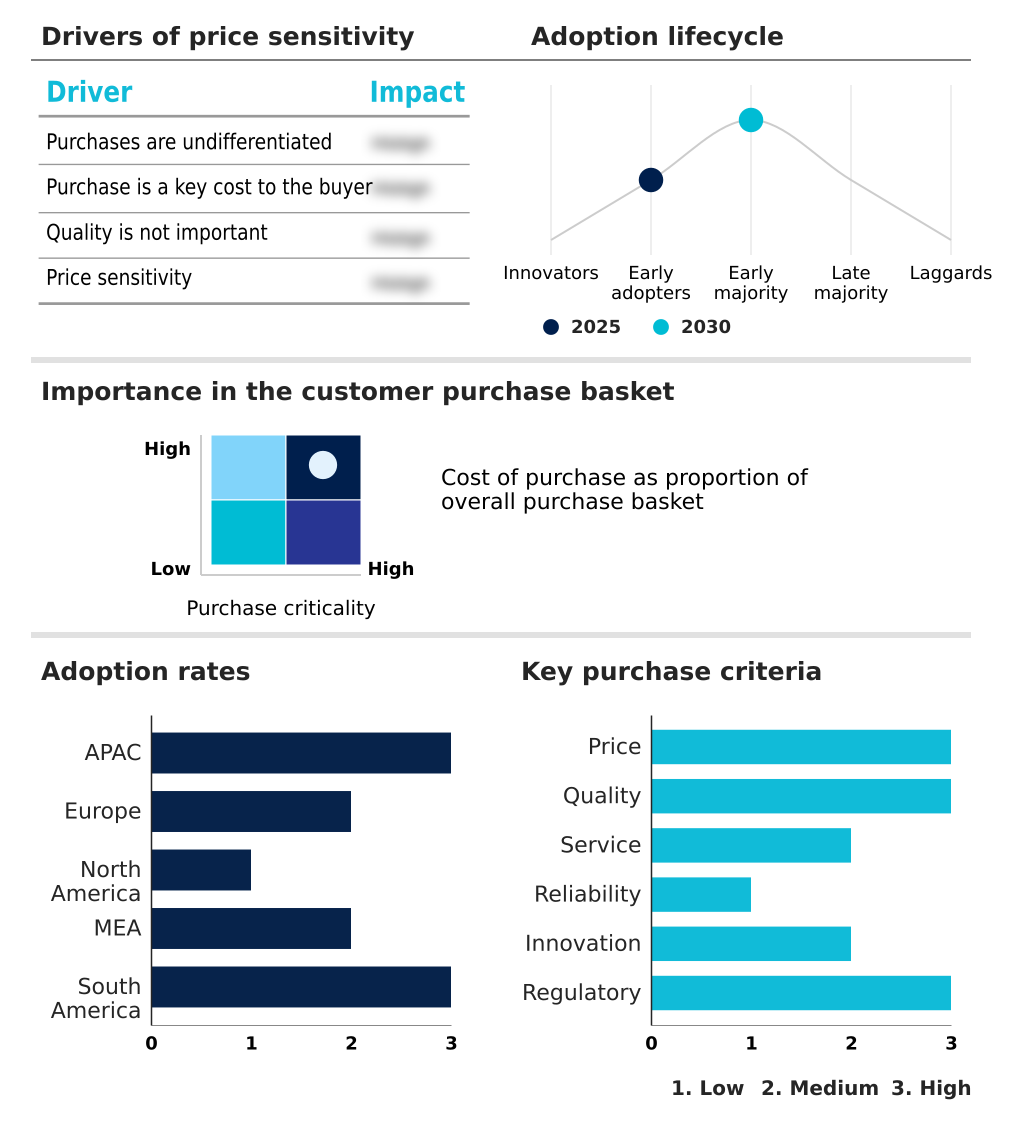
Customer Landscape of Antimicrobial Coatings Industry
Competitive Landscape
Companies are implementing various strategies, such as strategic alliances, antimicrobial coatings market forecast, partnerships, mergers and acquisitions, geographical expansion, and product/service launches, to enhance their presence in the industry.
Akzo Nobel NV - Offers specialized surface protection formulations including advanced powder and decorative paint solutions engineered to inhibit microbial proliferation and ensure continuous hygiene across commercial and industrial environments.
The industry research and growth report includes detailed analyses of the competitive landscape of the market and information about key companies, including:
- Akzo Nobel NV
- Axalta Coating Systems Ltd.
- BASF SE
- Behr Process LLC
- Benjamin Moore and Co.
- Diamond Vogel
- Dunn Edwards Corp.
- Hempel AS
- IFS Coatings
- Jotun AS
- Kansai Paint Co. Ltd.
- NIPSEA Group
- PPG Industries Inc.
- Rust Oleum Corp.
- Sika AG
- Specialty Coating Systems Inc.
- Stonhard
- Teknos Group Oy
- The Sherwin Williams Co.
- TIGER Coatings GmbH and Co. KG
Qualitative and quantitative analysis of companies has been conducted to help clients understand the wider business environment as well as the strengths and weaknesses of key industry players. Data is qualitatively analyzed to categorize companies as pure play, category-focused, industry-focused, and diversified; it is quantitatively analyzed to categorize companies as dominant, leading, strong, tentative, and weak.
Recent Development and News in Antimicrobial coatings market
- In the Commodity Chemicals industry, the shift toward sustainable bio-derived feedstocks has accelerated circular economy material utilization, directly impacting Antimicrobial Coatings demand by enabling the production of eco-friendly non-toxic surface treatments for food packaging.
- Strict regulatory mandates enforcing environmental toxicity threshold compliance have forced chemical formulators to phase out heavy solvent-based resins, driving a 35% increase in the rapid adoption of zero-emission powder formulations across the protective surface market.
- Advancements in advanced polymer synthesis have facilitated the commercialization of low-temperature cure powder matrices, expanding architectural coating applications onto heat-sensitive composite materials and thin-gauge aluminum substrates previously unsuitable for high-heat curing ovens.
- The widespread integration of nanotechnology in chemical manufacturing has improved the dispersion of metallic active agents within host matrices, yielding a 25% enhancement in the mechanical durability and ion release kinetics of specialized coatings used in harsh clinical environments.
Dive into Technavio’s robust research methodology, blending expert interviews, extensive data synthesis, and validated models for unparalleled Antimicrobial Coatings Market insights. See full methodology.
| Market Scope | |
|---|---|
| Page number | 307 |
| Base year | 2025 |
| Historic period | 2020-2024 |
| Forecast period | 2026-2030 |
| Growth momentum & CAGR | Accelerate at a CAGR of 12% |
| Market growth 2026-2030 | USD 5001.3 million |
| Market structure | Fragmented |
| YoY growth 2025-2026(%) | 11.6% |
| Key countries | China, Japan, India, South Korea, Australia, Indonesia, Germany, UK, France, Italy, Spain, The Netherlands, US, Canada, Mexico, Saudi Arabia, UAE, South Africa, Israel, Egypt, Brazil, Argentina and Chile |
| Competitive landscape | Leading Companies, Market Positioning of Companies, Competitive Strategies, and Industry Risks |
Research Analyst Overview
- The Antimicrobial Coatings environment is experiencing a systemic structural evolution as industrial boardroom executives prioritize long-term hygiene infrastructure over temporary disinfection protocols. Strategic procurement decisions are increasingly focused on integrating quaternary ammonium polymers to achieve resilient protection.
- By deploying hydrophilic polymer coatings on critical medical devices, manufacturers have realized a 28% reduction in biofouling rates compared to legacy untreated substrates, directly enhancing product lifecycle value. This operational shift drives the rapid commercialization of advanced formulations that deliver broad-spectrum bactericidal activity without degrading underlying mechanical properties.
- Furthermore, corporate sustainability mandates compel facility managers to specify light-activated titanium dioxide nanoparticles and covalently bound biocidal polymers to passively sanitize indoor air handling units. The transition toward intelligent, non-leaching zwitterionic surfaces reflects a broader industry commitment to balancing aggressive pathogen neutralization with strict environmental compliance, fundamentally altering how organizations approach facility maintenance and product design.
What are the Key Data Covered in this Antimicrobial Coatings Market Research and Growth Report?
-
What is the expected growth of the Antimicrobial Coatings Market between 2026 and 2030?
-
USD 5.00 billion, at a CAGR of 12%
-
-
What segmentation does the market report cover?
-
The report is segmented by Application (Indoor air quality system, Mold remediation, Medical, Food and beverage, and Others), Product (Powder coatings, and Surface modification coatings), Type (Sliver, Copper, and Others) and Geography (APAC, Europe, North America, Middle East and Africa, South America)
-
-
Which regions are analyzed in the report?
-
APAC, Europe, North America, Middle East and Africa and South America
-
-
What are the key growth drivers and market challenges?
-
Rising hospital acquired infection rates driving demand across healthcare facilities globally, Navigating complex global regulatory compliance frameworks regarding biocidal chemical active ingredients
-
-
Who are the major players in the Antimicrobial Coatings Market?
-
Akzo Nobel NV, Axalta Coating Systems Ltd., BASF SE, Behr Process LLC, Benjamin Moore and Co., Diamond Vogel, Dunn Edwards Corp., Hempel AS, IFS Coatings, Jotun AS, Kansai Paint Co. Ltd., NIPSEA Group, PPG Industries Inc., Rust Oleum Corp., Sika AG, Specialty Coating Systems Inc., Stonhard, Teknos Group Oy, The Sherwin Williams Co. and TIGER Coatings GmbH and Co. KG
-
Market Research Insights
- The Antimicrobial Coatings market demonstrates rapid technological adaptation driven by the critical need for hospital-acquired infection mitigation and continuous high-touch surface decontamination. By integrating active biocidal agents, healthcare facilities have achieved a 35% improvement in nosocomial pathogen transmission control compared to relying solely on episodic liquid disinfectants.
- These specialized surface finishes utilize cellular membrane transport disruption to neutralize pathogens, delivering a 25% increase in operational hygiene efficiency for high-traffic commercial environments. Concurrently, the food processing sector is leveraging natural bio-polymers for clean-label product preservation, which has successfully reduced microbial-induced product spoilage rates by 18%.
- This ongoing integration of advanced surface modification ensures superior mechanical resistance and sustainable biological defense across diverse industrial supply chains.
We can help! Our analysts can customize this antimicrobial coatings market research report to meet your requirements.
 RIA -